
Trisomy 21
(Down Syndrome)
Trisomy 21 is a congenital disorder commonly known as "Down syndrome." It was named after Dr. John Langdon Down, who first discovered and reported it. The birth rate of trisomy 21 (Down syndrome) is estimated to be 1/800 to 1/1,000.
Down syndrome (trisomy 21) is also known as the most common congenital trisomy in newborns.※1
\ Find out the risk of Down syndrome in the fetus /
Click here for details onNon-Invasive Prenatal Testing (NIPT)
Cause
It is caused by the abnormal division of the 21st chromosome, resulting in three copies of the chromosome instead of the usual two. A chromosomal abnormality where there is one more chromosome than usual is called a trisomy, and Down syndrome is also called trisomy 21 because there are three copies of the 21st chromosome.
Down syndrome (trisomy 21) is classified into three types based on chromosomal structure: standard, translocation, and mosaic.※2
<Standard Type>
This type is observed in approximately 95% of Down syndrome cases and occurs when three copies of chromosome 21 are present instead of the usual two.
It is caused by the failure of chromosomes to separate properly during the formation of eggs or sperm.
<Translocation Type>
This occurs in approximately 3-4% of all Down syndrome cases and is caused by chromosomal translocation, where part of chromosome 21 breaks off and attaches to another chromosome.
<Mosaic Type>
This is found in approximately 1-2% of all Down syndrome cases, where a mixture of cells with chromosomal abnormalities and cells with a normal chromosome count coexists in the body. Depending on the proportion of cells with chromosomal abnormalities, Down syndrome symptoms may be milder.
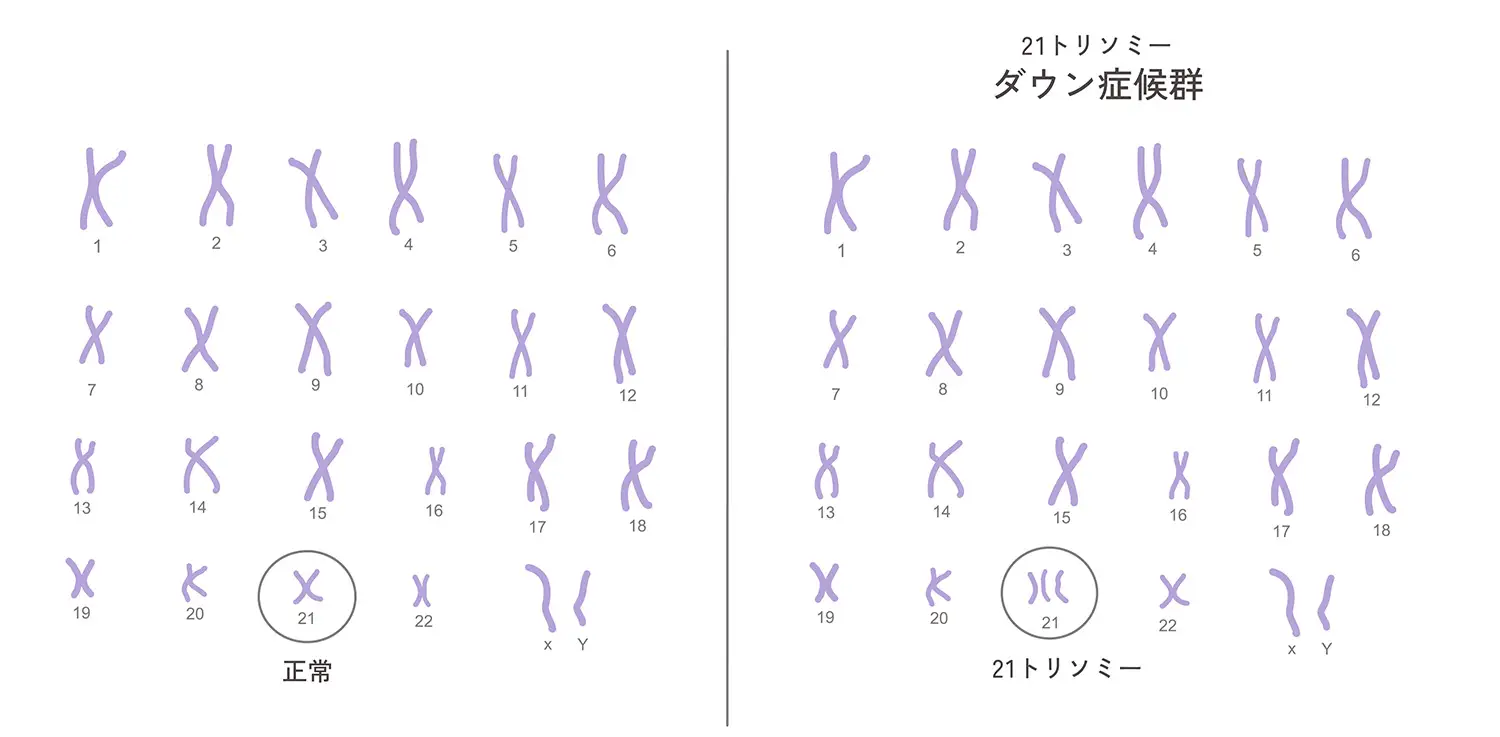
Down syndrome (trisomy 21) is classified into three types based on chromosomal structure: standard, translocation, and mosaic.※2
<Standard Type>
This type is observed in approximately 95% of Down syndrome cases and occurs when three copies of chromosome 21 are present instead of the usual two.
It is caused by the failure of chromosomes to separate properly during the formation of eggs or sperm.
<Translocation Type>
This occurs in approximately 3-4% of all Down syndrome cases and is caused by chromosomal translocation, where part of chromosome 21 breaks off and attaches to another chromosome.
<Mosaic Type>
This is found in approximately 1-2% of all Down syndrome cases, where a mixture of cells with chromosomal abnormalities and cells with a normal chromosome count coexists in the body. Depending on the proportion of cells with chromosomal abnormalities, Down syndrome symptoms may be milder.
Symptoms
While symptoms vary from person to person, there are several common physical characteristics and health issues.※3
<Physical Characteristics>
・Flat facial features
・Enlarged tongue
・Upward slanting eyes
・Fingerprint patterns running horizontally
・A single deep crease across the palm
<Cognitive and Developmental>
・Delayed growth
・Delayed speech development
・Learning and intellectual disabilities
・Attention and concentration issues
<Health Issues>
・Heart disease, especially congenital heart disease
・Hearing impairment
・Vision problems, such as strabismus
・Digestive system issues; susceptibility to infections due to a weak immune system
・Hormone-related problems such as hypothyroidism
・Increased risk of leukemia and other blood disorders
These symptoms can present in varying degrees depending on the individual. In addition, individuals with Down syndrome have diverse abilities and personalities, and with the provision of appropriate support and resources, it is often possible to live a fulfilling life.
<Physical Characteristics>
・Flat facial features
・Enlarged tongue
・Upward slanting eyes
・Fingerprint patterns running horizontally
・A single deep crease across the palm
<Cognitive and Developmental>
・Delayed growth
・Delayed speech development
・Learning and intellectual disabilities
・Attention and concentration issues
<Health Issues>
・Heart disease, especially congenital heart disease
・Hearing impairment
・Vision problems, such as strabismus
・Digestive system issues; susceptibility to infections due to a weak immune system
・Hormone-related problems such as hypothyroidism
・Increased risk of leukemia and other blood disorders
These symptoms can present in varying degrees depending on the individual. In addition, individuals with Down syndrome have diverse abilities and personalities, and with the provision of appropriate support and resources, it is often possible to live a fulfilling life.
Treatment
Down syndrome is a genetic congenital condition, and there is no cure for the underlying cause.
However, many interventions are implemented to support the health, growth, and development of individuals with Down syndrome. Major therapies include the following:※4
<Physical Therapy>
Through play-based activities, physical therapy promotes the acquisition of motor skills necessary for daily life. For instance, basic movements such as crawling and rolling over are practiced during infancy, while more complex movements like walking, running, and climbing stairs are trained from childhood through school age.
<Occupational Therapy>
Occupational therapy trains individuals to acquire necessary skills through actual daily activities, such as drawing, studying, exercising, dressing, and using scissors or chopsticks. The goal is to improve the ability to perform activities in daily life.
<Speech-Language Therapy>
Practices word pronunciation and comprehension using cards showing animals, food, etc. This approach focuses on improving language ability and helping the development of communication skills.
Each person with Down syndrome has their own personality and grows at their own pace.
It is important to consider the medical care, developmental support, and family assistance needed for children with Down syndrome.
Thanks to these medical advances, the average life expectancy for individuals with Down syndrome has more than doubled in the last 30 years.
Check related articles
However, many interventions are implemented to support the health, growth, and development of individuals with Down syndrome. Major therapies include the following:※4
<Physical Therapy>
Through play-based activities, physical therapy promotes the acquisition of motor skills necessary for daily life. For instance, basic movements such as crawling and rolling over are practiced during infancy, while more complex movements like walking, running, and climbing stairs are trained from childhood through school age.
<Occupational Therapy>
Occupational therapy trains individuals to acquire necessary skills through actual daily activities, such as drawing, studying, exercising, dressing, and using scissors or chopsticks. The goal is to improve the ability to perform activities in daily life.
<Speech-Language Therapy>
Practices word pronunciation and comprehension using cards showing animals, food, etc. This approach focuses on improving language ability and helping the development of communication skills.
Each person with Down syndrome has their own personality and grows at their own pace.
It is important to consider the medical care, developmental support, and family assistance needed for children with Down syndrome.
Thanks to these medical advances, the average life expectancy for individuals with Down syndrome has more than doubled in the last 30 years.
Check related articles
Frequently Asked Questions
Q.What is 21 trisomy (Down syndrome)?
A.
21 trisomy (Down syndrome) is a congenital disorder caused by the presence of three copies of chromosome 21 instead of the usual two. It is the most common trisomy in newborns, with a reported birth rate of 1 in 800 to 1,000 births (1). It was named after Dr. John Langdon Down, who first reported it in 1866.
Q.What is the difference between the three types of Down syndrome (standard, translocation, and mosaic)?
A.
Down syndrome is classified into three types based on chromosomal structure (2). Standard type (approx. 95%) occurs when chromosome 21 fails to separate properly during sperm or egg formation, resulting in three chromosomes. Translocation type (approx. 3-4%) is caused by part of chromosome 21 attaching to another chromosome. Mosaic type (approx. 1-2%) is a mixture of cells with normal and abnormal chromosome numbers, and symptoms may be milder depending on the ratio of abnormal cells.
Q.What are the main symptoms of Down syndrome?
A.
Symptoms vary by individual but can be broadly divided into three areas (3). Physical characteristics include flat facial features, an enlarged tongue, upward slanting eyes, and a single deep crease across the palm. Cognitive and developmental aspects may include delayed speech and learning/intellectual disabilities. Health issues reported include congenital heart disease (approx. 40-50%), hearing and vision impairment, hypothyroidism, and an increased risk of leukemia.
Q.Is there a fundamental cure for Down syndrome?
A.
Since Down syndrome is a genetic chromosomal abnormality, there is currently no fundamental cure. However, early interventions such as physical therapy (supporting basic movements), occupational therapy (training in daily life skills), and speech therapy (supporting communication development) can greatly assist health and development (4). Due to medical advances, the average life expectancy of individuals with Down syndrome has more than doubled over the past 30 years.
Q.Is there a way to screen for the risk of Down syndrome during pregnancy?
A.
Non-Invasive Prenatal Testing (NIPT) allows for the non-invasive screening of fetal 21 trisomy risk from maternal blood from 10 weeks of pregnancy. Since NIPT only requires a blood draw, it carries no miscarriage risk compared to amniocentesis or chorionic villus sampling, and is widely used as a high-precision screening test with a sensitivity of over 99% (5). In case of a positive result, amniocentesis is recommended for confirmation.