
●Trisomy 13 (Patau Syndrome)
Trisomy 13 is a congenital disorder caused by a chromosomal abnormality, also known as "Patau syndrome". It was named Patau syndrome because it was discovered and reported by Klaus Patau and others.
Trisomy 13 (Patau syndrome) is a chromosomal abnormality that occurs in approximately 1 in 10,000 to 20,000 live births, and is more common in females (male-to-female ratio of 1:2). *1
\ Discover the risk of fetal Patau syndrome /
Causes
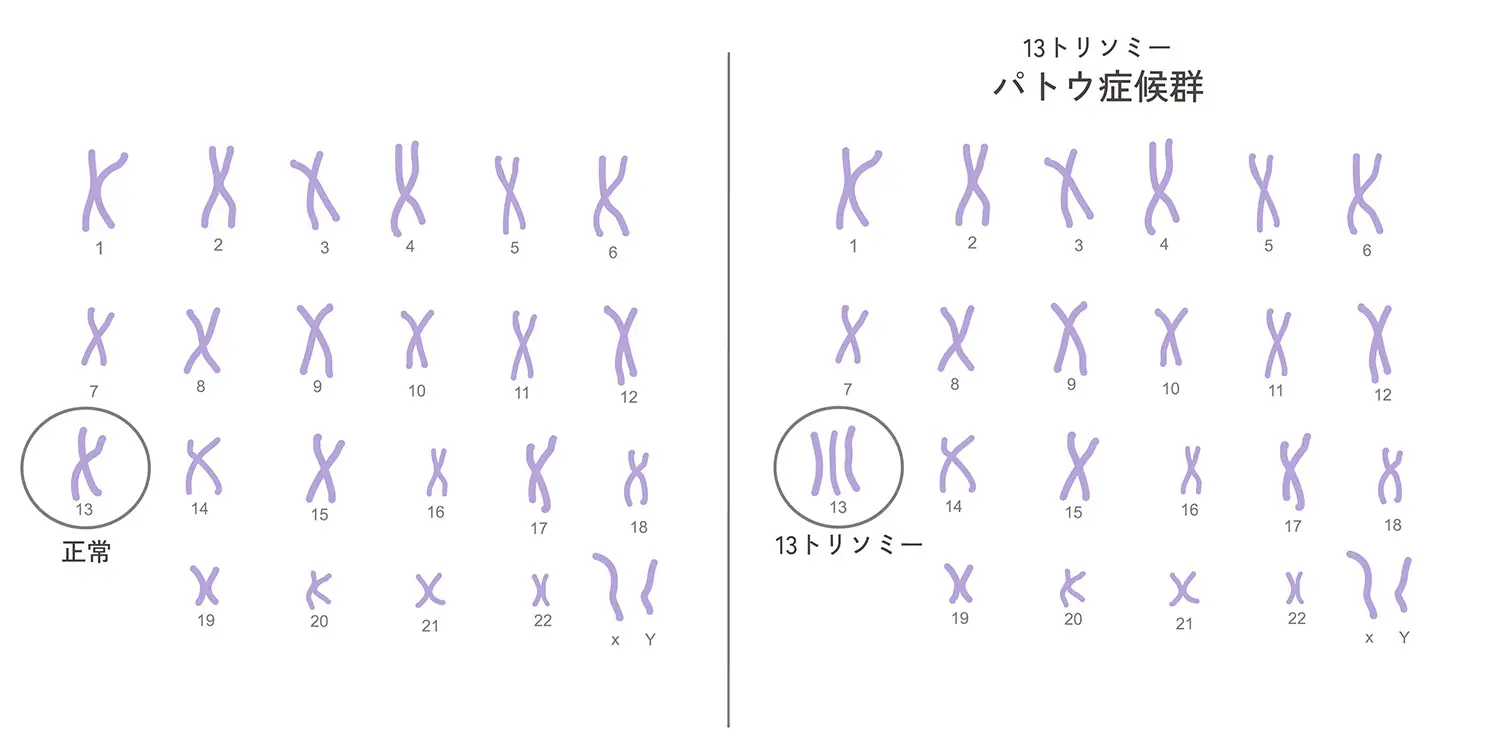
Patau syndrome (Trisomy 13) occurs when there are three copies of chromosome 13 instead of the usual two.
This chromosomal abnormality occurs due to several causes as follows. *2
Standard Type (Trisomy 13)
During the formation of parental reproductive cells (egg or sperm), chromosomes fail to separate correctly, resulting in an extra copy of chromosome 13 being included in the child's cells.
Consequently, there are three copies of chromosome 13.
Approximately 80% of Patau syndrome (Trisomy 13) cases are said to be caused by this chromosomal nondisjunction.
Translocation Type
This occurs when a portion of chromosome 13 becomes attached (translocated) to another chromosome.
If either parent carries a translocated chromosome, Trisomy 13 can be inherited.
Approximately 15% of Patau syndrome (Trisomy 13) cases are of this translocation type.
Mosaic Type
This case is observed in about 5% of Patau syndrome patients, where a mixture of cells with chromosomal abnormalities and cells with a normal number of chromosomes exists in the body. Depending on the proportion of cells with the abnormality, symptoms of Patau syndrome may be milder.
Since Patau syndrome is caused by a chromosomal change occurring during the formation of parental reproductive cells, it cannot be prevented. While it is known that the risk increases with maternal age, it can also occur in children born to younger mothers.
Symptoms
Patau syndrome (Trisomy 13) is characterized by several distinctive symptoms, but they vary from individual to individual. *3
Physical Features
• Microcephaly
• Eye abnormalities
• Cleft lip and/or palate
• Limb abnormalities
Cognition and Development
• Severe intellectual disability
• Developmental delay
Health Issues
• Congenital heart disease
• Respiratory diseases
• Kidney and gastrointestinal disorders
Pregnancies in which Patau syndrome is identified in the early stages carry a high probability of miscarriage or stillbirth.
Statistics show a survival rate of approximately 50% at one month and 10% at one year after birth, though there are cases of individuals surviving into adulthood.
Treatment
While there is currently no fundamental cure for Patau syndrome, medical care and developmental support tailored to various symptoms are provided.
Recently, it has been reported that medical interventions such as neonatal intensive care and heart surgery have led to an increasing number of cases with improved survival prognosis.
Neonatal Intensive Care
Monitoring the newborn's heart rate, respiratory rate, blood oxygen levels, and blood pressure on a 24-hour basis, and administering various treatments such as mechanical ventilation, oral medications, and intravenous drips as needed.
It is crucial to consider the medical care, developmental support, and family assistance needed for children with Patau syndrome. *4