
Last revised: June 28, 2025
Infidelity test kits sold online rely on the acid phosphatase reaction, which carries a risk of misjudgment. seeDNA offers a highly accurate infidelity test that combines semen testing using the immunochromatography method with DNA analysis via PCR, eliminating false positives and false negatives.
- ・Introduction
- ・The reliability of "infidelity test kits" sold online
- └ The limitations of the acid phosphatase method, explained
- ・"Semen testing" using the latest testing technology — what is immunochromatography?
- ・Points to note about the accurate "immunochromatography" semen test
- └ ① The test showed a semen reaction, a "positive" result, but... (possibility of a false positive)
- └ ② The test showed no semen reaction, a "negative" result, but... (possibility of a false negative)
- ・The most accurate infidelity test, combining semen testing with DNA analysis
- ・The sensitivity and reliability of the PCR method used in infidelity testing
- └ Comparison of testing methods
Introduction
 Many people have suspected their partner of infidelity, and many have been suspected themselves. Some of you may have gone beyond mere suspicion and actually had a test done, only to find that someone you trusted tested "positive," or you may have been confronted by a partner with supposed evidence of infidelity that you had no memory of.
In recent years, the spread of the internet has made it easy to obtain infidelity test kits online. However, behind this convenience lies a problem with testing accuracy. In fact, there have been reported cases where a commercial kit returned a "positive" result, yet a subsequent re-examination by a specialized institution found no semen at all.
Wait a moment.
Was that infidelity test really conducted using a method reliable and accurate enough to trust the result?
In this article, we explain the principles behind commercial infidelity test kits and their limitations, and from the perspective of seeDNA, a specialized testing institution, we provide a detailed explanation of the highly accurate infidelity testing method that combines "immunochromatography," a technique actually used in forensic science, with "DNA analysis via PCR."
The reliability of "infidelity test kits" sold online
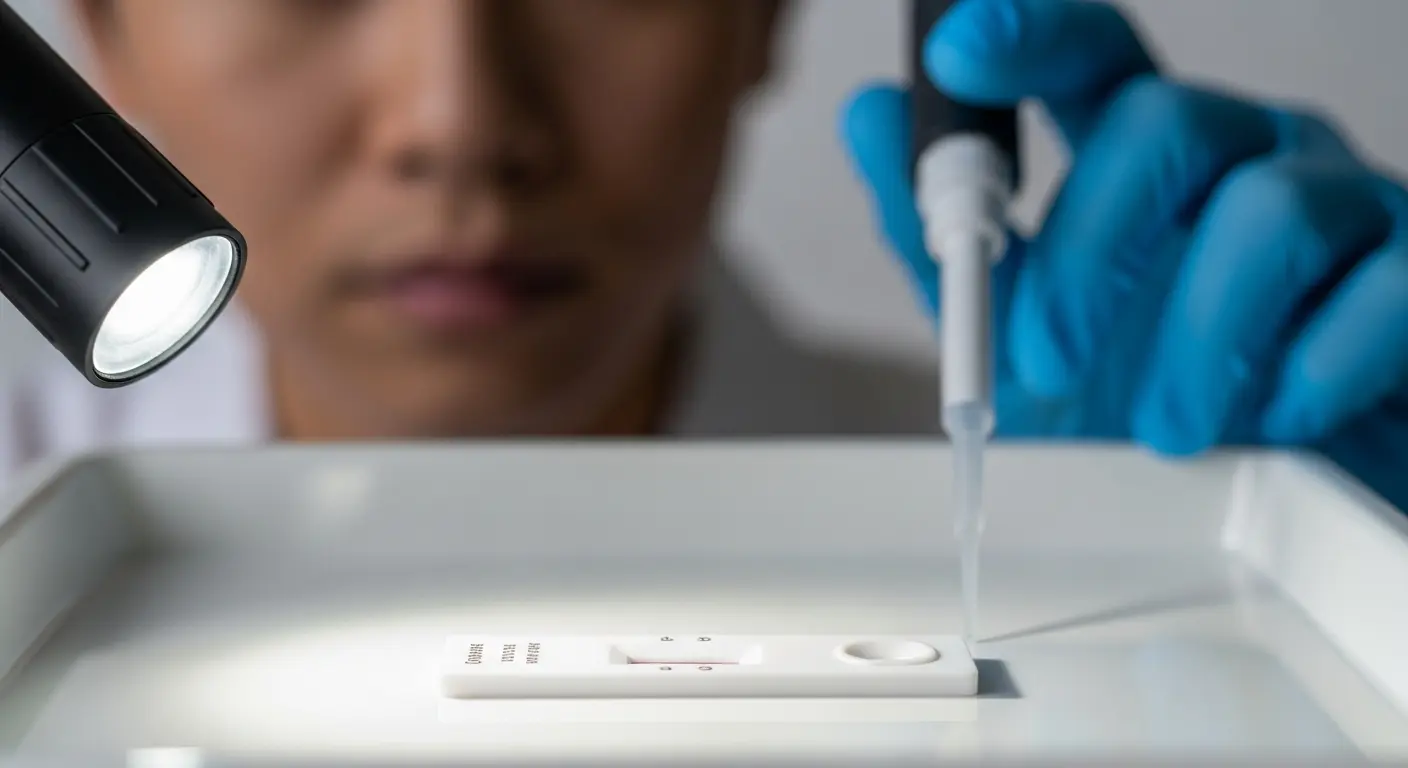 A variety of test kits for detecting semen are currently sold online. Since it is a simple test that only requires spraying two reagents to produce a color change if semen is present, some readers may have tried one themselves.
The mechanism of these infidelity test kits is that they produce a color change when they react with "acid phosphatase (AcP)," an enzyme abundantly present in semen. Acid phosphatase is present in seminal plasma (the liquid portion of semen) at a very high concentration, and it has long been used in forensic medicine as a presumptive (preliminary) test for semen (1).
However, detecting "acid phosphatase" does not conclusively prove that a substance is semen. While acid phosphatase is indeed abundant in semen, it is also present — albeit at lower concentrations — in saliva and vaginal secretions (1). Furthermore, since acid phosphatase activity has also been confirmed in some plants and fungi, it cannot even be ruled out that traces of food on clothing could cause a false reaction.
In other words, if this kind of infidelity test kit is used on a woman's underwear or sanitary products, it can produce a "positive" result even when she is completely innocent. If someone judges based solely on the result of a commercial kit without understanding this risk of false positives, they risk creating an irreparable rift of trust with an innocent partner.
The limitations of the acid phosphatase method, explained
- Low specificity, since it is also found in body fluids other than semen (saliva, vaginal secretions, etc.)
- Enzyme activity decreases over time, creating a risk of false negatives
- What is detected is merely the "presence of an enzyme" — it cannot identify whose bodily fluid it is
- In forensic practice, it is positioned only as a "presumptive (preliminary) test" and is considered insufficient as a confirmatory test (2)
"Semen testing" using the latest testing technology — what is immunochromatography?
 seeDNA's semen test uses the latest "immunochromatography" technology, the same technique used by the FBI and CSI.
"Immunochromatography" is a technology also used in home pregnancy tests. This method uses the specific binding reaction between an antigen and antibody to detect a target substance in a sample via lateral flow (capillary flow in the horizontal direction). When a sample is applied to the test device, the target antigen in the sample binds to a labeled antibody within the device and accumulates on the test line, producing a color change (3).
In semen testing, "immunochromatography" detects semen using antibodies against prostate-specific antigen (PSA), a substance abundantly present in male semen. PSA is a type of serine protease produced by prostate epithelial cells, and it is present in seminal plasma at a very high concentration (several mg/mL or more). By contrast, PSA in blood serum is typically 4 ng/mL or lower — orders of magnitude lower than the concentration in seminal plasma (4).
By using immunochromatography with antibodies specific to this PSA, it is possible to accurately determine whether semen is present on a piece of evidence. Even for samples taken from women's underwear or sanitary products, it is possible in the "vast majority" of cases to determine the presence or absence of semen with high accuracy. Compared to the acid phosphatase method, PSA-based testing has significantly higher specificity, offering the major advantage of greatly reducing the rate of false positives.
Points to note about the accurate "immunochromatography" semen test
However, even the highly accurate "immunochromatography" method for detecting semen requires additional confirmation in the following cases, so caution is needed.
① The test showed a semen reaction, a "positive" result, but... (possibility of a false positive)
In very rare cases, some women's bodies produce large amounts of PSA, an antigen normally produced by the prostate, an organ unique to men. In women, it is known that PSA is secreted in small amounts from sources such as Skene's glands (paraurethral glands), but individual variation is quite large, and in some women, detectable levels of PSA can be present in vaginal secretions. In such cases, a "positive" result can occur in reaction to vaginal secretions even when no semen is present at all (4).
② The test showed no semen reaction, a "negative" result, but... (possibility of a false negative)
There are cases where semen is actually present, but the amount is below the detection limit of the "immunochromatography" test kit, resulting in a "negative" judgment. For example, if the sample has degraded over time or if washing has significantly reduced the PSA concentration, the result may fall below the detection limit.
To guard against the possibility of false positives and false negatives such as ① and ②, seeDNA recommends conducting an infidelity test that combines semen testing with DNA analysis using the PCR method.
The most accurate infidelity test, combining semen testing with DNA analysis
The PCR method (polymerase chain reaction) has become a familiar term thanks to COVID testing, but this PCR method is a technology that can amplify trace amounts of DNA contained in evidence to detect the gene of interest. In PCR, the double strand of DNA is separated by heat denaturation, primers are annealed, and an extension reaction is carried out by DNA polymerase; by repeating this cycle, a specific DNA fragment is amplified exponentially (5).
By using PCR, which can amplify even the tiniest trace of DNA remaining in a sample by more than 10 million times, an accurate "negative" or "positive" result can be confirmed as follows.
- Conducting a semen test (immunochromatography): First, an immunochromatography test using PSA antibodies is performed on the evidence to make an initial determination of whether semen is present.
- DNA extraction and PCR amplification: DNA is extracted from the sample, and PCR is used to amplify a DNA fragment containing a gene region specific to the Y chromosome.
- Sex determination via Y-chromosome detection: If a gene from the "Y chromosome," indicating male origin, is detected in the DNA amplified by PCR, this strongly supports the earlier positive result from the semen test.
- Individual identification via STR profiling: In addition, by examining special regions of DNA equivalent to a "DNA fingerprint" (STR: Short Tandem Repeat), it is possible to determine whose DNA was detected.
- Comprehensive judgment and reporting: The results of the semen test and the DNA analysis are evaluated comprehensively, and an accurate conclusion based on scientific evidence is reported.
If a stain found on an item tested turns out to be not just semen, but semen belonging to a man other than yourself, this becomes the most definitive proof of infidelity. Conversely, if no "Y chromosome" is detected, it may be necessary to consider the possibility of the woman's own physiological condition (the PSA-producing constitution mentioned above) before concluding "positive."
The sensitivity and reliability of the PCR method used in infidelity testing
Our "PCR method" is a test that is 10 to 100 times more sensitive than the "immunochromatography method". ("Highly sensitive" means it can detect an even smaller trace amount. The range of 10 to 100 times exists because the concentration of PSA and semen varies from person to person.)
Even with a "negative" result from the semen test, if the "Y chromosome" of a man other than yourself is detected from evidence — such as women's underwear — where male DNA would not normally be found, the possibility of infidelity cannot be ruled out. In other words, by combining it with PCR, it is possible to build a testing system that does not overlook important clues even in cases that would fall below the detection limit of immunochromatography alone.
Comparison of testing methods
| Comparison item | Acid phosphatase method | Immunochromatography + PCR method |
|---|---|---|
| Detection target | Enzyme (AcP) | PSA antigen + DNA |
| Specificity | Low (also reacts with saliva, etc.) | High (double confirmation with PSA + Y chromosome) |
| Individual identification | Not possible | Possible (STR profiling) |
seeDNA's infidelity test is more accurate than the acid-phosphatase-based semen test kits sold online. It is an infidelity test that combines semen testing via "immunochromatography" with DNA analysis, and can clearly resolve proof of innocence or suspicions of a partner's infidelity.
Learn more about infidelity testing here
Frequently Asked Questions
Q1. What is the difference between commercial infidelity test kits and seeDNA's semen test?
A. Most commercial kits use the reaction of an enzyme called "acid phosphatase," which can produce a positive reaction even with saliva or vaginal secretions. seeDNA, on the other hand, uses immunochromatography to detect prostate-specific antigen (PSA), a test with far greater specificity. We further combine this with DNA analysis via PCR to minimize the risk of false positives and false negatives.
Q2. Can semen be detected even from washed clothing?
A. Washing significantly reduces PSA concentration and DNA quantity, which can make detection more difficult. However, since the PCR method is 10 to 100 times more sensitive than immunochromatography, it may still be able to detect trace amounts of remaining DNA. Since results vary depending on the condition of the sample, please first consult with our specialized staff.
Q3. How long does it take to receive the test results?
A. After the sample arrives at seeDNA's testing laboratory, results are typically reported within a few days to about a week. The required time may vary depending on the condition of the sample and the combination of tests requested, so please check with us directly for details when you inquire.
Q4. Is it necessary to have DNA analysis done in addition to the semen test?
A. The semen test (immunochromatography) alone can determine the presence of semen with high accuracy, but identifying "whose semen it is" requires DNA analysis (STR profiling). We also strongly recommend combining it with DNA analysis to eliminate the risk of false positives (a woman's PSA-producing constitution) and false negatives (a trace amount of semen).
Q5. Can test results be accepted as evidence in court?
A. seeDNA is a specialized institution certified to ISO 9001 and conducts testing using scientifically reliable methods. Our test reports may be submitted as documentation in legal proceedings. However, whether a court ultimately accepts them as evidence depends on the individual case and the judge's discretion, so we also recommend consulting with a lawyer.
Q6. Is my privacy protected? I don't want my family to find out.
A. seeDNA holds Privacy Mark (P Mark) certification and maintains a strict system for managing personal information. We also offer options for how test results are delivered, designed so that only you personally can receive them, so you can use our service with peace of mind.
Reassuring support from seeDNA Genetic Medical Research Institute
seeDNA Genetic Medical Research Institute is a trusted and reliable specialized institution for DNA testing and genetic testing, certified under the international quality standard ISO 9001 and the Privacy Mark for personal information protection.
If you have concerns about family or parent-child blood relationships, or your partner's infidelity, our DNA testing experts are here to support you so you can feel completely at ease — please feel free to contact us.
[Free Consultation with Specialized Staff]

If you have any questions,
please feel free to contact our toll-free number.
/Open every day, including weekends/
Business hours: Monday-Sunday 9:00 AM-6:00 PM
(excluding holidays)
 Author
W, in charge of parent-child DNA testing (STR)
Affiliation: seeDNA Co., Ltd. Testing Department