
Last revised: May 26, 2025
Non-invasive parent-child DNA testing (NIPPT), which uses fetal DNA in maternal blood, is possible even during pregnancy. With seeDNA, paternity can be confirmed in as little as 4 days from 7 weeks of pregnancy onward, and testing can be safely carried out at more than 300 partner hospitals nationwide.
- ・Can DNA testing confirm paternity during pregnancy?
- ・How prenatal parent-child DNA testing works and its accuracy
- ・Over 300 partner hospitals, No. 1 in Japan
- └ Testing process
- └ Difference between private and legal tests
- ・"Prenatal parent-child DNA testing" is conducted by a specialized DNA testing institution
- ・Why seeDNA is chosen
- ・Points to note about prenatal parent-child DNA testing
- ・Free consultation
Can DNA testing confirm paternity during pregnancy?

For various reasons — affairs, IVF, or cases involving multiple partners — more and more people each year want to confirm the father of their unborn baby while still pregnant. However, in Japan the Japan Society of Obstetrics and Gynecology prohibits performing amniocentesis or chorionic villus sampling for any purpose other than diagnosing genetic disorders, which means parent-child DNA testing is not among the permitted uses. As a result, many people struggle to get a paternity test done through conventional invasive methods.[ref:1]
Conventional prenatal paternity testing has traditionally relied on collecting amniotic fluid or chorionic villus tissue. However, these methods require invasive procedures that carry risks such as miscarriage for both the mother and the baby, and are therefore restricted on medical ethics grounds. Specifically, amniocentesis is reported to carry a miscarriage risk of about 0.1–0.3%, with chorionic villus sampling carrying a similar level of risk.[ref:2] [ref:5] Against this backdrop, there has been strong demand for a testing method that can safely and accurately confirm parentage during pregnancy.
So how can you determine the father of your unborn baby during pregnancy?
Paternity testing during pregnancy can be handled by seeDNA, a specialized DNA testing institution, through its Prenatal Parent-Child DNA Test (NIPPT: Non-Invasive Prenatal Paternity Test). This test uses a blood sample from the pregnant mother to confirm the father of the unborn baby. Ever since Lo et al. discovered in 1997 that cell-free fetal DNA (cffDNA) exists in maternal blood [ref:2], this technology has advanced rapidly, and it is now possible to determine parentage non-invasively with high accuracy.
Specifically, by analyzing the fetal DNA* contained in the mother's blood from 7 weeks of pregnancy onward alongside the DNA of the presumed father, the biological parent-child relationship can be confirmed with the highest accuracy in as little as 4 days. The cffDNA in maternal blood is mainly generated when placental trophoblast cells release DNA into the maternal bloodstream through apoptosis (natural cell death), and its concentration increases as pregnancy progresses.[ref:6]
*Because the amount of fetal DNA in the blood varies from person to person, a result may occasionally not be obtainable even after 7 weeks of pregnancy. However, seeDNA's prenatal parent-child DNA test comes with a free retest (including free round-trip express shipping) or a partial refund guarantee for blood drawn after 7 weeks, so you can rest assured.
Learn more about prenatal parent-child DNA testing here
How prenatal parent-child DNA testing works and its accuracy
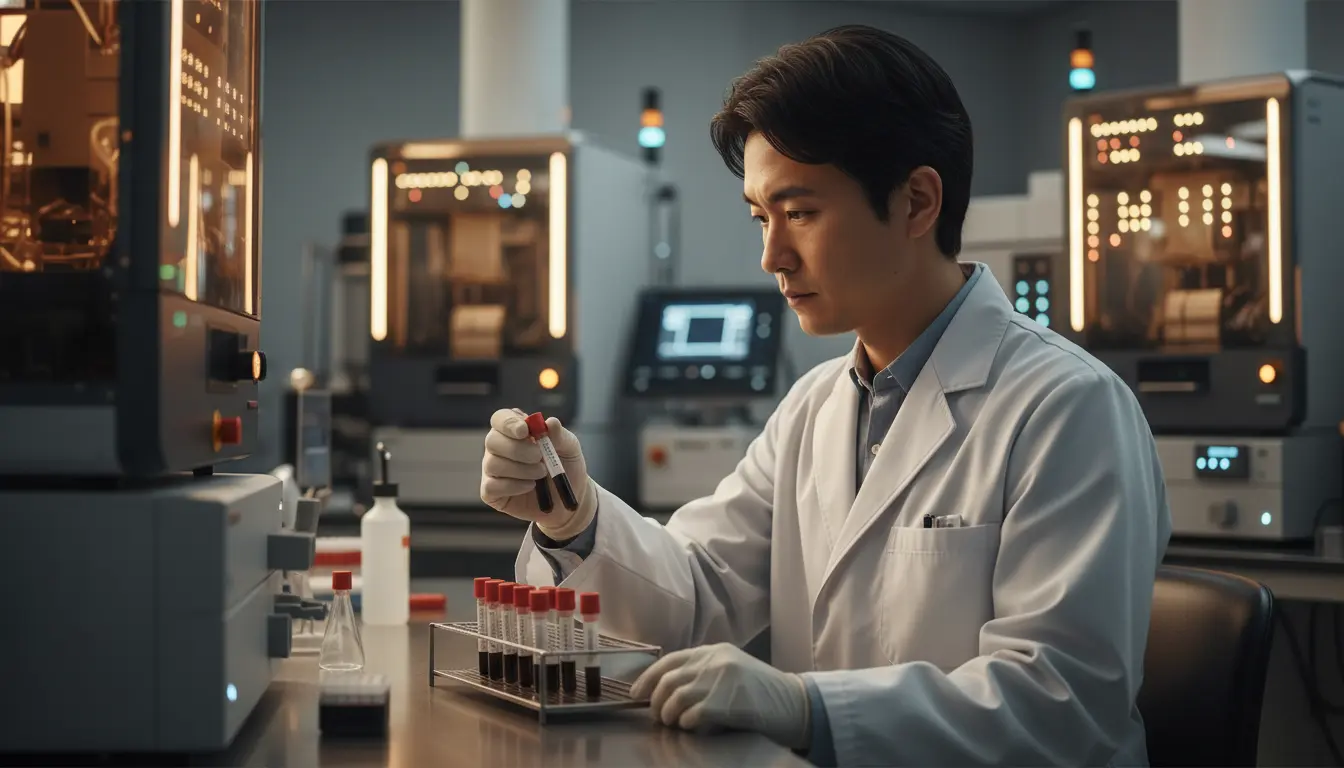
Prenatal parent-child DNA testing is carried out using Next Generation Sequencing (NGS) technology. Fetal DNA fragments are identified from within the DNA extracted from maternal blood, and genetic markers called SNPs (single nucleotide polymorphisms) are analyzed across several hundred thousand sites. This allows the fetal DNA profile to be compared with the DNA profile of the candidate father, determining parentage with an accuracy of over 99.99%.[ref:4] [ref:7]
The core of this technology lies in its ability to accurately separate and identify only the fetal-derived DNA component from a blood sample in which maternal and fetal DNA are mixed together, using advanced bioinformatics analysis. Specifically, at gene loci where the mother is homozygous (AA type), if the fetus is heterozygous (AB type), the B allele can be determined to have come from the father. By integrating this information across tens of thousands to hundreds of thousands of SNP loci, parentage can be determined with extremely high accuracy. Because there is no need to directly collect fetal cells as with amniocentesis, the test poses no risk to either the mother or the baby and can be performed safely.
Over 300 partner hospitals, No. 1 in Japan

There are two types of testing: a private test, which is completed entirely by mail, and a legal test, in which a specialist is present to collect the sample. In either case, because the baby's DNA is contained in the mother's blood, a blood draw at a hospital is required.
seeDNA has over 300 partner hospitals where DNA testing can be arranged, spanning from Hokkaido to Okinawa, so you won't need to travel far for a blood draw. There is also no restriction on which hospital performs the blood draw, so if your regular obstetrics clinic or another medical institution is willing to accommodate it, testing can be arranged there as well.
If you'd like to have blood drawn at one of our partner hospitals, we can arrange the appointment on your behalf — please feel free to ask. The oral epithelial cells commonly used as the father's sample can be easily collected at home simply by lightly swabbing the inside of the cheek for about 10 seconds with a cotton swab. Testing using items a person has touched, such as hair or a toothbrush, is also possible.
Testing process
- Apply and purchase a kit: Apply via the seeDNA official website or by phone, and receive your testing kit.
- Collect the candidate father's sample: Use the cotton swab included in the kit to collect oral epithelial cells (easy to do at home). Alternative samples such as hair or a toothbrush can also be used.
- Draw the mother's blood: 20ml of blood is drawn at a partner hospital or your regular medical institution. seeDNA can also arrange the appointment on your behalf.
- Ship the samples: Send the collected samples to seeDNA's testing lab by mail.
- DNA analysis and results: We report the results in as little as 4 days after the samples arrive.
Difference between private and legal tests
| Item | Private Test | Legal Test |
|---|---|---|
| Sample collection | Collected and mailed by yourself | Collected with a specialist present |
| Main use | Personal confirmation | Court and legal proceedings |
| ID verification | Not required | Photo ID must be presented |
"Prenatal parent-child DNA testing" is conducted by a specialized DNA testing institution
Because prenatal parent-child DNA testing requires the mother's blood (20ml), many people mistakenly believe the test itself must be applied for through a hospital. In fact, this test is conducted not by a hospital, but by a specialized DNA testing institution.
Some hospitals and clinics do accept applications for this kind of test, but under medical law, fetal parent-child DNA testing is a non-clinical test and cannot be performed at a hospital. Blood collected at a hospital must be sent to a specialized DNA testing institution for analysis. Because paternity testing arranged through a hospital or clinic in this way involves an intermediary, the cost tends to be higher and it takes longer to receive results. For this reason, applying directly to a specialized DNA testing institution is both cheaper and faster.
Since drawing blood is a medical procedure, it must be performed at a hospital or clinic, but seeDNA partners with over 300 medical institutions nationwide, so there's no need to travel far. A quick, smooth blood draw is possible at your nearest medical institution.
Why seeDNA is chosen
- Fast results in as little as 4 days: Results are available in as little as 4 days after the samples arrive at the lab, minimizing your period of anxious waiting.
- Over 99.99% accuracy: Next generation sequencing technology combined with advanced bioinformatics analysis delivers extremely accurate results.
- Non-invasive and safe: Since the test is completed with just a maternal blood draw, there is zero risk to the unborn baby.
- Over 300 partner hospitals nationwide: Covering the whole country from Hokkaido to Okinawa, blood draws are available at a medical institution near you.
- ISO 9001 and Privacy Mark certified: The only DNA testing institution in Japan certified under the international quality management standard and the Privacy Mark for data protection.
- Free retest and refund guarantee: Even if no result is obtained from blood drawn after 7 weeks of pregnancy, a free retest or partial refund guarantee applies.
- Supports a wide range of samples: In addition to oral epithelial cells, alternative samples such as hair, toothbrushes, and nail clippings are also supported.
There's no need to spend your pregnancy in anxiety. seeDNA's Prenatal Parent-Child DNA Test can accurately confirm the father of your unborn baby in as little as 4 days.
Learn more about prenatal parent-child DNA testing here
Points to note about prenatal parent-child DNA testing
There are a few important points to keep in mind when considering prenatal parent-child DNA testing. First, testing is only possible from 7 weeks of pregnancy onward. This is because it takes a certain amount of time for the concentration of cell-free fetal DNA (cffDNA) in maternal blood to reach a level sufficient for testing. If the pregnancy is too early, the proportion of fetal DNA fragments (fetal fraction) may be too low to obtain an accurate result.[ref:6]
Additionally, in cases of multiple pregnancies, such as twins, testing may not be available. This is because DNA is released from multiple fetuses in a multiple pregnancy, making it difficult to match each individual fetus with a candidate father. We recommend consulting with seeDNA's specialist staff before testing in such cases.
Furthermore, the test result only indicates whether a biological parent-child relationship exists — it does not establish a legally recognized parent-child relationship. If legal validity is required, please choose the legal test, which is conducted with a specialist present.
Free consultation
seeDNA is the only DNA testing institution in Japan certified under both the international quality standard ISO 9001 and the Privacy Mark for data protection. If you have concerns about a parent-child blood relationship, or are troubled by suspicions of infidelity, please feel free to consult seeDNA.
[Free consultation with specialist staff]
[Toll-free number]
0120-919-097
[Business hours]
Monday–Sunday, 9:00 AM – 6:00 PM (excluding public holidays)
Frequently Asked Questions
Q1. From what week of pregnancy can prenatal parent-child DNA testing be performed?
A. Testing is possible from 7 weeks of pregnancy onward. This is generally when the concentration of cell-free fetal DNA (cffDNA) in maternal blood reaches a level sufficient for testing. However, because the amount of cffDNA varies from person to person, if a result cannot be obtained, please rest assured that seeDNA provides a free retest or a partial refund guarantee.
Q2. How long does it take to get the test results?
A. Results are available in as little as 4 days after the samples arrive at seeDNA's testing lab. This is among the fastest turnaround times of any DNA testing institution in Japan. We aim to meet our customers' need to shorten the anxious waiting period before childbirth as much as possible.
Q3. Does prenatal DNA testing affect the unborn baby?
A. seeDNA's prenatal parent-child DNA test is a non-invasive test that only requires a maternal blood draw. Because there's no need to insert a needle into the uterus, unlike amniocentesis or chorionic villus sampling, there is no risk to the unborn baby. The test can be safely performed with the same procedure as a standard blood draw.
Q4. How should the candidate father's sample be collected?
A. The most common method is oral epithelial cells (cheek cells), which can be collected simply by lightly swabbing the inside of the cheek for about 10 seconds with the cotton swab included in the kit. This can be done easily at home. In addition to oral epithelial cells, everyday items with DNA attached, such as hair (with the root), a toothbrush, nail clippings, or cigarette butts, can also be used as samples.
Q5. What is the difference between applying directly through a hospital versus applying directly to seeDNA?
A. If you apply for paternity testing through a hospital or clinic, the hospital merely acts as an intermediary, adding an intermediary fee that raises the overall cost. In addition, because samples must be forwarded from the hospital to the DNA testing institution, it takes longer to receive results. By applying directly to seeDNA, you can receive results faster while keeping costs down.
Q6. What is the difference between a private test and a legal test?
A. A private test is for personal confirmation purposes — you collect the sample yourself and complete the process by mail. A legal test is attended by seeDNA's specialist staff, who verify your identity before collecting the sample, and results in a report that can be used as evidence in court or legal proceedings. Please choose based on your intended use.
Q7. Can testing be done for multiple pregnancies (such as twins)?
A. In the case of a multiple pregnancy such as twins, DNA is released into maternal blood from more than one fetus, which can make it difficult to match each individual fetus with a candidate father. For this reason, multiple pregnancies may not be eligible for testing. Please contact seeDNA's specialist staff for details.
Reliable support from the seeDNA Genetic Medicine Research Institute
The seeDNA Genetic Medicine Research Institute is a trusted, specialized institution for DNA and genetic testing that has obtained the international quality standard ISO 9001 and the Privacy Mark for data protection.
If you're troubled by questions about family or parent-child blood relationships, or by a partner's infidelity, our DNA testing experts are here to provide the support you need with peace of mind — please feel free to contact us.
[Free consultation with specialist staff]

If you have any questions,
please feel free to contact our toll-free line.
/Open every day, including weekends/
Business hours: Monday–Sunday 9:00 AM–6:00 PM
(excluding public holidays)
 Author
Kihan Tomikane, Ph.D.
Completed his master's and doctoral studies in Biosystems and Molecular Information Medicine at the University of Tsukuba Graduate School
In 2017, developed the first prenatal DNA testing method in Japan using trace-amount DNA analysis technology (Patent No. 7121440) (Patent No. 7331325)