
Revision date: April 29, 2025
There are two types of DNA testing: "private testing" and "legal testing," which differ in many respects, including purpose, cost, samples, anonymity, and whether a witness is required. This article explains the characteristics of both in detail and how to choose between them.
Partially revised on 2024.09.06
When conducting prenatal DNA testing or paternity DNA testing, there are two methods: "private testing" and "legal testing." For example, when performing a DNA test to determine whose child someone is, "private testing" is used for personal confirmation, while "legal testing" is used as proof of a parent-child relationship in mediation or court proceedings.
DNA testing is a technology that analyzes human genetic information (DNA) to scientifically prove parent-child or blood relationships [ref:1]. Today, the mainstream method involves comparing and analyzing repeat sequences on DNA called STR (Short Tandem Repeat) at multiple locations, allowing parent-child relationships to be determined with extremely high accuracy [ref:2]. Thanks to this technological progress, DNA testing is no longer used only in special circumstances as it once was; the number of ordinary people using it to resolve personal questions has also risen sharply.
However, when people actually consider undergoing DNA testing, many wonder, "Which should I choose, private or legal testing?" While there is no difference in the accuracy of the test itself between the two, they differ significantly in the strictness of procedures, cost, purpose of use, documents to be submitted, and the evidentiary value of the results. This article explains the characteristics and differences between the two testing methods in detail to help support you in making the best choice for your situation.
- ・"Private testing" is conducted for personal confirmation purposes, so you can be tested anonymously.
- ・Points to consider when choosing between private and legal testing
- ・About private testing
- └ Testing method
- └ Notification of results
- └ Flow of private testing
- ・About legal testing
- └ Testing method
- └ Notification of results
- ・Our strength: high-precision paternity DNA testing
- ・The technical background supporting the reliability of DNA testing
- ・Switching from private testing to legal testing
"Private testing" is conducted for personal confirmation purposes, so you can be tested anonymously.
On the other hand, "legal testing" is intended for use as proof of a parent-child relationship in mediation or court proceedings, so it always requires testing under a real name with identity verification.
Other differences between "private testing" and "legal testing" include cost, whether a witness is required, and the type of sample submitted.
The table below summarizes the differences between "private testing" and "legal testing."
Comparison table of high-precision paternity DNA testing: "Private" vs. "Legal"
| Private | Legal | |
| Cost | ¥24,800 | ¥88,000 |
| Turnaround time (speed) | 4-6 days (2-3 days) | 4-6 days (2-3 days) |
| Minimum guaranteed accuracy | 99.99% or higher | 99.99% or higher |
| Witness required | Not required | Required (free) |
| Sample | Any item with human cells attached*1 | Oral epithelium |
| Anonymous testing | Possible | Not possible |
| Submission to public institutions | Not guaranteed | Guaranteed |
| Private | Legal | |
| Cost | ¥24,800 | ¥88,000 |
| Turnaround time (speed) | 4-6 days (2-3 days) | 4-6 days (2-3 days) |
| Minimum guaranteed accuracy | 99.99% or higher | 99.99% or higher |
| Witness required | Not required | Required (free) |
| Sample | Any item with human cells attached*1 | Oral epithelium |
| Anonymous testing | Possible | Not possible |
| Submission to public institutions | Not guaranteed | Guaranteed |
As the comparison table above shows, private testing and legal testing are the same in terms of scientific accuracy (99.99% or higher) and turnaround time (usually 4-6 days, or 2-3 days with expedited service). The major difference lies in "what the results will be used for" and "where they will be submitted," along with the accompanying strictness of procedures [ref:3].
Points to consider when choosing between private and legal testing
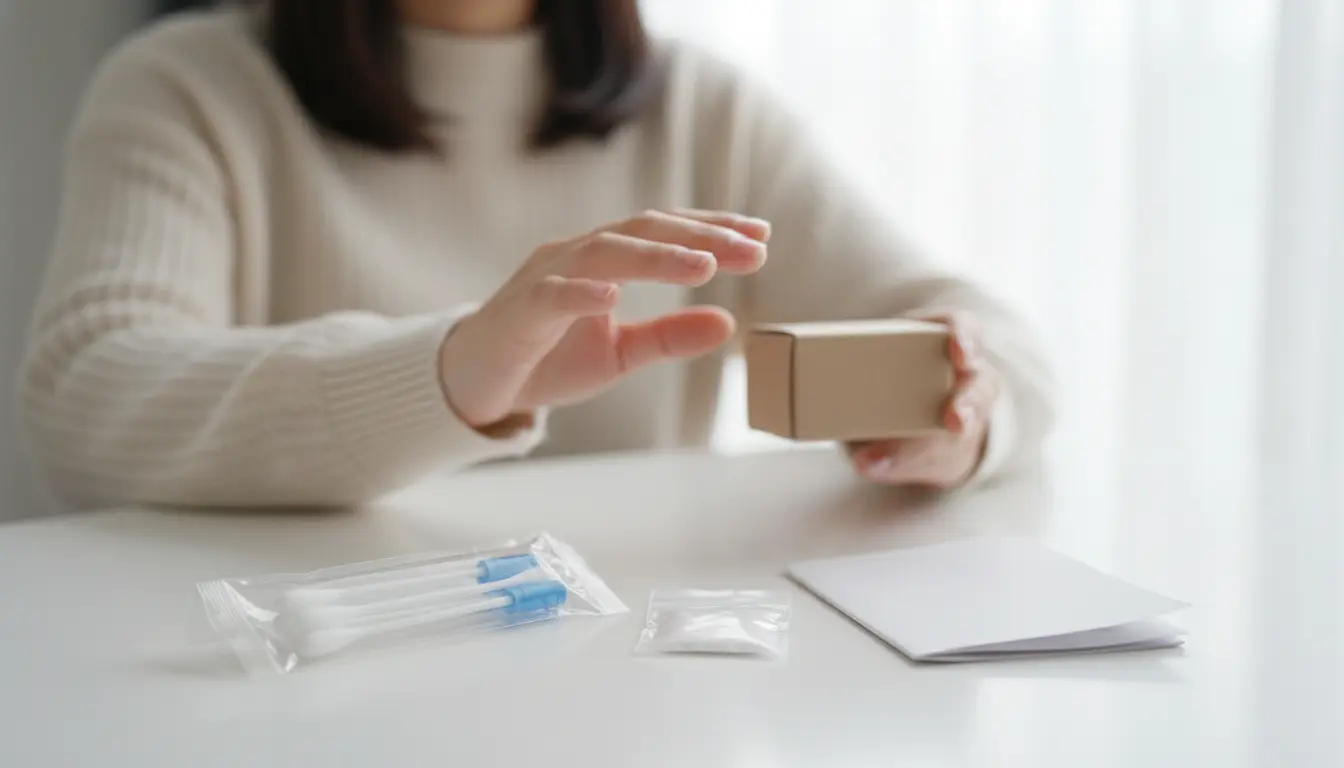
When choosing a testing method, it is important to first clarify the purpose for which you will use the DNA test results. Below is a summary of cases suited to each type of testing.
- Cases suited to private testing: when you want to personally confirm a parent-child relationship, when you have no plans to submit the results in court or for official procedures, when you want to test without the other party knowing, or when you want to use a sample other than oral epithelium, such as a toothbrush or cigarette butt.
- Cases suited to legal testing: when you need to prove a parent-child relationship in family court mediation or litigation, when submitting results to a public institution for a paternity claim or inheritance procedure, or when the test result is needed for an international procedure (visa application, nationality confirmation, etc.).
About private testing

Testing method
For private testing, sample collection is done by the customer themselves. DNA testing can be performed as long as you have an item with human tissue attached, such as a toothbrush, cigarette butt, or disposable chopsticks.
Everything needed for testing is included in the sample collection kit sent by us, so there is no need to worry. No identity verification documents or other submissions are required, so there is nothing the customer needs to prepare.
Since we are unable to contact test subjects other than the applicant, we ask that the applicant confirm the consent of all test subjects themselves.
* If a test subject is a minor, the signature must be provided by their parent or guardian on their behalf.
While private testing is easy to start, its validity as legal evidence is not guaranteed. However, for those seeking personal confirmation, it is a highly effective option, offering high-precision results while keeping costs down.
Notification of results
Test results are confirmed via a results report uploaded to "My Page," which you are notified about by email. If you wish, we can also mail you the results report — please feel free to contact us.
Flow of private testing
- Application: Apply via the web or by phone. Anonymous applications are also accepted.
- Receiving the sample collection kit: The sample collection kit will be sent to you.
- Sample collection and return: Collect the sample yourself and send it to us using the enclosed return envelope.
- DNA analysis: DNA analysis is performed at our laboratory. Accuracy is ensured through a double-check system.
- Notification of results: You can check the results in the results report on My Page.
About legal testing
Testing method
For legal testing, a witness (a specialized staff member) must be present at sample collection. At the time of sample collection, we verify the customer's identification and take a photograph for identity verification, in order to certify that the test results are from a sample collected from the person themselves.
Some customers may worry, "Won't having a witness present incur an extra fee?"
However, we offer free witnessing at more than 200 partner legal offices nationwide.
If it is difficult for you to visit a partner location, sample collection with an on-site witness is also available.
Legal testing maintains a consistent "chain of custody" from sample collection through to the reporting of results, giving it the reliability needed for courts, immigration authorities, and other public institutions to accept the results as official evidence [ref:4]. This is one of the biggest differences from private testing.
Notification of results
In addition to the results report uploaded to the "My Member Page," which you are notified about by email, we also send you a printed copy of the results report.
We can also issue reports in English or Korean certified by the Ministry of Foreign Affairs (official seal certification / apostille), so please feel free to let us know if you need this.
Our strength: high-precision paternity DNA testing
Our paternity DNA testing can resolve lifelong concerns about parent-child blood relationships,
with high-precision DNA testing 10 times more precise than the international standard, resolving the matter in as little as 2 days.
Additionally, thanks to our latest fully automated system, we can offer high-quality testing at low cost. Private testing costs ¥24,800, and legal testing costs ¥88,000, to resolve your concerns about a parent-child relationship.
To prevent human error, we perform a double-check by analyzing samples twice, so you can rest assured
, and we can deliver results as quickly as possible.
Depending on the storage conditions and duration of a sample, the DNA it contains may become damaged and unable to be tested. In such cases, please rest assured that we offer free retesting and a money-back guarantee.
The technical background supporting the reliability of DNA testing
STR analysis, widely used in modern DNA paternity testing, is a method that compares the number of repeats of short base sequences scattered throughout the human genome, for each individual [ref:2]. Because half of a child's DNA is inherited from each parent, a child's STR type always consists of a combination inherited from the father and the mother. Using this principle, the test checks whether the presumed father's STR type is consistently contained within the child's STR type, to determine whether a parent-child relationship exists.
At seeDNA, we perform analysis using more than 10 times the number of genetic loci recommended internationally, achieving an extremely high minimum guaranteed accuracy of 99.99% or higher. Furthermore, by adopting a fully automated DNA extraction and amplification system, we minimize the risk of contamination while maintaining some of the most competitive costs in the industry.
Switching from private testing to legal testing
Many people think, "I'd like to confirm things privately first, and proceed with legal procedures later if necessary." In such cases, it is possible to first confirm the parent-child relationship with private testing, and then apply for legal testing separately based on those results. However, submitting private testing results as-is to a court as legal evidence is not guaranteed to be accepted, so if legal proof is needed, we recommend choosing legal testing from the start [ref:3].
Under Japan's legal system, a DNA test result does not by itself automatically change a legally recognized parent-child relationship. For example, when a legal father-child relationship is presumed under the presumption of legitimacy (Article 772 of the Civil Code), legal procedures such as a lawsuit denying legitimacy or a lawsuit confirming the non-existence of a parent-child relationship in family court are required to deny the relationship [ref:5]. In such procedures, the results of legal testing are treated as extremely important evidence.
Frequently Asked Questions
Q1. Is there a difference in testing accuracy between private and legal testing?
A. No, there is no difference in testing accuracy. For both private and legal testing, we perform DNA analysis with a minimum guaranteed accuracy of 99.99% or higher. The differences lie in the strictness of the procedures (identity verification and witness requirements) and the legal evidentiary value of the results.
Q2. Can the results of a private test be used in court?
A. In some cases it may be possible to submit private testing results to a court, but their validity as legal evidence is not guaranteed. If you need results that will be reliably accepted as proof of a parent-child relationship in mediation or litigation, we recommend applying for legal testing from the start.
Q3. Is there a fee for a witness at legal testing?
A. We offer free witnessing at more than 200 partner legal offices nationwide. If it is difficult to visit a partner location, on-site witnessed sample collection is also available, so please feel free to consult with us.
Q4. What kinds of samples can be used for private testing?
A. For private testing, in addition to oral epithelium collected with our designated swab, items with human cells attached — such as a toothbrush, cigarette butt, disposable chopsticks, nails, or hair (with root) — can be used as samples. However, if you use a sample other than oral epithelium, manual DNA extraction is required, which adds extra cost and time.
Q5. Can legal testing results be used for procedures overseas?
A. Yes, they can. We support the issuance of reports in English and Korean certified by the Ministry of Foreign Affairs (official seal certification / apostille), so they can also be used for overseas visa applications, nationality confirmation, and other procedures. Please feel free to contact us for details.
Q6. What happens if DNA cannot be detected from the sample?
A. Depending on the storage conditions and duration of the sample, there are cases where the DNA is damaged and testing is not possible. In such cases, we offer free retesting and a money-back guarantee, so please rest assured.
Reassuring support from seeDNA Genetic Medicine Research Institute
seeDNA Genetic Medicine Research Institute is a trusted and reliable specialist institution for DNA testing and genetic testing, holding both the international quality standard ISO9001 and the Privacy Mark for personal information protection.
If you are troubled by questions about family or parent-child blood relationships, or a partner's infidelity, our DNA testing experts are here to support you with peace of mind, so please feel free to contact us.
[Free consultation with specialized staff]

If you have any questions,
please feel free to contact our toll-free number.
\ Open every day, including weekends /
Business hours: Monday-Sunday 9:00 AM - 6:00 PM
(excluding holidays)
 Author
Dr. Kihan Tomikane, M.D.
Completed a master's and doctoral program in Biosystems Regulation and Molecular Information Medicine at the University of Tsukuba Graduate School.
In 2017, developed prenatal DNA testing(Patent 7331325) using Japan's first trace-DNA analysis technology(Patent 7121440).