
Rewritten on: February 5, 2026
Through the real experiences of people who took NIPT, we take a detailed look at the anxiety before testing, the psychological burden of waiting for results, and the emotions that follow after receiving them. We organize the key points, from an expert's perspective, for making a choice you can feel at peace with.
When you're considering NIPT (Non-Invasive Prenatal Testing), one of the things many people wonder about is "what did people who actually took it feel?" It can be difficult to translate a doctor's explanation or official information into your own feelings, so many people go looking for personal accounts. At the same time, some experience stories found online can heighten anxiety, and some lack sufficient medical background. This article carefully organizes the real voices of people who took NIPT, focusing on "what they worried about before the test and how they came to terms with the results." We also comprehensively explain the medical and psychological points that personal accounts alone can't fully convey—the basic mechanism and accuracy of NIPT, how to respond if the result is positive, and how to navigate differences in temperature between partners. We hope this serves as material to help you make a choice you can feel confident about.[ref:1]
- ・Real feelings before taking NIPT
- └ Common worries during the stage of hesitation
- ・From test day to waiting for results
- └ Tips for getting through the waiting period
- ・Honest feelings after receiving the result
- ・The basic mechanism and accuracy of NIPT
- └ The relationship between NIPT's positive predictive value and prior probability
- ・"Differences in temperature between partners" seen in personal accounts, and how to deal with them
- ・What you should know if the result is positive
- └ The importance of confirming follow-up support after a positive result
- ・Recent research findings on the psychological effects of NIPT
- ・Thinking about your own choice, informed by personal accounts
Real feelings before taking NIPT

Ms. A, who was expecting her first child at age 35, became strongly aware of NIPT after her doctor mentioned during a prenatal checkup that "given your age, NIPT is an option to consider." Up until then her pregnancy had been progressing smoothly, and she says, "I thought this was a test that had nothing to do with me." As she researched the topic once she got home, what occupied Ms. A's mind was the anxiety that "once I know the result, I may never be able to go back to how I felt before." What would she do if it was positive—could she really accept that decision? Looking back, she says she searched the internet repeatedly late into the night without reaching an answer.
When she talked to her husband, his response was, "Aren't you worrying too much?" She knew he meant no harm, but she says she felt a kind of loneliness, as if she were carrying the decision alone. Even so, the reason she ultimately decided to take the test was, "because I could picture myself regretting giving birth without knowing." For Ms. A, NIPT was a choice not to erase her anxiety, but to face reality.
Feeling strong hesitation and anxiety at the stage of considering NIPT is a very natural reaction. In fact, studies on prenatal testing have reported that the decision-making process itself regarding whether to take the test can be a major psychological burden for pregnant women.[ref:2] A study published in BMC Pregnancy and Childbirth in 2015 also showed that decision-making about NIPT depends heavily on the balance between a pregnant woman's autonomy and the information provided, and that being pressured to decide without sufficient counseling increases anxiety and stress.[ref:8] What matters is not searching for the "right answer" of whether to take the test or not, but sorting out how much you want to know, and how you want to come to terms with what you learn.
Common worries during the stage of hesitation
- Whether you can think in advance about what choice you would make if the result were positive
- Whether you've talked things through enough with your partner or family
- Feeling guilty about taking the test itself
- Wavering between the optimism that "it might be fine even without testing" and anxiety
- Uncertainty about whether to tell people around you that you're taking NIPT
- Financial anxiety about the fact that the test cost is entirely out of pocket
All of these worries are ones that pregnant women commonly carry, and there's no need to reach a conclusion alone. Using genetic counseling at a medical institution, or having repeated, gradual conversations with a partner, often helps sort out one's feelings little by little.
From test day to waiting for results

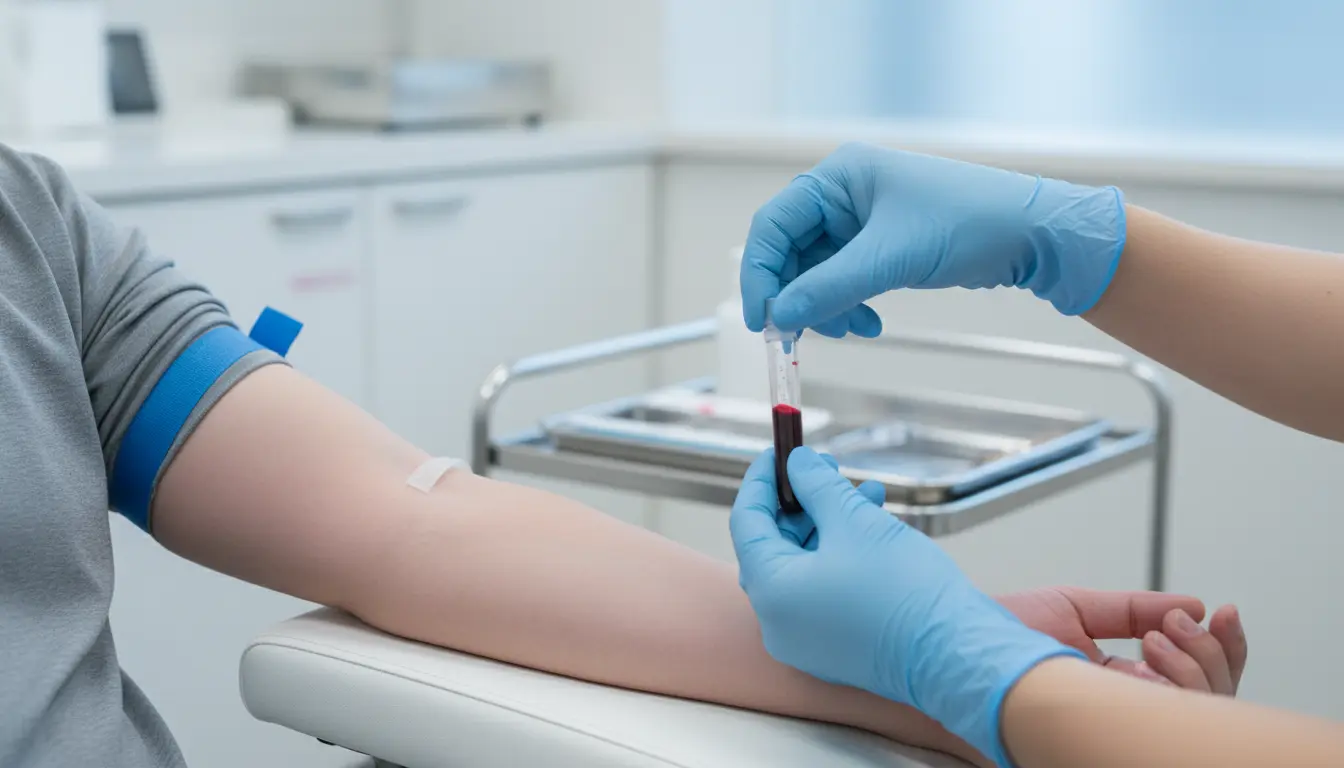
On the day of the test, NIPT turned out to be more anticlimactic than Ms. A had imagined. After checking in and receiving a brief explanation, all that happened was a normal blood draw. It took only a short time, and while she felt a bit let down, thinking "can this really tell us anything?", she also says that the moment the blood draw finished, reality hit her all at once.
NIPT is a test that analyzes fetal-derived cell-free DNA (cfDNA) contained in the mother's blood, and does not require an invasive procedure like amniocentesis or chorionic villus sampling.[ref:3] Because of this, the physical burden is limited to a blood draw, but the psychological burden tends to grow larger after the test. Most of the cfDNA in maternal blood is placenta-derived, and its proportion (the fetal fraction) rises as gestational age advances. Generally, a sufficient fetal fraction for testing is obtained from around 10 weeks of pregnancy onward, but in women with a higher BMI (body mass index) or at earlier gestational ages, the fetal fraction tends to be lower, and in rare cases no result can be obtained (an indeterminate result).[ref:9]
The problem came after that. Over the roughly one to two weeks it took for results to come back, Ms. A recalls, "the waiting period was the hardest part." During the day she could distract herself with work and housework, but at night the thought "what if it's positive" wouldn't leave her mind. She also says she pored over personal accounts online, and found herself bouncing between reassuring information and information that fueled her anxiety. On the other hand, there were also times when she deliberately kept her distance from information, thinking "there's nothing I can change until the result comes." For Ms. A, this waiting period may have been a time to face her own feelings, more than about the result itself.
With NIPT, the period of waiting for results is psychologically the most burdensome. Gathering information is important, but if anxiety grows strong, it's also necessary to step back from it at times. Anxiety while waiting for results is not abnormal—many pregnant women feel the same way.[ref:3]
Tips for getting through the waiting period
- Limit your information gathering to trustworthy sources only (official medical institution websites, academic society guidelines, etc.)
- On nights when anxiety is strong, deliberately create time away from your smartphone
- Put your anxious feelings into words and share them with your partner or trusted family
- Check in advance about genetic counseling or consultation services available at medical institutions
- Picture in advance the next steps (such as whether to pursue a confirmatory test) regardless of the outcome
\NIPT with results in as little as 3 days/
Honest feelings after receiving the result
On the day the result came in, Ms. A says she couldn't open the notification on her phone right away. "The desire to know" and "the fear of knowing" hit her at the same time, and she says she sat frozen, staring at the screen, for hours. When she took a deep breath and checked the result, the words "low risk" came into view. In that moment, a wave of relief washed over her, and along with it the tension she had been holding suddenly released, and she couldn't stop crying.
On the other hand, after feeling reassured, there was also a period when she asked herself, "if I was going to get this anxious, maybe I didn't need to take the test." But as time passed, Ms. A's feelings gradually settled. "Whatever the result was going to be, I was trying to face it without running away. That fact is what supports me now," she says. For Ms. A, NIPT was not simply a test to obtain a result, but a process of shaping her own resolve as a parent. "I don't know if it was the right choice. But I have no intention of denying the choice I made at that time," she says with a calm expression.
Emotions after receiving an NIPT result tend to be complex regardless of the outcome. It's not at all unusual to feel confusion or even regret alongside relief. Studies show that while many pregnant women who receive a low-risk NIPT result report feeling reassured, some also report "ethical conflict about having taken the test itself."[ref:4] A review published in Prenatal Diagnosis in 2014 also reported that even with a negative NIPT result, a certain proportion of women's anxiety about residual risk is not completely resolved.[ref:10] What matters is not the result itself, but how much you thought things through and tried to come to terms with them along the way.
The basic mechanism and accuracy of NIPT
When reading personal accounts, it's very important to correctly understand the medical mechanism behind NIPT. NIPT is a test that analyzes fetal-derived cell-free DNA (cfDNA) present in maternal blood from 10 weeks of pregnancy onward, using next-generation sequencing, to screen for numerical abnormalities in specific chromosomes.[ref:3]
The main conditions NIPT screens for are three autosomal abnormalities: trisomy 21 (Down syndrome), trisomy 18 (Edwards syndrome), and trisomy 13 (Patau syndrome). Depending on the testing facility, sex chromosome abnormalities or microdeletion syndromes may also be included. An important point to keep in mind here is that NIPT is strictly a "screening test," not a "diagnostic test." While NIPT's sensitivity (the probability of correctly detecting a positive) for trisomy 21 is extremely high, at over 99%, the possibility of a false positive (a positive result when there is actually no abnormality) is not zero. For this reason, when NIPT returns a positive result, it's strongly recommended to undergo a confirmatory diagnostic test, such as amniocentesis or chorionic villus sampling, to reach a final diagnosis.[ref:3][ref:5]
Behind NIPT's high accuracy lies the dramatic advancement of next-generation sequencing (NGS) technology. By randomly reading a large number of cfDNA fragments in maternal blood and statistically analyzing the proportion of fragments derived from each chromosome, it determines whether a particular chromosome is present in a greater-than-normal amount (in the case of trisomy, it should be about 1.5 times the normal amount). This method began to be applied clinically in earnest around 2011 and spread rapidly around the world.[ref:9]
The relationship between NIPT's positive predictive value and prior probability
Important points about NIPT's accuracy
NIPT's positive predictive value (the probability that a positive result is actually correct) varies depending on maternal age and the condition in question. For example, in the case of trisomy 21, the positive predictive value is higher for women 35 and older, while the proportion of false positives tends to be relatively higher in women in their twenties. This is not because NIPT's accuracy is lower, but because the prevalence (prior probability) of the condition itself is lower in younger age groups.[ref:5] For instance, the probability that a 35-year-old pregnant woman is carrying a fetus with trisomy 21 is roughly 1 in 350, while for a 25-year-old it is roughly 1 in 1,250. Even with a test of the same sensitivity and specificity, the statistical property that positive predictive value drops in a population with lower prevalence (a consequence of Bayes' theorem) comes into play.
| Type of test | Characteristics | Risk |
|---|---|---|
| NIPT (non-invasive) | Maternal blood draw only, highly sensitive screening | No miscarriage risk |
| Amniocentesis (invasive) | Enables definitive diagnosis | Approx. 0.1-0.3% miscarriage risk |
| Chorionic villus sampling (invasive) | Enables definitive diagnosis early in pregnancy | Approx. 0.5-1% miscarriage risk |
As the table above shows, NIPT's greatest advantage is that it carries an extremely low physical risk to mother and fetus compared with invasive tests. However, because NIPT is strictly a screening test, a decision on whether to proceed to a confirmatory test if the result is positive will be necessary. To make that decision smoothly, it's important to picture beforehand "what I would do if it's positive," even before taking the test.
"Differences in temperature between partners" seen in personal accounts, and how to deal with them
As touched on in Ms. A's experience, differences in temperature between partners often become an issue during decision-making around NIPT. Because the pregnant woman herself has the physical, lived sense of nurturing a life inside her, her anxiety about the test result tends to feel more acute, whereas it's not uncommon for the partner to show an optimistic reaction, such as "it'll probably be fine" or "you're worrying too much."
This difference in temperature doesn't necessarily mean one side is indifferent—it's often said to arise because the way each person receives information about the same event, and the speed at which they process emotions, differ. Some partners deliberately adopt an optimistic attitude out of a belief that "voicing anxiety itself might increase the pregnant woman's stress."[ref:6] There are also reported cases in which couples who took NIPT at an unaccredited facility were suddenly informed of a positive result and faced serious conflict without receiving adequate counseling.[ref:7]
When discussing NIPT as a couple, it helps to keep the following points in mind.
- Don't rush to a conclusion of "take it" or "don't take it"—first share what each of you is anxious about
- Share accurate information about the test's mechanism and accuracy with your partner as well, to build a shared understanding
- Discuss in advance what direction you would take if the result were positive
- Know that receiving genetic counseling together as a couple is also a valid option[ref:6]
- Even if opinions differ after discussion, it's important to ultimately respect the pregnant woman's own wishes
Because this is an emotionally charged topic, it's important in these discussions to focus not on "what is correct" but on "how each of you feels." Many cases have also been reported in which having a third-party genetic counselor involved makes it easier for each partner's anxieties and values to be put into words, leading to more constructive dialogue.
What you should know if the result is positive
In Ms. A's account, the result reported was "low risk," but it's also important, when considering the test, to have knowledge prepared in case the NIPT result is "positive (high risk)." The first thing to understand is that even a positive NIPT result is not a definitive diagnosis. As noted earlier, NIPT is a screening test, and false positives are possible. When NIPT returns a positive result, it's essential to undergo a confirmatory test, such as amniocentesis or chorionic villus sampling, to check whether a chromosomal abnormality is actually present.[ref:3][ref:7]
There are reported cases in which, at unaccredited facilities, women who received a positive result were unable to obtain sufficient genetic counseling or follow-up. When choosing a facility to be tested at, it's important to check beforehand whether adequate support is in place for the case of a positive result.
The importance of confirming follow-up support after a positive result
After receiving a positive NIPT result, what a pregnant woman needs most is accurate information and psychological support. The Japan Society of Obstetrics and Gynecology's guidelines require facilities that offer NIPT to have genetic counseling systems in place. In reality, however, this system can be inadequate at unaccredited facilities, and there are warnings that pregnant women who receive a positive result risk making a hasty decision before undergoing a confirmatory test.[ref:7] When choosing a facility, it's recommended to check the following points.
- Whether a meeting with a genetic counselor is available if the result is positive
- Whether there is a referral system in place for confirmatory tests (amniocentesis, chorionic villus sampling)
- Whether the explanation of results includes a careful discussion of the test's limitations and the possibility of a false positive
Even if a chromosomal abnormality is confirmed by a diagnostic test, there's no need to reach a conclusion right away. It's important to talk things through thoroughly with a genetic counselor or your doctor, obtain accurate information on the characteristics, prognosis, and support systems for the condition involved, and then make a decision based on your own and your partner's values.[ref:3][ref:7]
Below is the general flow from receiving a positive NIPT result to reaching a final decision.
- Receive a positive (high-risk) NIPT result
- Meet with your doctor or a genetic counselor to accurately understand what the result means
- Consider whether to undergo a confirmatory test (amniocentesis or chorionic villus sampling)
- Discuss the path forward with specialists based on the confirmatory test result
- Share information with your partner and family and reach a decision you can accept
Recent research findings on the psychological effects of NIPT
Various studies have been conducted in recent years on the psychological effects of NIPT. A systematic review published in BMC Pregnancy and Childbirth in 2015 showed that while many pregnant women who take NIPT report moderate to high anxiety before the test, that anxiety is markedly reduced after receiving a low-risk result.[ref:8] There is also data suggesting that the introduction of NIPT has reduced the number of conventional invasive tests performed (such as amniocentesis), which may be contributing to pregnant women's peace of mind by helping them avoid miscarriage risk.[ref:9]
On the other hand, ethical issues accompanying the spread of NIPT are also being discussed. A paper published in Prenatal Diagnosis in 2014 pointed out the risk that, because NIPT is perceived too casually as a "simple blood test," an increasing number of people may undergo it without adequately understanding its meaning and limitations.[ref:10] In particular, it's important to correctly understand that what NIPT can detect is centered on numerical chromosomal abnormalities, and it cannot screen for every congenital condition.
These research findings underscore once again that deciding whether to take NIPT requires sufficient information and counseling. Rather than deciding based on personal accounts alone, combining them with evidence-based medical information will help you reach a decision you can feel more at peace with.
Thinking about your own choice, informed by personal accounts
What emerges from the accounts of people who have taken NIPT is that it's not the test itself, but the process of thinking about whether to take it and coming to terms with the result, that carries great meaning. Even while carrying anxiety, hesitation, and inner conflict, many people search for their own reasons and make their choice.
Personal accounts can be a helpful way for pregnant women in a similar situation to relate their own feelings, but there's no need to apply them to yourself exactly as they are. The following are some perspectives that can help when deciding whether to take NIPT.[ref:6]
- Are you the type who finds reassurance by "knowing" the test result, or the type whose anxiety increases instead?
- Have you considered in advance the possibility that the result could affect your decision about continuing the pregnancy?
- Have you talked things through enough with your partner and family?
- Are you making use of opportunities for specialized consultation, such as genetic counseling?
- Do you understand that choosing "not to take" the test is also a legitimate decision?
What matters is not which is "correct"—taking it or not—but whether it's a choice you can feel at peace with. NIPT is not a test that determines the future; it's simply one piece of information to help you think. When you're unsure, we hope you'll make the decision that honors your own values.
As with Ms. A's experience introduced in this article, many people go through a "process of shaping their resolve as a parent" through the test. Whatever choice you make, the fact that you thought seriously and struggled along the way has great value in itself. If you're carrying anxiety that feels too much to bear alone, please don't hesitate to consult a specialized institution.
\Find out your risk for Down syndrome and sex chromosome conditions/
 Apply / Purchase a kit
Frequently Asked Questions
Q1. From how many weeks of pregnancy can NIPT be taken?
A. NIPT is generally available from 10 weeks of pregnancy onward. This is because it's from around this point that the concentration of fetal-derived cell-free DNA (cfDNA) in maternal blood rises sufficiently. However, the recommended week may vary slightly depending on the testing facility, so please check in advance.[ref:3]
Q2. If the NIPT result is "positive," does that mean the baby definitely has an abnormality?
A. No. Even if NIPT returns a positive result, it doesn't necessarily mean the baby has a chromosomal abnormality. NIPT is a screening test, and a false positive is possible. For this reason, if the result is positive, it's recommended to undergo a confirmatory test such as amniocentesis or chorionic villus sampling to obtain an accurate diagnosis.[ref:5]
Q3. Is genetic counseling necessary when taking NIPT?
A. Receiving genetic counseling before and after taking NIPT is strongly recommended. In genetic counseling, you can receive an accurate explanation of the test's mechanism, accuracy, and limitations, and also think through psychological preparation for the result and your options if it's positive, together with a specialist.[ref:6]
Q4. How long is the waiting period for results?
A. This varies by testing facility and method, but generally results come back in about one to two weeks. At the seeDNA Institute of Genetic Medicine, we're able to deliver results in as little as 3 days. If you feel strong anxiety during the waiting period, we recommend checking the expected turnaround time in advance and preparing yourself psychologically.
Q5. What should we do if my partner and I disagree about whether to take NIPT?
A. The first step is to create a space to honestly share your feelings and worries with each other. Sharing accurate information about NIPT's mechanism and accuracy with your partner, and discussing it with a shared understanding, often narrows the gap in how you each feel. Receiving genetic counseling together as a couple is also effective.[ref:6]
Q6. Is NIPT covered by insurance?
A. As of now (February 2026), NIPT is, in principle, not covered by insurance (out-of-pocket). However, costs and test content can differ between accredited and unaccredited facilities, so we recommend checking the test cost and support system in advance.
Q7. Can NIPT return an "indeterminate" result?
A. Yes, in rare cases, an "indeterminate" result can occur. This mainly happens when the concentration of fetal-derived cfDNA (the fetal fraction) in maternal blood is insufficient. This is more likely in women with a higher BMI or those tested at an earlier gestational age. In many indeterminate cases, a result can be obtained by retesting after some time has passed.[ref:9]
seeDNA Institute of Genetic Medicine's Trusted Support
The seeDNA Institute of Genetic Medicine is a trusted specialist institution for DNA testing and genetic testing, certified to the international quality standard ISO 9001 and holding the Privacy Mark for privacy protection.
If you have concerns about family or parent-child biological relationships, or a partner's infidelity, our DNA testing specialists are here to support you so you can feel truly at ease—please feel free to contact us.
[Free consultation with our specialist staff]

If you have any questions,
please feel free to contact our toll-free line.
\Open every day, including weekends/
Business hours: Mon-Sun 9:00-18:00
(except holidays)
Author
M.D., Ph.D.
Tasuku Hiroshige
Ph.D. in Medicine; specialist and instructor certified by the Japanese Urological Association; certified by the Japanese Society for Cancer Therapy; specialist certified by the Japan Society of Anti-Aging Medicine; industrial physician certified by the Japan Medical Association; certified by the Japanese Society of Chemotherapy; certified by the Japanese Society for Sexually Transmitted Infections; Certificate of da Vinci system
Training As a Console Surgeon, among others.
After graduating from Kagoshima University School of Medicine in 2010, he built extensive clinical experience as a urologist. Alongside his clinical work, he is also active in academic pursuits such as conference presentations, papers, and securing research funding. In addition to his urology specialty and instructor qualification, he holds specialist credentials across a wide range of fields including cancer treatment, anti-aging medicine, and infectious disease treatment. He draws on his extensive medical knowledge and skills to provide care tailored to each patient.