
Rewritten on: January 18, 2026
The "DNA cassette tape" developed by China's Southern University of Science and Technology is a revolutionary data storage technology with a recording capacity of 362PB per kilometer and a storage lifespan of up to 20,000 years. We explain this ultimate backup medium, which applies the mechanics of cassette tape and even enables random access and rewriting.
Have you ever used a cassette tape? Although cassette tape is a technology from a bygone era, the latest information processing technology using DNA is ushering in an era where the ultimate storage medium—one that could replace conventional hard disks and SSDs—can be created. With the explosive growth of digital data, the total volume of data worldwide is projected to reach 175 zettabytes (ZB) by 2025 [ref:3]. How to safely and durably store this enormous volume of data is one of the greatest technological challenges facing modern society. Attracting attention as an innovative answer to this challenge is technology that uses "DNA," the blueprint of life, as a data storage medium. DNA has a proven track record of accurately preserving genetic information for tens of thousands of years in nature, and its information density overwhelms every digital recording medium in existence today.
\Discover your genetic tendencies for health risks, physical traits, and talent/
- ・The Birth of the "DNA Cassette Tape"
- ・1.5 Million Times the Capacity of a Smartphone and a 20,000-Year Storage Lifespan
- ・The Technical Breakthrough: Why "Tape"?
- ・The Basic Principles of DNA Storage
- ・Key Use Cases and Benefits
- ・Challenges to Practical Implementation
- ・Global Trends in DNA Storage Research
- ・Summary: The Future of Data Storage
The Birth of the "DNA Cassette Tape"
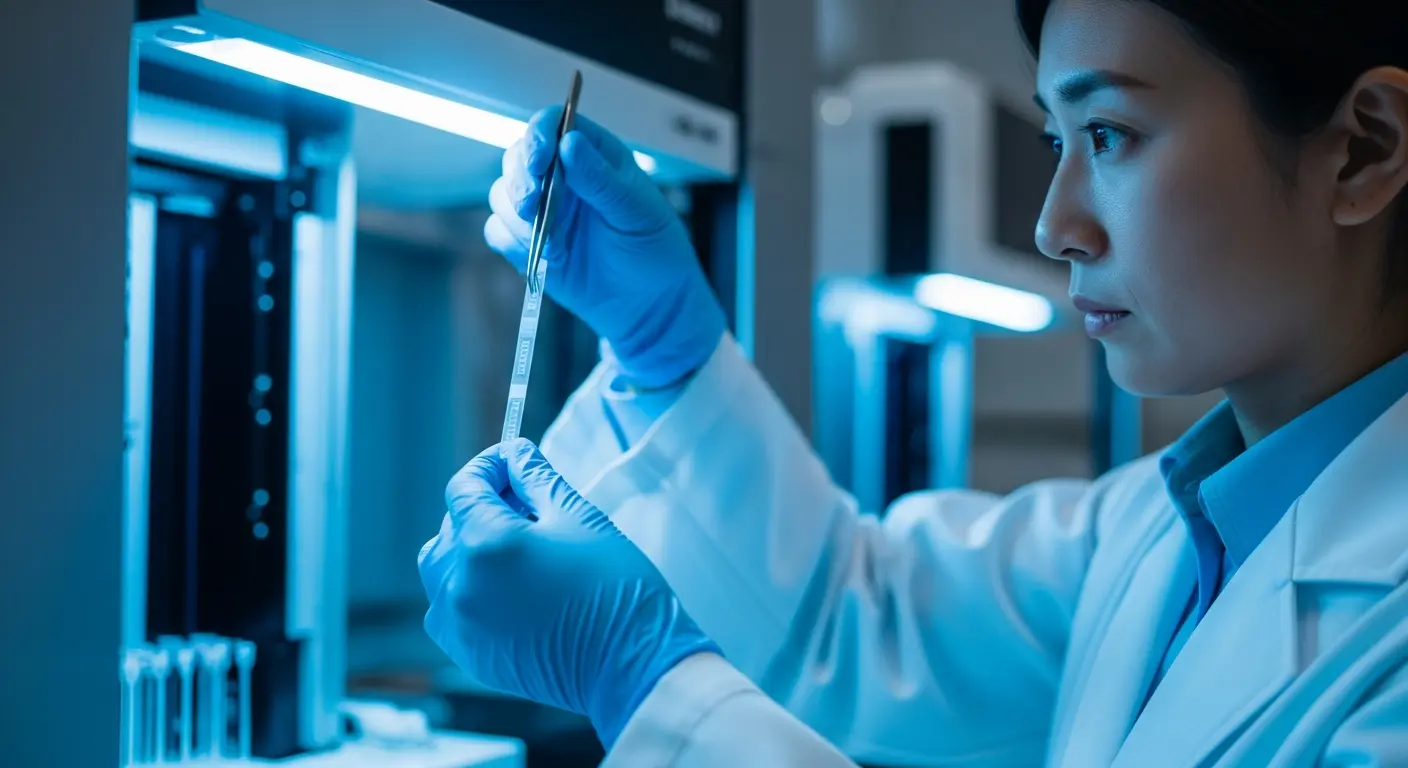
A research team at China's Southern University of Science and Technology (SUSTech) has developed an innovative DNA data storage technology that applies the mechanics of the 1980s cassette tape [ref:1]. This technology combines a recording density that overwhelms conventional electronic media (HDDs, SSDs) with an ultra-long-term storage lifespan. A conventional cassette tape records audio or video as a magnetic signal on plastic film coated with a magnetic substance. This "DNA cassette tape," on the other hand, adopts a groundbreaking method of chemically fixing DNA molecules onto a nylon tape and converting digital information into DNA base sequences (the four letters A, T, G, and C) for recording.
This idea, which cleverly repurposes the existing concept of the cassette tape, is not merely nostalgic—it is grounded in the scientific rationality that the physical "linear structure" of tape is extremely well suited to the chain-like structure of DNA. Just as magnetic tape "records and plays back data in sequence," DNA strands can likewise hold data as a "sequence of bases arranged in a row," making the tape-type format extremely sensible.
1.5 Million Times the Capacity of a Smartphone and a 20,000-Year Storage Lifespan
 The standout feature of this technology is its overwhelming storage capability. The smartphones we commonly use today generally have a storage capacity of around 256GB to 1TB, but DNA cassette tape has a recording capacity on a scale that far surpasses this. The notable figures and performance metrics are as follows [ref:1].
- Recording capacity: Approximately 362 petabytes (PB) on 1km of DNA tape. This is equivalent to about 362,000 terabytes, matching roughly 18,000 units of the largest-capacity HDD currently on the market (about 20TB).
- Comparison: It is theoretically possible to compress about 1.5 million times the data volume of a typical smartphone into the size of a palm. Even all the music data humanity has ever produced is said to fit within a fraction of this capacity [ref:4].
- Storage lifespan: Over approximately 300 years at room temperature. When frozen (minus 20 degrees), the integrity of the data is estimated to be maintained for over 20,000 years.
- Durability: Stability that far exceeds conventional hard disks (lifespan of about 3–10 years) or SSDs (lifespan of about 5–10 years). There is also no risk of degradation from electromagnetic pulses (EMP) or magnetism.
Why can DNA achieve such a high recording density? The reason comes down to the fact that DNA is a "nanoscale molecule." By converting the smallest unit of digital data—bits (0s and 1s)—into the four types of DNA base molecules (A, T, G, C) for storage, it becomes possible to pack an enormous amount of information into an extremely tiny space. In theory, 1 gram of DNA can store about 215 petabytes (215,000TB) of data, a figure that overwhelms any existing storage technology [ref:5].
The Technical Breakthrough: Why "Tape"?
In previous DNA storage research, the mainstream approach was to store DNA fragments dispersed in liquid, which made it extremely difficult to quickly retrieve specific pieces of data. DNA molecules in liquid mix together, so a complex process of PCR (polymerase chain reaction) and sequencing was required just to identify "which molecule holds which piece of data." By mimicking the physical structure of cassette tape, this research team at Southern University of Science and Technology brilliantly solved the following challenges [ref:2].
- Random access (individual retrieval): By placing microscopic barcodes (address markers) on the nylon tape and assigning a unique address to each data write location, it became possible to identify and read out only the needed data. This is a capability that was difficult to achieve with conventional liquid-based DNA storage, offering operability similar to "selecting and opening a file" as with a USB drive or HDD.
- Rewritability: Through chemical processing (using special enzymatic reactions and chemical reagents), the team introduced a mechanism to erase DNA information at a specific location and overwrite (reuse) it with new data. Conventional DNA storage had the constraint of being "write-once, unable to change," but this technology makes a "record → erase → re-record" cycle possible, just like a cassette tape.
- Physical organization: By fixing DNA onto a single tape rather than dispersing it in liquid, compatibility with computer data management (file structures) has improved dramatically. The physical format of tape has the major advantage of integrating easily with existing data management systems (file systems).
The Basic Principles of DNA Storage
To understand the basic mechanism of DNA data storage, let's walk through the process step by step. Roughly speaking, there are three major stages from converting digital data into DNA to reading it back out again.
- Encoding: Digital data (a string of 0 and 1 bits) is converted into a sequence of DNA bases (A, T, G, C). For example, rules are set such as mapping "00" to A, "01" to T, "10" to G, and "11" to C, translating any digital file (image, video, document, etc.) into a DNA sequence. Redundant codes for error correction are also incorporated at this stage.
- Synthesis (writing): Based on the encoded base sequence, artificial DNA molecules are chemically synthesized. In the case of DNA cassette tape, the synthesized DNA fragments are chemically fixed at a specific position on the nylon tape, along with barcode information that assigns a physical address.
- Sequencing (reading): When retrieving data, the barcode on the tape is scanned to locate the target DNA fragment, and the base sequence is read using a device such as a next-generation sequencer (NGS) or nanopore sequencer. The sequence that is read is then restored to the original digital data through a decoding algorithm.
What matters throughout this entire process is that the technology repurposes DNA's inherent ability to "accurately replicate and preserve information" for artificial data recording. Living organisms have a track record of storing and transmitting genetic information using DNA over billions of years, and applying this natural mechanism to digital storage is an extremely rational approach from a scientific standpoint [ref:5].
Key Use Cases and Benefits
This technology is expected to be used as "cold storage" for data that is rarely accessed but must never be lost. Data centers around the world currently consume an enormous amount of electricity—reaching a level comparable to the total electricity consumption of some nations. Because DNA storage requires no electricity at all while data is being stored, it could serve as a fundamental solution to this problem.
- Archiving public records and historical materials: Records of civilization spanning thousands of years, national legal documents, digital archives of cultural heritage, and other intellectual property of humanity can be preserved for an ultra-long term. This is also an effective means of minimizing the risk of data loss from natural disasters or war.
- Scientific research data: Vast research logs such as space observation data, experimental data from the Large Hadron Collider (LHC), and genome analysis can be stored long-term in a space-efficient and low-cost manner. Particularly in the field of genomic science, demand for DNA storage is rising as a destination for the genome data that is rapidly accumulating around the world.
- Energy reduction: By dramatically reducing the electricity needed to maintain data centers (cooling and operation), this technology contributes significantly to achieving carbon neutrality. Because DNA can hold information with zero electricity, it has the potential to fundamentally resolve the enormous energy consumption problem of current data centers.
- Ultra-long-term storage of personal data: This technology is also expected to be used as a means of reliably passing down personal digital assets across generations—family photos, videos, medical records, and other things "rarely viewed, but never to be lost."
Challenges to Practical Implementation
Of course, challenges remain. At present, reading and writing data takes time—restoring just a few image files can take nearly an hour. For this reason, it is not meant to replace the everyday memory of a smartphone or a computer's SSD, but is instead expected to be used as "cold storage" for storing "precious data that is rarely viewed but must never be lost", such as public records, scientific data, or family photos. The main factors currently hindering widespread adoption are as follows.
- Read/write speed: DNA synthesis (writing) and sequencing (reading) take several hours, making the technology unsuited to real-time processing at present. However, next-generation sequencer technology is getting faster every year, and this challenge is expected to improve significantly in the future.
- Cost: Because chemical synthesis of DNA is expensive, further cost reduction is needed for commercial use. At present, writing 1MB of data to DNA is said to cost several thousand dollars, but just as semiconductor technology became dramatically cheaper over the past few decades, DNA synthesis technology is also seeing costs fall at a pace comparable to Moore's Law.
- Standardization challenges: International standards for encoding methods, error-correction algorithms, and physical formats have not yet been established, so data compatibility between different research institutions is not guaranteed. Going forward, discussion needs to progress at international standards bodies such as ISO and IEEE.
Global Trends in DNA Storage Research
Research into using DNA as a data storage medium is not limited to Southern University of Science and Technology's "DNA cassette tape." Universities and companies around the world are vigorously pursuing research and development in this field. In 2012, Professor George Church and his team at Harvard University succeeded in storing the data of an entire book (about 700KB) in DNA, demonstrating to the world the feasibility of DNA storage [ref:5]. In 2017, a team at Columbia University succeeded in an experiment to record and restore an entire operating system (about 2.14MB) in DNA, demonstrating improved efficiency through a combination with data compression technology.
Furthermore, major technology companies such as Microsoft and Twist Bioscience are also expanding their investment toward the commercialization of DNA storage. In 2019, Microsoft developed a prototype system that automates the entire process from writing data to DNA through to reading it back out. As these public- and private-sector efforts accelerate, the timeline for DNA storage to reach a practical level may arrive sooner than initially expected [ref:3]. In Japan as well, research is progressing on technology to encapsulate DNA in capsules to store data equivalent to 50,000 smartphones, drawing attention as a new paradigm for data storage [ref:3].
Summary: The Future of Data Storage
The "DNA cassette tape" is the ultimate backup medium, fusing biological information storage methods with the analog concept of magnetic tape. Physical limits (the end of Moore's Law) are approaching for the miniaturization of silicon (semiconductor) chips, and improving recording density along the same conventional trajectory is becoming difficult. Amid this situation, biostorage technology that harnesses DNA—the "ultimate nanoscale storage" produced by nature—is likely to become a powerful means of reliably carrying humanity's digital heritage thousands, even tens of thousands, of years into the future.
Of course, challenges remain in terms of everyday data processing speed and cost, but if technological progress and cost reduction continue, the day may come, not too far off, when "storing important data in DNA" becomes a common option. Attention will continue to focus on the new frontier opened up by the fusion of life sciences and digital technology.
 Apply / Purchase a Kit
Frequently Asked Questions
Q1. What is DNA cassette tape?
A. DNA cassette tape is an innovative data storage technology developed by China's Southern University of Science and Technology. It applies the physical structure of the 1980s cassette tape, chemically fixing DNA molecules onto a nylon tape to store digital data. In theory, 1km of tape can record about 362 petabytes of data (equivalent to about 1.5 million smartphones), and it is said to be storable for over 20,000 years when frozen [ref:1].
Q2. How is digital data written to DNA?
A. Digital data (a string of 0 and 1 bits) is converted (encoded) into a sequence of DNA's four types of bases (A, T, G, C). The converted DNA sequence is chemically synthesized and fixed at a specific position on the tape. When retrieving data, a sequencer decodes the base sequence and restores (decodes) it back into the original digital data [ref:2].
Q3. What advantages does it have over conventional HDDs and SSDs?
A. It has advantages in three main areas. First, "recording density"—1 gram of DNA can theoretically hold about 215PB of data. Second, "storage lifespan"—compared to an HDD's 3–10 years, DNA lasts about 300 years at room temperature and over 20,000 years when frozen. Third, "energy efficiency"—DNA requires no electricity at all while data is stored. However, it still lags behind conventional media in read/write speed and cost.
Q4. Can DNA cassette tape be rewritten (overwritten)?
A. Yes, one of the major breakthroughs of this research is "rewritability." Chemical processing can erase the DNA information at a specific location on the tape and overwrite it with new data. Conventional DNA storage was "write-once, unable to change," but this technology makes reuse possible, just like a cassette tape [ref:2].
Q5. Will the day come when ordinary people can use DNA cassette tape?
A. At present it is still at the research stage, and challenges remain such as slow read/write speed (about an hour to restore a few images) and the high cost of DNA synthesis. However, the cost of DNA synthesis technology is falling rapidly year by year, and major IT companies such as Microsoft are also pursuing research toward commercialization. Practical implementation is likely to begin first with archival use by government agencies and research institutes, with the possibility of it eventually being offered to the general public as an ultra-long-term backup service [ref:3].
Q6. Can data stored in DNA storage become corrupted?
A. DNA is a chemically very stable molecule, but it can degrade due to environmental factors such as high temperature, ultraviolet light, and oxidation. However, if stored in an appropriate environment (cool, dry, and shielded from light), data integrity can be maintained for thousands to tens of thousands of years. In addition, by incorporating error-correction codes at the time of writing, a mechanism is in place to accurately restore the original data even if part of the base sequence is damaged.
Reassuring Support from the seeDNA Institute of Genetic Medicine
The seeDNA Institute of Genetic Medicine is a trusted specialist in DNA testing and genetic testing that holds ISO9001 international quality certification and the Privacy Mark for privacy protection.
If you are troubled by questions of family or parent-child blood relationships, or a partner's infidelity, our DNA testing specialists are here to support you so you can feel truly at ease—please feel free to contact us.
[Free Consultation with Specialist Staff]

If you have any questions,
please feel free to contact our toll-free number.
\Open every day, including weekends/
Business hours: Mon-Sun 9:00 AM-6:00 PM
(excluding public holidays)
 Author
Yoshinori Tomikane, M.D., Ph.D.
Graduated from the master's/doctoral program in Biosystem Studies / Molecular and Regulatory Medicine at the University of Tsukuba
In 2017, developed prenatal DNA testing(Patent 7331325) using Japan's first trace-DNA analysis technology(Patent 7121440)