
Last revised: December 7, 2025
DNA testing analyzes the STR profile (genetic fingerprint) to scientifically prove personal identity and blood relationships. Through PCR amplification and precise STR analysis, it achieves an extremely high level of reliability, with a misjudgment probability of less than one in a trillion.
- ・What Is DNA Testing?
- ・DNA Is a "Fingerprint That Contains the Body's Blueprint"
- ・What Is STR? The True Identity of the "Genetic Fingerprint"
- ・How DNA Testing Works, Step by Step
- ・How to Read the Results and Their Reliability
- ・Main Uses of DNA Testing
- ・The Difference Between Legal and Private Testing
- ・The Technical Background Behind the Accuracy of STR Analysis
- ・Points to Know Before Undergoing DNA Testing
- ・Summary
What Is DNA Testing?

DNA testing is a forensic science examination that identifies individuals and blood relationships by analyzing the DNA contained in a person's body. It is used around the world as a highly reliable method for confirming parent-child relationships, criminal investigations, and identifying missing persons. The history of DNA testing goes back to the 1980s, when British geneticist Dr. Alec Jeffreys developed a personal identification technique called "DNA fingerprinting" in 1984 [ref:1][ref:7]. Since then, as the technology has advanced, DNA testing has become increasingly precise, and today it is used in a wide range of situations, from legal proceedings to personal confirmation. In Japan as well, the Ministry of Justice has introduced cases in which DNA testing is used to confirm parent-child relationships, and the National Research Institute of Police Science under the National Police Agency also positions it as an important tool for criminal investigations [ref:2][ref:3].
DNA Is a "Fingerprint That Contains the Body's Blueprint"
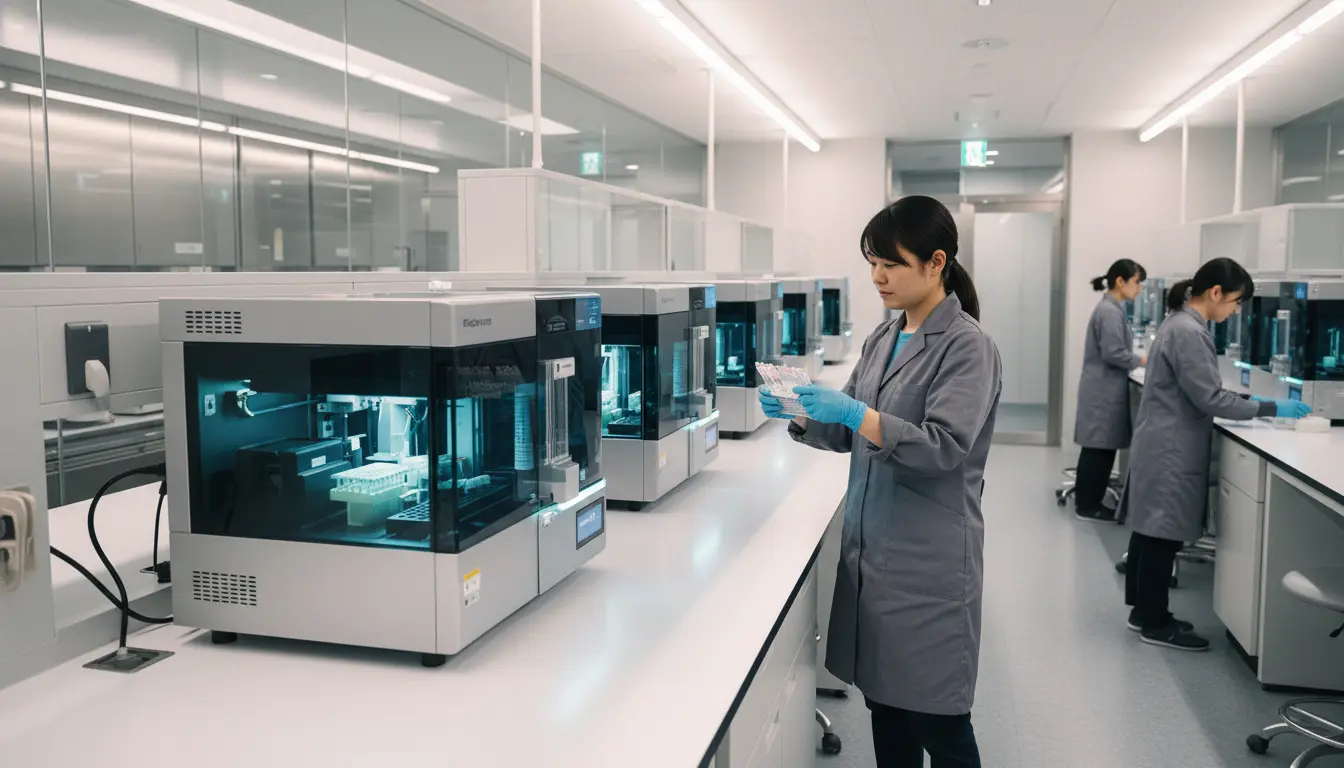
DNA is present in every cell and can be detected from even a tiny sample, such as hair, blood, or a bit of skin. DNA is a molecule made up of four types of bases (A, T, G, and C) arranged in sequence, and it functions as a kind of "blueprint" that determines the characteristics of our bodies. Human DNA consists of about 3 billion base pairs and contains roughly 20,000 to 25,000 genes. About 99.9% of DNA is shared between any two people, but the remaining 0.1% is the part that differs from person to person, and examining that difference makes it possible to identify "whose DNA it is." In terms of base count, this 0.1% difference amounts to about 3 million locations — more than enough information to identify an individual. DNA has a double helix structure and is copied precisely every time a cell divides, so the same DNA information can be obtained no matter which part of the body it is taken from. This property is exactly what underpins the reliability of DNA testing [ref:2][ref:3].
What Is STR? The True Identity of the "Genetic Fingerprint"

DNA testing focuses heavily on a region called "STR" (Short Tandem Repeat). An STR is a region where a specific short base sequence (usually 2 to 6 bases) repeats many times, and the number of repeats differs from person to person. Currently, in the internationally widespread CODIS (Combined DNA Index System), 20 STR regions are used as the standard [ref:4]. For example, in a certain DNA region, a base sequence such as "GATA" might repeat
- Person A: 10 repeats
- Person B: 13 repeats
— showing this kind of difference. The pattern created by analyzing and lining up this information across multiple STR regions is the "STR profile" — the genetic fingerprint. Except for identical twins, no two people have exactly the same STR profile. The great advantages of STR are that it can be easily amplified by PCR, it can be analyzed even from old, degraded DNA samples, and many regions can be analyzed simultaneously (multiplex analysis). Thanks to these characteristics, STR analysis has become established as the global standard method in DNA testing today [ref:5][ref:8].
How DNA Testing Works, Step by Step
DNA testing proceeds through several steps, from sample collection to result reporting. Each step is carried out under strict quality control to ensure accuracy.
- Sample collection
The inside of the cheek is swabbed with a cotton swab to collect oral mucosal cells. A variety of samples can be used as long as human cells are attached, including blood, hair (with the root attached), nails, and toothbrushes. In criminal investigations, saliva or skin fragments left at the scene are also used. - DNA extraction
DNA is chemically extracted from the collected cells. Reagents that break down cell membranes and proteins are used to isolate and purify pure DNA molecules. - Amplifying the DNA with PCR
A technique called "PCR (polymerase chain reaction)" is used to amplify the necessary DNA region by millions of times. This groundbreaking technology, which increases DNA exponentially by repeatedly raising and lowering the temperature, is also known for earning Dr. Kary Mullis the Nobel Prize in Chemistry in 1993 [ref:6]. - Analyzing the STR regions
The amplified DNA is read using a capillary electrophoresis instrument to create each person's STR profile. Fluorescently labeled primers are used, and multiplex PCR is employed to analyze multiple STR regions simultaneously. - Comparing the results
In paternity testing, it is confirmed — based on Mendel's laws of inheritance — whether the child's STR pattern includes one copy inherited from each parent. In criminal cases, it is statistically determined whether the DNA found at the scene matches the suspect's STR profile.
How to Read the Results and Their Reliability
DNA test results are presented as probabilities. In paternity testing, a "probability of paternity of 99.99% or higher" indicates a parent-child relationship, while 0% indicates no parent-child relationship. This probability is calculated based on the "combined paternity index (CPI)," and the more STR regions analyzed, the higher the accuracy achieved. Personal identification using STR analysis is extremely precise, with a misjudgment probability of less than one in a trillion. This level of accuracy is achieved by simultaneously analyzing 20 or more STR regions, and even when a parent-child relationship is ruled out, mismatches are confirmed across multiple STR regions, keeping the risk of false negatives extremely low [ref:5][ref:9].
Main Uses of DNA Testing
DNA testing technology is used in many different areas of modern society.
- Confirming parent-child and family relationships (parent-child, grandparent, siblings, etc.) — used for legal procedures such as family register corrections, inheritance, and child support claims, as well as for personal confirmation purposes.
- Criminal investigations (identifying perpetrators, matching victims) — DNA samples left at crime scenes are compared with a suspect's DNA to help resolve cases.
- Identifying remains (identification in disasters or incidents) — an essential means of identifying victims' remains in large-scale disasters or accidents.
- Medicine and research (genetic disease screening, ancestry analysis, etc.) — also applied to assessing the risk of hereditary diseases and to ancestry analysis for learning about one's roots.
- Animal pedigree verification and conservation — DNA testing is also used to certify the pedigree of pets and livestock and to help conserve rare animal species.
The Difference Between Legal and Private Testing
When requesting DNA testing, there are broadly two types: "legal testing" and "private testing."
- Legal testing: Testing with official legal effect that can be used in court proceedings or family register procedures. Identity verification, third-party witnessing, and evidence preservation are carried out strictly, making it suitable for paternity suits or inheritance disputes.
- Private testing: Intended for personal use, such as confirmation within a family. It can be carried out simply by collecting a sample at home with a kit and mailing it in, but it has no legal effect. Its main advantage is lower cost.
| Item | Legal Testing | Private Testing |
|---|---|---|
| Legal effect | Yes | No |
| Identity verification / witnessing | Required | Not required |
| Main use | Court proceedings / family register procedures | Personal confirmation |
The Technical Background Behind the Accuracy of STR Analysis
Behind DNA testing's remarkable accuracy of "less than one in a trillion" lies the increase in the number of STR regions analyzed. Early DNA testing could only analyze a few STR regions, but today's multiplex kits can analyze 20 or more regions simultaneously. As the number of regions analyzed increases, the probability of a chance match decreases exponentially [ref:5].
The development of capillary electrophoresis has also contributed greatly to improved accuracy. By electrically separating fluorescently labeled DNA fragments within a thin capillary tube and detecting them with a laser, even a difference of a single base in length can be accurately identified. Furthermore, in recent years, STR analysis using next-generation sequencers (NGS) has become increasingly practical, making it possible to detect subtle differences that could not be distinguished with conventional methods [ref:1][ref:8].
Points to Know Before Undergoing DNA Testing
- Check the reliability of the testing institution: Whether it holds ISO certification or Japan's Privacy Mark (P-Mark) is an important indicator for judging its quality control system.
- Be careful when handling samples: To prevent contamination of the collected sample, it's important to follow the instructions in the collection kit, such as not touching the swab tip with bare hands.
- Choose the right type of test for your purpose: If the result will be used for legal procedures, be sure to choose legal testing. Results from private testing have no legal effect.
- Be prepared for how you'll receive the results: DNA test results can have a major impact on one's life. Consulting with a lawyer or counselor beforehand is one option worth considering.
- Protecting privacy: DNA information is the ultimate form of personal data. Choose a trustworthy institution and check its data management policy after testing as well.
Summary
DNA testing is a technology that scientifically reveals personal identity and blood relationships by reading the STR profile, the "genetic fingerprint." Thanks to PCR amplification and precise STR analysis technology, modern DNA testing offers an extremely high level of reliability. By simultaneously analyzing 20 or more STR regions, the probability of misjudgment is kept below one in a trillion, and paternity testing can prove a parent-child relationship with a probability of 99.99% or higher. With both legal and private testing options available, you can choose the method that suits your purpose. It's fair to say that "your genes are evidence that exists nowhere else in the world." If you have any questions or concerns about DNA testing, please feel free to contact the specialist staff at seeDNA Genetic Medicine Research Institute.
Frequently Asked Questions
Q1. What is the "STR profile" used in DNA testing?
A. An STR profile is a summary created by analyzing the pattern of "repeats of a short base sequence (STR)" found at multiple locations in the DNA. Since the number of repeats differs from person to person, combining multiple STR regions means that, except for identical twins, no one else in the world is thought to have the same pattern. For this reason it is also called a "genetic fingerprint," and it is used to identify individuals and determine blood relationships.
Q2. How long does it take to get DNA test results?
A. Results are typically available within 3 to 5 business days after the sample arrives. However, depending on the condition of the sample and the type of test, additional time may be required. seeDNA Genetic Medicine Research Institute also offers an expedited option, so please contact us if you're in a hurry.
Q3. How reliable is the accuracy of DNA testing?
A. With modern personal identification using STR analysis, the probability of misjudgment is less than one in a trillion. In paternity testing, if a parent-child relationship exists, it is determined to be "a parent-child relationship" with a probability of 99.99% or higher, and if no such relationship exists, it is determined to be "not a parent-child relationship" with 100% certainty. This high level of reliability is achieved by analyzing 20 or more STR regions.
Q4. How should I decide between legal testing and private testing?
A. If you plan to use the result for legal procedures such as court proceedings, paternity recognition, family register correction, or inheritance, please choose "legal testing." In legal testing, identity verification, third-party witnessing, and evidence preservation are all carried out strictly, and a report with official legal effect that can be submitted to a court is issued. On the other hand, if you simply want to confirm something personally, "private testing" is sufficient. Private testing can be completed simply by collecting a sample at home and mailing it in, and it costs less than legal testing.
Q5. What kinds of samples can be used for DNA testing?
A. The most common sample is oral mucosa (collected by swabbing the inside of the cheek), but testing is also possible from a variety of samples containing human cells, such as blood, hair (with the root attached), nails, toothbrushes, cigarette butts, chewed gum, and used cups. However, depending on the condition of the sample, extracting DNA may be difficult, so please consult with the testing institution in advance.
Q6. Could a third party find out about my DNA test results?
A. seeDNA Genetic Medicine Research Institute holds the international quality standard ISO9001 and Japan's Privacy Mark (P-Mark), and maintains a strict system for managing personal information. Test results are only communicated to the client themselves and will not be disclosed to any third party without the client's consent. Because DNA information is the ultimate form of personal data, it is handled under a thorough security system.
The Reassuring Support of seeDNA Genetic Medicine Research Institute
seeDNA Genetic Medicine Research Institute is a trusted specialist institution for DNA testing and genetic testing, holding the international quality standard ISO9001 and the Privacy Mark (P-Mark) for privacy protection.
If you're troubled by questions about family or parent-child blood relationships, or a partner's infidelity, our DNA testing experts are here to support you so you can feel at ease — please feel free to contact us.
[Free Consultation with Specialist Staff]

If you have any questions,
please feel free to contact our toll-free number.
/Open every day, including weekends/
Business hours: Monday-Sunday 9:00-18:00
(excluding holidays)
 Reviewed by
M.D. / Testing Staff: L. L.
After earning a doctorate in clinical medicine from the Graduate School of the International University of Health and Welfare, joined seeDNA as a testing staff member.
Handles testing and data analysis for prenatal parent-child DNA testing.
[References]
(2) Science, December 1985
(3) Science Portal - Japan's Latest Science and Technology Information Site, February 2008
(4) For Those Without Family Registration
(5) National Police Agency
(6) Guidelines on DNA Testing, December 2019
(7) J Oncol, 2012
(8) NobelPrize.org
(9) Forensic Sci Int Genet, January 2013