
Revised: October 17, 2025
This article explains in detail the miscarriage and complication risks associated with definitive diagnostic amniocentesis and chorionic villus sampling, based on the latest research data. It covers how the tests work, specific risk figures, confined placental mosaicism, and precautions for multiple pregnancies.
When you want a more accurate picture of your baby's health during pregnancy, many people hear about definitive diagnostic tests — amniocentesis and chorionic villus sampling (CVS). These are among the most accurate prenatal tests, allowing direct confirmation of chromosomal abnormalities or genetic disorders. However, while accuracy is high, what worries expectant mothers and their families most is often the "risk."
If a screening test such as NIPT comes back positive, or if there are risk factors such as advanced maternal age or family history, doctors may suggest one of these invasive tests as a definitive diagnosis. At that point, many people wonder, "How high is the risk of miscarriage?" or "Will there be any effect on the baby?"
This article explains, based on the latest large-scale research data, the miscarriage and complication risks associated with amniocentesis and chorionic villus sampling in an easy-to-understand way. Knowing the actual figures and the nature of the risks accurately is the first step toward choosing a test with peace of mind.
- ・What Is a Definitive Diagnosis? Basics of Amniocentesis and CVS
- ・Risks of Amniocentesis
- └ Miscarriage risk
- └ Other complications
- ・Risks of Chorionic Villus Sampling
- └ Miscarriage risk
- └ Risks specific to CVS
- └ Differences by approach method
- └ Confined placental mosaicism (CPM)
- └ Risks in multiple pregnancies
- ・Comparing the Risks of Amniocentesis and CVS
- ・What You Can Do to Minimize Risk
- ・Summary
What Is a Definitive Diagnosis? Basics of Amniocentesis and CVS
 Prenatal tests are broadly divided into two categories: "non-definitive tests (screening tests)" and "definitive tests (definitive diagnosis)." NIPT (non-invasive prenatal testing), combined testing, and maternal serum marker testing are all screening tests, which assess the "possibility" that the fetus has a chromosomal abnormality. Even if these tests come back positive, it does not necessarily mean the fetus actually has an abnormality [ref:6].
Amniocentesis and CVS, on the other hand, are classified as "definitive tests." Because they directly collect fetal cells for chromosome and gene analysis, they boast a diagnostic accuracy of over 99% [ref:4]. However, because they are invasive tests that directly approach the tissue surrounding the fetus, the fact that the risk of miscarriage is not zero is a major difference from screening tests.
Whether to undergo a definitive diagnostic test is decided by comprehensively weighing the results of screening tests, age, family genetic history, and the values of the expectant mother and her family. For this reason, it is extremely important to fully understand the nature and degree of the risks before undergoing the test.
Risks of Amniocentesis
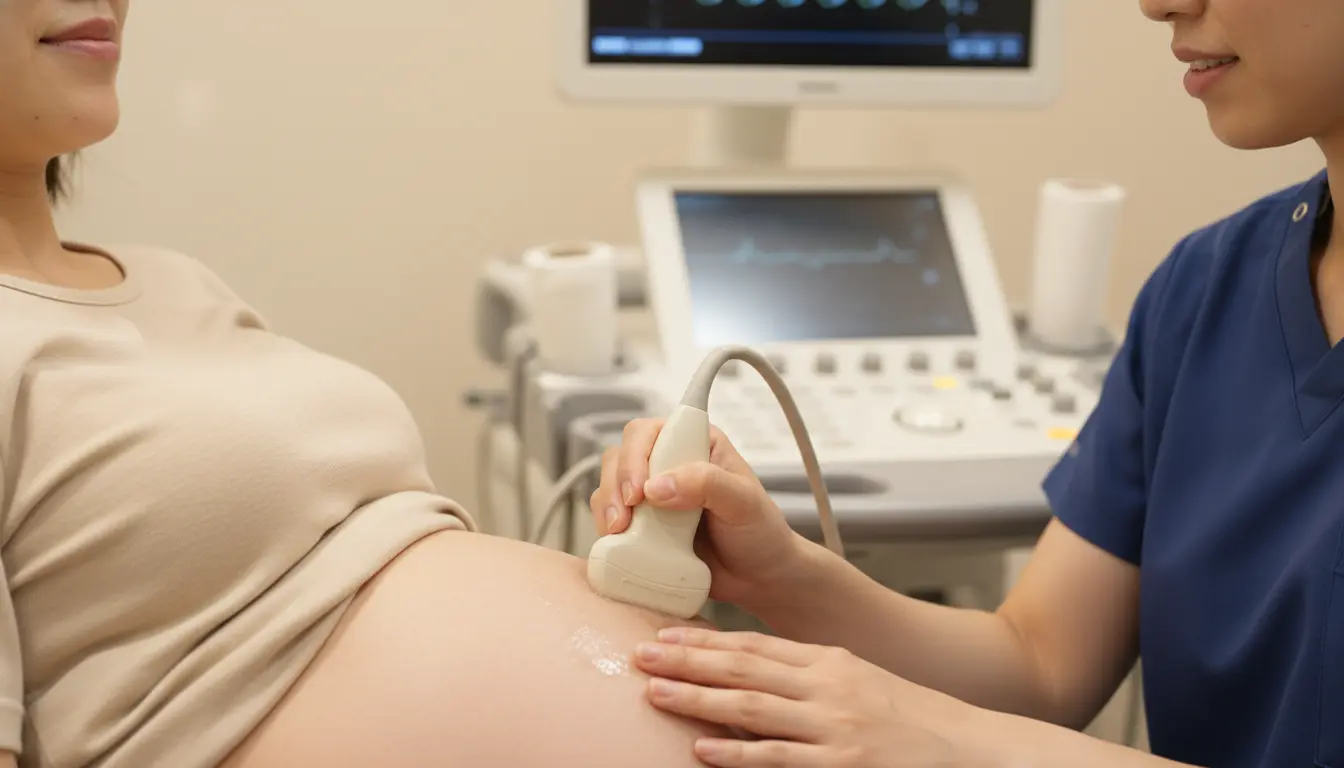
Amniocentesis is a definitive diagnostic method performed from 15 weeks of pregnancy onward. While confirming the position with ultrasound, a thin needle is inserted into the mother's abdomen to collect a small amount of amniotic fluid (usually about 15-20ml) surrounding the fetus. The amniotic fluid contains cells derived from the fetus, and by culturing these cells and analyzing the number and structure of chromosomes, it is possible to examine in detail the presence of chromosomal abnormalities such as Down syndrome (trisomy 21) and certain genetic disorders.
Amniocentesis has a long history and has been widely performed around the world as a prenatal definitive diagnostic test. The test itself usually takes about 10-15 minutes and can be done as an outpatient procedure in a single day. It usually takes about 2-3 weeks to get results from the collected amniotic fluid.
Miscarriage risk
The most important risk to be aware of with amniocentesis is miscarriage.
According to a large-scale systematic review and meta-analysis published in 2019, the miscarriage risk attributable to amniocentesis is reported to be about 0.3% (about 3 in 1,000 cases) [ref:1]. Meanwhile, another meta-analysis published in 2015 puts the risk at about 0.1% (about 1 in 1,000 cases) [ref:2].
While there is some variation between studies, both figures are lower than the older estimate of "1 in 200-300 (0.3-0.5%)." This is thought to be due to advances in ultrasound guidance technology and improvements in testing technique. However, since the risk is not "zero," thorough informed consent (explanation and agreement) is required before undergoing the test [ref:7].
Other complications
In addition to miscarriage, the following complications have been reported:
- Infection
Intrauterine infection (such as chorioamnionitis) can occur after amniocentesis. However, according to guidelines from the International Society of Ultrasound in Obstetrics and Gynecology (ISUOG), the risk is less than 0.1%, and it can largely be prevented with proper sterile technique [ref:3]. If infection occurs, symptoms such as fever, abdominal pain, or abnormal discharge may appear, so it is important to see a medical provider immediately if such symptoms are noticed after the test. - Amniotic fluid leakage
A small amount of amniotic fluid may leak from the needle insertion site after the test, occurring at a rate of about 1-2% [ref:3]. In most cases it stops naturally and amniotic fluid volume recovers in a short time, but in rare cases, persistent leakage can lead to intrauterine infection or miscarriage. Note that, compared with spontaneous rupture of membranes at the same gestational age, the risk of miscarriage from test-related amniotic fluid leakage is considered lower [ref:3]. - Direct fetal injury
If the needle is inserted without ultrasound guidance, the fetus may very rarely be injured. Reported cases include eye trauma, skin or tendon injury, vascular injury, and even brain injury, but since it is standard practice in modern medicine to perform the test while confirming the fetus's exact position in real time with ultrasound, such cases are extremely rare [ref:3]. - Transient abdominal pain or bleeding
Mild abdominal pain or a very small amount of bleeding may be observed after the test. In most cases these resolve naturally within a few days. However, if there is severe abdominal pain or persistent bleeding, you should contact your doctor promptly.
Risks of Chorionic Villus Sampling

Chorionic villus sampling (CVS) is a definitive diagnostic method performed around 10-14 weeks of pregnancy. Chorionic villus tissue, part of the placenta, is collected to examine chromosomal abnormalities and genetic disorders in detail. Whereas amniocentesis is performed from 15 weeks of pregnancy onward, CVS has the major advantage of being able to be performed earlier. This allows results to be obtained earlier, giving the expectant mother and her family more time to consider their future plans.
There are two approach methods: transabdominal CVS (TA-CVS), in which a needle is inserted through the abdomen, and transcervical CVS (TC-CVS), in which a thin catheter or forceps is inserted through the vagina and cervix to collect the sample. The choice of method is made by the doctor based on a comprehensive assessment of the placenta's position, the shape of the uterus, and the mother's build.
Miscarriage risk
The most important risk to be aware of with CVS is also miscarriage.
According to a 2019 systematic review and meta-analysis, the miscarriage risk attributable to CVS is reported to be about 0.2% (about 2 in 1,000 cases) [ref:1]. A separate 2015 meta-analysis also reported a similar figure of about 0.22% [ref:2].
There was once a time when CVS was thought to carry a higher miscarriage risk than amniocentesis, but recent research has shown there is no significant difference between the two. Thanks to improved testing technique and advances in ultrasound technology, both tests can now be performed more safely.
Risks specific to CVS
- Fetal limb defects
If CVS is performed before 9 weeks of pregnancy, there is a slightly increased risk of limb defects in the fetus. However, this is an extremely rare occurrence, and performing the test from 10 weeks of pregnancy onward greatly reduces this risk [ref:4]. Based on this finding, it is now the international standard not to perform CVS before 10 weeks of pregnancy. - Maternal bleeding
With the transcervical method, a small amount of temporary bleeding may occur. This happens when a catheter is inserted through the cervix, and it usually stops naturally. However, women taking anticoagulant medication may have a somewhat higher risk of bleeding, so it is important to be sure to discuss any medications you are taking with your doctor before the test [ref:4]. - Infection
The risk of infection after the test is reported to be very low, at less than 0.5% [ref:4]. However, if the mother has a blood-borne infection such as HIV or hepatitis (B or C), the test may increase the risk of mother-to-child (vertical) transmission, so it is necessary to receive thorough explanation before the test and carefully weigh the risks and benefits. - Rh incompatibility
If the mother's blood type is Rh-negative and the fetus is Rh-positive, the test may cause the mother's and fetus's blood to mix, leading to the production of anti-D antibodies in the mother, which can cause fetal hemolytic disease. For this reason, Rh incompatibility is a relative contraindication, and it is common practice to administer anti-D immunoglobulin before and after the test for Rh-negative mothers [ref:4].
Differences by approach method
There are some differences in the complications that can occur between the transabdominal and transcervical methods. The transcervical method is somewhat more prone to bleeding, while the transabdominal method may cause pain at the needle insertion site. However, it has been reported that there is no significant difference in overall miscarriage risk or the rate of serious complications between the two [ref:2]. In actual clinical practice, doctors choose whichever method allows for safer and more reliable sample collection, based on the placenta's position (anterior, posterior, etc.) and the mother's physical condition.
Confined placental mosaicism (CPM)
CVS carries a unique issue known as confined placental mosaicism (CPM). This is estimated to occur in about 1-2% of all cases [ref:4].
What is confined placental mosaicism?
Normally, the placenta and the baby develop from the same fertilized egg and should therefore carry the same chromosomal information. However, during early cell division, a chromosomal change can occur in only some of the cells that make up the placenta. In this case, a discrepancy arises in which CVS may show "an abnormality" even though the baby itself has normal chromosomes.
Conversely, in rare cases the placenta's chromosomes may be normal while the baby has a chromosomal abnormality (true mosaicism), which has been reported at a frequency of about 10% [ref:4].
If there is a suspected discrepancy between the CVS results and clinical findings, a follow-up amniocentesis may be performed in the second trimester (15 weeks or later) to confirm. This kind of step-by-step testing makes it possible to arrive at a more accurate diagnosis.
Risks in multiple pregnancies
In twin or higher-order multiple pregnancies, the risk of complications tends to be somewhat higher compared with singleton pregnancies. This is thought to be partly because a sample must be collected separately for each fetus in a multiple pregnancy, making the procedure more complex. However, the increase in risk is often not statistically clear, and a 2020 study has shown that the procedure can be performed safely when carried out by an experienced doctor using an appropriate method [ref:5]. For multiple pregnancies, it is recommended to have the test performed at a facility with more experience.
Comparing the Risks of Amniocentesis and CVS
Here is a comparative summary of the main risks of both tests.
| Item | Amniocentesis | CVS |
|---|---|---|
| Timing | 15 weeks of pregnancy or later | Around 10-14 weeks of pregnancy |
| Miscarriage risk | About 0.1-0.3% | About 0.2-0.22% |
| Specific risk | Amniotic fluid leakage (1-2%) | Confined placental mosaicism (1-2%) |
As shown above, the miscarriage risk for both tests is under 1%, and safety has improved significantly thanks to advances in medical technology in recent years [ref:1] [ref:2]. The difference in testing timing is often the biggest factor in choosing between them: CVS tends to be chosen when earlier results are desired, while amniocentesis tends to be chosen when certainty is prioritized.
What You Can Do to Minimize Risk
While the risk of a definitive diagnostic test cannot be reduced to zero, keeping the following points in mind can help minimize it.
- Choose an experienced facility and doctor
The safety of the test depends heavily on the skill and experience of the doctor performing it. Choosing a facility with a high annual case volume can reduce the risk of complications [ref:3]. - Observe the appropriate testing timing
Amniocentesis is recommended from 15 weeks and CVS from 10 weeks of pregnancy. Because CVS performed before 9 weeks has been linked to a risk of limb defects, strictly observing the timing is especially important [ref:4]. - Tell your doctor about any medications you are taking before the test
If you are taking anticoagulant or antiplatelet medication, your bleeding risk may be higher, so be sure to inform your doctor beforehand. - Rest and monitor your condition properly after the test
Avoid strenuous exercise and lifting heavy objects for 24-48 hours after the test, and rest as much as possible. If you notice any abnormalities such as abdominal pain, bleeding, fever, or amniotic fluid leakage, it is important to contact a medical provider immediately. - Make use of screening tests such as NIPT beforehand
NIPT is a non-invasive test that only requires a blood sample from the mother and carries no direct risk to the fetus. If NIPT comes back negative (low risk), unnecessary invasive testing can be avoided. The current standard approach to prenatal diagnosis is a step-by-step one, proceeding to amniocentesis or CVS only when a definitive diagnosis is truly needed [ref:6].
Summary
Amniocentesis and CVS are both definitive diagnostic methods that can directly examine the fetus's chromosomes and genes. While they offer high diagnostic accuracy, they carry certain risks such as miscarriage and infection. Recent large-scale meta-analyses have clearly shown that these risks are lower than previously thought, but they are not "zero."
Also, the likelihood of complications varies depending on factors such as testing timing, placental position, and multiple pregnancy. Because CVS carries the unique issue of confined placental mosaicism, interpreting results requires specialized knowledge.
What matters most is understanding the benefits and risks correctly and then making the choice that is best for you and your family. There is no single "right answer" about whether to undergo testing, and decisions based on a couple's own values and life plans should be respected above all. We hope this article helps ease the concerns of those considering testing and leads to a choice you feel confident about.
If you are concerned about the risks of a definitive diagnostic test and would first like to learn about your baby's health through a non-invasive method, NIPT is also an option. NIPT only requires a blood sample from the mother and is a safe testing method that carries no direct risk to the fetus.
\NIPT — safe for both mother and baby during pregnancy/
 Apply / Purchase a Kit
Frequently Asked Questions
Q1. Specifically, how high is the miscarriage risk from amniocentesis?
A. According to the latest large-scale research, the miscarriage risk attributable to amniocentesis is reported to be about 0.1-0.3% (roughly 1-3 in 1,000 cases). This is lower than earlier estimates, and advances in ultrasound guidance technology and testing technique have contributed to the improved safety.
Q2. Which carries a higher risk, CVS or amniocentesis?
A. Recent research reports the miscarriage risk of CVS at about 0.2% and amniocentesis at about 0.1-0.3%, with no significant difference between the two. However, there are differences in the types of complications: CVS carries the unique issue of confined placental mosaicism, while amniocentesis carries the risk of amniotic fluid leakage.
Q3. What is confined placental mosaicism?
A. Confined placental mosaicism (CPM) refers to a condition in which part of the placenta has a different chromosomal makeup from the baby. Because CVS examines placental tissue, this discrepancy can occur at a rate of about 1-2%. As a result, there are cases where the test shows "an abnormality" even though the baby itself is normal, and confirmation by amniocentesis is performed as needed.
Q4. If NIPT comes back positive, is a definitive diagnostic test mandatory?
A. If NIPT comes back positive, undergoing a definitive diagnostic test (amniocentesis or CVS) is recommended, but the final decision rests with the expectant mother and her family. Because NIPT is a screening test, it may include false positives (cases judged positive even though there is actually no abnormality), so confirmation by a definitive diagnostic test is considered important.
Q5. Is there anything that can be done to reduce the risk of a definitive diagnostic test?
A. Undergoing testing at an experienced facility with an experienced doctor, observing the appropriate testing timing, informing your doctor of any medications you are taking beforehand, and resting properly after the test are all important for minimizing risk. A step-by-step approach — first assessing chromosomal abnormality risk with NIPT and proceeding to a definitive diagnostic test only when necessary — is also recommended.
Q6. Can a definitive diagnostic test be performed in a multiple pregnancy (such as twins)?
A. Yes, amniocentesis and CVS can be performed even in twin or higher-order multiple pregnancies. However, because a sample must be collected separately for each fetus, the procedure becomes more complex and the risk of complications may be somewhat higher. It is recommended that definitive diagnostic testing in multiple pregnancies be performed at a particularly experienced facility.
Reassuring Support from seeDNA Genetic Medicine Research Institute
seeDNA Genetic Medicine Research Institute is a trusted specialist institution for DNA testing and genetic testing, certified with the international quality standard ISO 9001 and Japan's Privacy Mark for privacy protection.
If you have concerns about family or parent-child blood relationships, or a partner's infidelity, our DNA testing specialists are here to support you with peace of mind, so please feel free to contact us.
[Free Consultation with Our Specialist Staff]

If you have any questions
please feel free to contact our toll-free number.
\Open every day, including weekends/
Business hours: Mon-Sun 9:00-18:00
(excluding public holidays)
Author
Doctor of Medical Science, Physician
Tasuku Hiroshige
Doctor of Medical Science; Board-Certified Specialist and Instructor, Japanese Urological Association; Certified Physician, Japanese Society of Cancer Therapy; Certified Specialist, Japanese Society of Anti-Aging Medicine; Certified Occupational Physician, Japan Medical Association; Certified Physician, Japanese Society of Chemotherapy; Certified Physician, Japanese Society for Sexually Transmitted Diseases; Certificate of da Vinci system
Training As a Console Surgeon, and others
After graduating from Kagoshima University School of Medicine in 2010, he built extensive clinical experience as a urologist. In addition to clinical work, he is also actively engaged in academic activities such as presenting at conferences, writing papers, and securing research funding. He holds specialist qualifications across a wide range of fields, including urology, cancer treatment, anti-aging medicine, and infectious disease treatment. He draws on his extensive medical knowledge and skills to provide care tailored to each patient.