
Last revised: August 20, 2024
This article explains in detail why the menstrual cycle and ovulation date alone cannot accurately identify a child's father, and describes reliable methods of confirming parentage through DNA testing, covering both prenatal and postnatal testing approaches.
- - The menstrual cycle and ovulation date cannot accurately confirm paternity
- - The due date and fertilization date are only "estimates"
- - High contraceptive failure rates reveal how uncertain the menstrual cycle really is
- └ Main reasons why estimating paternity from the menstrual cycle is difficult
- - Methods for confirming paternity through blood or DNA testing
- └ (1) Prenatal DNA testing using blood (NIPPT)
- └ (2) Prenatal DNA testing using amniotic fluid
- └ (3) Postnatal DNA testing
- └ Comparison of testing methods
- - The process for undergoing DNA testing
- - Prenatal DNA testing from the specialized DNA testing institution "seeDNA"
The menstrual cycle and ovulation date cannot accurately confirm paternity
 Many people wonder, "If I calculate from my menstrual cycle, can't I figure out who the baby's father is?" However, to state the conclusion up front, the menstrual cycle and ovulation date alone cannot accurately identify the father. Because the ovulation date varies significantly due to individual differences, physical condition, and stress during a given month, the estimated date of fertilization given by an obstetrician is nothing more than a "rough estimate." This article explains, from a specialized institution's perspective, the medical reasons why paternity cannot be determined from the menstrual cycle, along with the various DNA testing methods that can reliably confirm a parent-child relationship.
The due date and fertilization date are only "estimates"
 At obstetrics clinics, pregnant women are given various pieces of information, including fetal size measurements from ultrasound (echo) scans, calculated due dates, calculations back from the last menstrual period, and estimated ovulation and fertilization dates. However, these figures are merely statistical estimates and do not necessarily apply precisely to every individual pregnant woman [ref:1].
Obstetricians state specific dates clearly in order to reassure expectant mothers. In reality, even in women with a stable menstrual cycle, the ovulation date can shift by several days, and cases where it shifts by more than a week due to stress, changes in physical condition, or hormonal imbalance are not uncommon [ref:2]. Furthermore, sperm can survive inside a woman's body for up to 5-7 days, meaning the timing of intercourse and the actual date of fertilization can differ substantially [ref:3].
In this way, because the ovulation date, fertilization date, and due date are all affected by multiple variable factors, it is medically impossible to determine "conception occurred from intercourse on this specific day" based on this information alone.
High contraceptive failure rates reveal how uncertain the menstrual cycle really is
 How unreliable the menstrual cycle really is becomes clear from contraceptive failure rate data. Comparing failure rates by contraceptive method, the withdrawal method (pulling out) has a failure rate of approximately 23.6%, while the rhythm method (calendar-based method) based on the menstrual cycle has a failure rate of approximately 20.5% — barely any difference [ref:4].
This figure vividly illustrates just how unreliable predictions based on the menstrual cycle and ovulation date really are. It has been medically confirmed that ovulation timing is not consistent every month, and varies cycle by cycle even within the same woman. For this reason, if there was intercourse with multiple partners within a two-week period, even an obstetrician cannot determine who the father is.
In cases where paternity cannot be determined due to relationships with multiple men, confirming the blood relationship through DNA testing is the only scientifically reliable method.
Main reasons why estimating paternity from the menstrual cycle is difficult
- The ovulation date can shift by several days to more than a week each month due to stress, physical condition, and hormonal fluctuations
- Sperm can survive inside a woman's body for up to 5-7 days, so the date of intercourse and the date of fertilization may not match
- There is also individual variation in fetal size measurements from ultrasound, introducing error when calculating back to the fertilization date
- The rhythm method has a contraceptive failure rate of about 20.5%, underscoring the unpredictability of ovulation prediction
- From a medical standpoint, there is no method that can identify the father using cycle information alone
Methods for confirming paternity through blood or DNA testing
Since paternity cannot be determined from the menstrual cycle, DNA testing is the scientifically reliable method available. DNA testing currently falls into two broad categories in terms of timing — prenatal (during pregnancy) testing and postnatal testing — each with its own characteristics.
(1) Prenatal DNA testing using blood (NIPPT)
A mother's blood contains fetal-derived DNA fragments (cell-free fetal DNA: cffDNA) that pass through the placenta. Using this technology, DNA can be compared between the mother's blood and a buccal swab (a cotton swab firmly pressed against the inside of the cheek and rubbed 10 times vertically and horizontally) or semen sample from the man presumed to be the father, allowing paternity to be confirmed even during pregnancy [ref:5].
The cost is approximately 150,000 yen, which is high compared to standard DNA testing, but because the test requires only a blood draw, it poses no risk to the fetus and places minimal burden on the mother's body. This type of testing has been performed overseas since the 2000s, and testing accuracy has improved dramatically since it was first developed.
Unfortunately, aside from seeDNA (seeDNA Co., Ltd.), there are currently no testing institutions in Japan with their own in-house lab capable of performing blood-based prenatal DNA testing, so other providers must outsource the analysis to overseas testing institutions.
Learn more here about blood-based prenatal DNA testing for the fetus during pregnancy
(2) Prenatal DNA testing using amniotic fluid
Besides using the mother's blood, there is also a method of performing DNA testing using amniotic fluid collected via amniocentesis. However, amniocentesis is an invasive procedure that carries a miscarriage risk of approximately 0.1-0.3% and poses a risk of harm to the baby [ref:6]. As a result, very few obstetric clinics are able to perform amniocentesis for the purpose of paternity testing.
The testing cost is roughly half that of blood-based prenatal DNA testing, and results can be confirmed more quickly since the testing period is shorter, but an additional collection fee of around 100,000 yen is charged separately by the hospital. Because of the risk to the fetus and the significant physical burden on the mother, paternity testing using amniotic fluid has become nearly obsolete worldwide in recent years.
For blood-based testing, seeDNA can refer clients to a hospital in their desired area where blood can be drawn; however, we are unable to refer hospitals that can collect amniotic fluid or chorionic villus samples, so clients must arrange this themselves.
(3) Postnatal DNA testing
Once the baby is born, DNA testing can be performed more easily and at lower cost. In addition to buccal swabs, a variety of samples can be used for testing, including toothbrushes, hair, and cigarette butts. In particular, testing using a buccal swab can produce results in as little as 3 business days.
seeDNA offers testing at the low price of 19,800 yen, while still achieving accuracy that exceeds the guidelines set by the American FBI, allowing for an accurate confirmation of the blood relationship. Please also see our page on next-generation DNA testing with accuracy that exceeds international standards.
Comparison of testing methods
| Testing method | Characteristics | Approximate cost |
|---|---|---|
| Blood-based prenatal testing (NIPPT) | No fetal risk, only a blood draw required | Approx. 150,000 yen |
| Amniotic fluid-based prenatal testing | Invasive, carries miscarriage risk | Approx. 75,000 yen + approx. 100,000 yen collection fee |
| Postnatal DNA testing | Simple, inexpensive, results in as little as 3 business days | From 19,800 yen |
The process for undergoing DNA testing
- Inquiry and free consultation: Please contact seeDNA's specialized staff by phone or online.
- Choosing a testing method: We will recommend the most suitable testing plan based on whether you are pregnant or the baby has already been born.
- Sample collection: For prenatal testing, a blood draw at a partner hospital is available; for postnatal testing, a buccal swab can be collected at home, among other options.
- DNA analysis: Analysis is carried out at seeDNA's in-house lab with accuracy that exceeds international standards.
- Reporting of results: We will notify you of the testing results in writing.
Prenatal DNA testing from the specialized DNA testing institution "seeDNA"
Find out who the baby's father is
from as early as 6 weeks of pregnancy
Frequently Asked Questions
Q1. Can the menstrual cycle be used to identify the baby's father?
A. No, information about the menstrual cycle or ovulation date alone cannot accurately identify the father. The ovulation date varies from month to month due to stress and physical condition, and since sperm can survive inside the body for up to 5-7 days, the day of intercourse does not necessarily match the day of fertilization. DNA testing is necessary for a reliable confirmation of parentage.
Q2. Is the fertilization date given at an obstetrics clinic accurate?
A. The fertilization date and due date given at an obstetrics clinic are statistical "estimates" calculated from ultrasound scans and the last menstrual period. Specific dates are given to reassure expectant mothers, but a margin of error of several days to about a week is not uncommon.
Q3. Is prenatal DNA testing risky for the fetus?
A. seeDNA's blood-based prenatal DNA testing (NIPPT) requires only a blood draw from the mother, so it poses no risk to the fetus. Amniocentesis-based testing, on the other hand, carries a miscarriage risk of approximately 0.1-0.3%, so it is now rarely performed worldwide.
Q4. From what point in pregnancy can prenatal DNA testing be performed?
A. seeDNA's blood-based prenatal DNA testing can be performed from 6 weeks of pregnancy onward. Since the baby's father can be confirmed from the early stages of pregnancy, this is also suitable for those who wish to resolve their concerns as early as possible.
Q5. What kinds of samples can be used for postnatal DNA testing?
A. Postnatal DNA testing can use a variety of samples, including buccal swabs (a cotton swab rubbed on the inside of the cheek), toothbrushes, hair (with roots attached), and cigarette butts. With a buccal swab, results can be available in as little as 3 business days.
Q6. How accurate is seeDNA's DNA testing?
A. seeDNA performs DNA testing with accuracy that exceeds the standards recommended by the American FBI's guidelines. Analysis is carried out at our own in-house lab, which holds the ISO9001 international quality certification, ensuring high reliability.
Reassuring Support from the seeDNA Genetic Medicine Research Institute
The seeDNA Genetic Medicine Research Institute is a trusted specialized institution for DNA testing and genetic testing, certified with the international quality standard ISO9001 and the Privacy Mark for personal information protection.
If you have concerns about family or parent-child blood relationships, or a partner's infidelity, our DNA testing specialists are here to provide reassuring support, so please feel free to contact us.
[Free Consultation with Specialized Staff]

If you have any questions,
please feel free to contact our toll-free number.
/Open every day, including weekends/
Business hours: Mon-Sun 9:00 AM-6:00 PM
(excluding holidays)
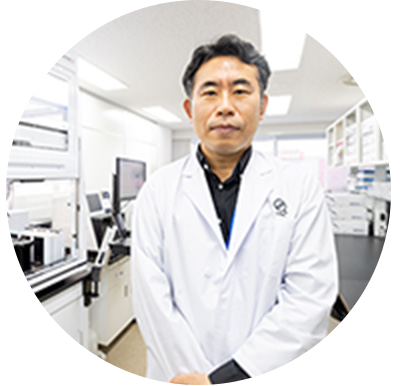 Author
Dr. Tomikane Okinori, M.D., Ph.D.
Graduated from the master's/doctoral program in Biosystem Studies and Molecular Informative Medicine at the University of Tsukuba Graduate School
In 2017, developed Japan's first prenatal DNA testing method using trace-DNA analysis technology(Patent No. 7121440)(Patent No. 7331325)