
Rewritten: November 6, 2024
A detailed explanation of the history of cracking the DNA genetic code, from Watson and Crick's discovery of the double helix structure to the codon-decoding race between Nirenberg and Ochoa. We introduce the full story of the groundbreaking research that underlies DNA testing.
- ・The Great Minds Who Built the History of Cracking the DNA Code
- ・Watson and Crick — Discovery of the DNA Double Helix Structure
- └ How the Base Sequence Determines Proteins
- ・Nirenberg — The Pioneer Who Took On Decoding the Genetic Code
- └ Protein Synthesis Experiments Using Artificial RNA
- └ What Is a Codon (The Unit of the Code)?
- ・The Code-Cracking Race Between Ochoa and Nirenberg
- └ Methods of Cracking the Code
- └ Key Features of the Genetic Code
- ・From Cracking the Genetic Code to the Age of DNA Testing
The Great Minds Who Built the History of Cracking the DNA Code
 DNA can be described as the blueprint that builds our bodies. Before the genetic code inscribed within it could be deciphered, there were countless groundbreaking studies and discoveries made by scientists. DNA technology is now widely used today in DNA testing and genetic testing, but understanding the history behind it — what the "DNA code" actually is and how it was decoded — is essential to deepening our understanding of genetics and DNA testing.
This article explains in detail the research and significance of the discoveries made by the great figures who left an especially large mark on the history of cracking the DNA code — chiefly Watson and Crick, Nirenberg, and Ochoa.
Watson and Crick — Discovery of the DNA Double Helix Structure
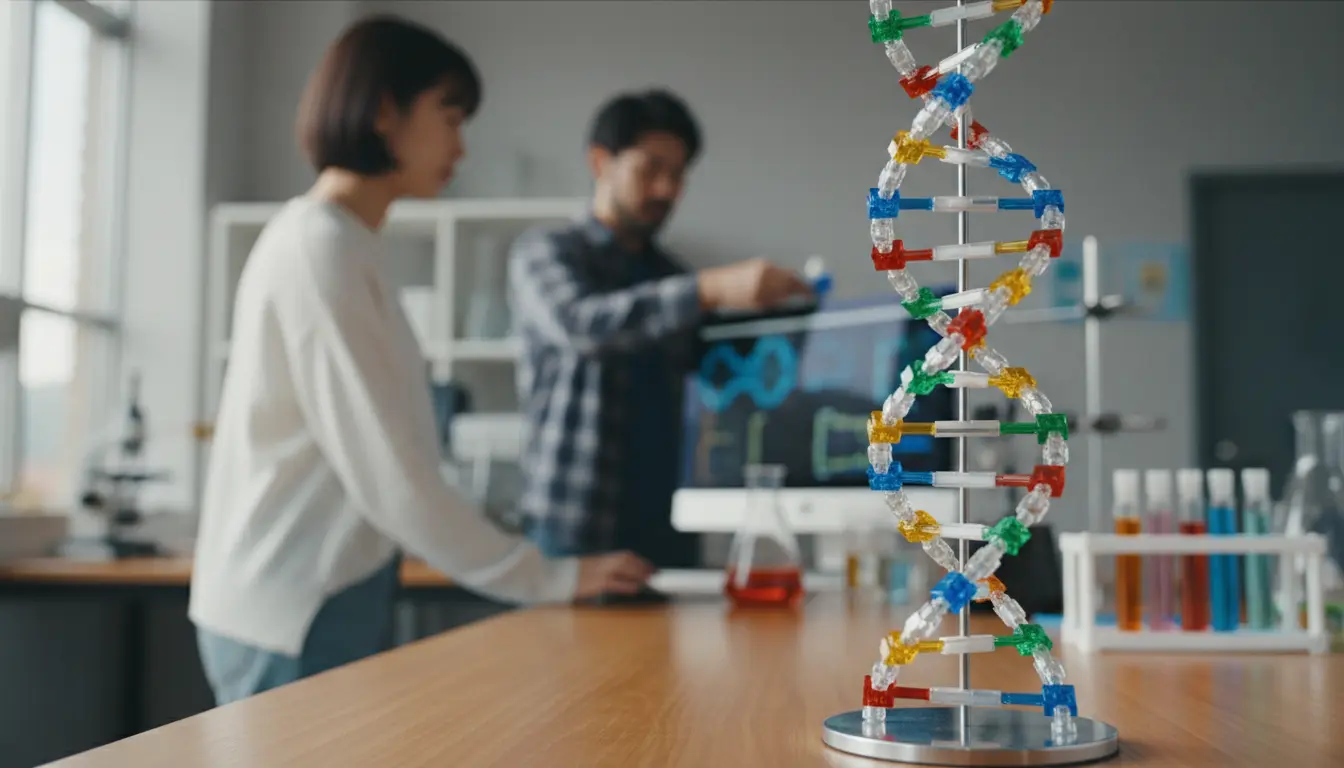
Anyone who has studied DNA has surely heard of Watson and Crick. In 1953, James Dewey Watson and Francis Harry Compton Crick announced that DNA takes the form of a double helix structure [ref:1]. This discovery is considered one of the most important achievements in 20th-century biology, and in 1962 the two, together with Maurice Wilkins, were awarded the Nobel Prize in Physiology or Medicine.
Their discovery revealed that the arrangement of the four types of bases in DNA — adenine (A), thymine (T), guanine (G), and cytosine (C) — functions as a code that expresses the characteristics of an organism. In the DNA double helix, A pairs with T and G pairs with C in a complementary fashion, and this mechanism of "complementary base pairing" enables the accurate replication of genetic information.
How the Base Sequence Determines Proteins
So what exactly does the sequence of these four bases represent? This question was answered through research on mutations in the fungus red bread mold (Neurospora crassa). This research, conducted in the 1940s by George Beadle and Edward Tatum, became known as the "one gene, one enzyme" hypothesis, and showed that each gene controls the synthesis of a specific enzyme (a type of protein) [ref:2]. It was discovered that when the DNA sequence changes, the protein changes as well.
In other words, we can say that the DNA base sequence represents the structure of protein molecules. Proteins are large molecules (macromolecules) formed by linking relatively simple substances called amino acids. Amino acids are joined in a chain by a chemical bond called a peptide bond, and by folding into three-dimensional shapes they become proteins with a huge variety of functions, such as enzymes, antibodies, and hormones.
This means that the DNA base sequence represents the sequence of amino acids. Organisms use around 20 types of amino acids to synthesize proteins. So how can just four types of bases represent 20 different amino acids? The answer to this fundamental question came from Nirenberg's groundbreaking experiment, introduced next.
Nirenberg — The Pioneer Who Took On Decoding the Genetic Code
In 1961, the scholar Marshall Warren Nirenberg succeeded in mixing various substances extracted from cells together in a test tube to synthesize protein [ref:3]. This experiment used a technique known as a "cell-free translation system," a groundbreaking method that reproduced the process of protein synthesis in a test tube without using living cells.
Protein Synthesis Experiments Using Artificial RNA
He first artificially synthesized RNA (ribonucleic acid), a type of nucleic acid. RNA is a substance that copies the DNA base sequence and serves as the basis for protein synthesis. The genetic information in DNA is first "transcribed" into mRNA (messenger RNA), and based on that mRNA information, protein is "translated" in an organelle called the ribosome. This chain of events is called the "central dogma" and is considered a fundamental principle of molecular biology.
One difference between RNA and DNA is that RNA uses a different base, U (uracil), in place of the base T (thymine) found in DNA. There is also a structural difference in that RNA is single-stranded while DNA is double-stranded. Note that in some viruses, RNA plays the role that DNA does in other organisms — for example, the influenza virus and the novel coronavirus (SARS-CoV-2) carry RNA as their genetic material.
Nirenberg synthesized an artificial RNA consisting solely of a continuous chain of the base U (uracil) — so-called "poly-U" — and used it to synthesize protein. The result was a protein made up of only one type of amino acid, phenylalanine (polyphenylalanine). Based on this discovery, it was determined that the three-base sequence UUU is the code (codon) that specifies phenylalanine.
What Is a Codon (The Unit of the Code)?
The unit of the genetic code is called a "codon," and a combination of three consecutive bases specifies one amino acid. There is a mathematical reason why the unit is three bases.
- With 1 base: 4 combinations (41 = 4) → not enough to specify 20 amino acids
- With 2 bases: 16 combinations (42 = 16) → still not enough
- With 3 bases: 64 combinations (43 = 64) → enough combinations for all 20 amino acids
With a combination of three bases, there are 64 possible combinations — enough not only to specify all 20 amino acids, but the remaining codons are also used as "start codons" and "stop codons," signaling the start and end of protein synthesis. Nirenberg's poly-U experiment, as the first study to experimentally prove the existence of this "triplet code," shines brightly in the history of molecular biology.
The Code-Cracking Race Between Ochoa and Nirenberg
When Nirenberg's groundbreaking experimental results were announced, the scientific community was electrified by the prospect of fully deciphering the genetic code. In particular, a fierce race to crack the code began between the Spanish-born biochemist Severo Ochoa and Nirenberg. Ochoa had already won the Nobel Prize in Physiology or Medicine in 1959 for discovering an RNA-synthesizing enzyme (polynucleotide phosphorylase), giving him a head start in RNA synthesis technology [ref:4].
Methods of Cracking the Code
Both research teams successively synthesized new RNA molecules mixing several types of bases in different ratios, and examined what kind of amino acid-containing proteins were produced from each. For example, RNA made by mixing U and C in a certain ratio produced proteins containing not only phenylalanine but also amino acids such as serine and leucine. By repeating this kind of experiment, they statistically estimated which amino acid each codon corresponded to.
- Synthesize artificial RNA with a specific base composition
- Synthesize protein using a cell-free translation system
- Analyze the types and amounts of amino acids contained in the resulting protein
- Estimate the amino acid specified by each codon from the base composition and the frequency of amino acid occurrence
- Combine the results of multiple experiments to complete the code table
Each time a new RNA was used, a protein containing a different amino acid was synthesized, and one by one the genetic code was deciphered. In addition, a technique developed by Har Gobind Khorana for chemically synthesizing RNA with a specific sequence also made a major contribution to cracking the code.
And by 1965, all 64 codes (since there are 4 types of bases, the number of possible arrangements of 3 bases is 4×4×4 = 64) had been fully deciphered. For this achievement, Nirenberg, Khorana, and Robert Holley were jointly awarded the Nobel Prize in Physiology or Medicine in 1968 [ref:5].
Key Features of the Genetic Code
The fully deciphered genetic code has been found to have the following features.
- Universality: nearly all organisms use the same genetic code (with a few exceptions)
- Degeneracy: since 64 codons specify only 20 amino acids, multiple codons can specify the same amino acid
- Start and stop codons: AUG functions as the start signal for protein synthesis, while UAA, UAG, and UGA function as stop signals
- No commas: there are no separator marks between codons — they are read continuously in groups of three
From Cracking the Genetic Code to the Age of DNA Testing
Today, the entire human DNA sequence (about 3 billion base pairs) has been mapped, and even the code for the proteins produced from DNA has been fully deciphered. The Human Genome Project, completed in 2003 — exactly 50 years after Watson and Crick's discovery — was a landmark achievement that has underpinned the dramatic subsequent progress of genomic science and medicine [ref:6].
DNA is now used for a variety of purposes, including personal identification, proof of blood relationships, disease risk assessment, and estimating physical characteristics. In DNA testing, by analyzing polymorphisms in the DNA sequence that differ between individuals (mainly STRs: short tandem repeats), it is possible to identify individuals with extremely high accuracy.
As a company that handles DNA, we at seeDNA hope to apply the research of these great scholars to provide you with excellent services.The achievements of Watson and Crick, Nirenberg, and Ochoa form the very foundation of today's genetic analysis technology, and correctly understanding this history and these principles is the first step toward more deeply appreciating the reliability and significance of DNA testing.
Frequently Asked Questions
Q1. What discovery did Watson and Crick make in DNA research?
A. In 1953, Watson and Crick discovered that DNA takes the form of a double helix structure. Within this structure, four types of bases (A, T, G, C) bond in complementary pairs, a mechanism that enables the accurate replication and transmission of genetic information. This discovery earned them the Nobel Prize in Physiology or Medicine in 1962.
Q2. What is the genetic code (codon)?
A. The genetic code (codon) is a unit consisting of a combination of three consecutive bases on DNA (or RNA) that specifies one amino acid. Combining the four types of bases three at a time yields 64 possibilities (4×4×4), which is enough to cover the specification of all 20 amino acids as well as the start and stop signals for protein synthesis.
Q3. How did Nirenberg decipher the genetic code?
A. In 1961, Nirenberg conducted a cell-free translation experiment using an artificial RNA (poly-U) made up solely of uracil (U), and discovered that a protein consisting only of phenylalanine was synthesized. This was the first experimental proof that the three-base sequence UUU is the codon that specifies phenylalanine.
Q4. What is the difference between DNA and RNA?
A. The main differences between DNA and RNA are the following three points. (1) DNA is double-stranded, while RNA is usually single-stranded. (2) The sugar in DNA is deoxyribose, while in RNA it is ribose. (3) The base thymine (T) is used in DNA, while uracil (U) is used in its place in RNA. RNA copies the information from DNA and serves as a template for protein synthesis.
Q5. How is the decoding of the genetic code related to DNA testing today?
A. Deciphering the genetic code led to a complete understanding of the meaning of the DNA base sequence, which established the foundation for technology that analyzes differences (polymorphisms) in DNA sequences between individuals. Today's DNA testing applies this knowledge to analyze polymorphisms such as STRs (short tandem repeats), making it possible to identify individuals and prove blood relationships with high accuracy.
Reassuring Support from the seeDNA Genetic Medical Research Institute
The seeDNA Genetic Medical Research Institute is a trusted specialist agency for DNA testing and genetic testing that holds the international quality standard ISO 9001 and the Privacy Mark for privacy protection.
If you are struggling with questions about family or parent-child blood relationships, or a partner's infidelity, our DNA testing specialists are here to support you with peace of mind, so please feel free to contact us.
[Free Consultation with Specialist Staff]

If you have any questions,
please feel free to contact our toll-free number.
/Open every day, including weekends/
Business hours: Monday-Sunday 9:00-18:00
(excluding holidays)
 Author
Kihan Tomikane, M.D., Ph.D.
Completed his master's and doctoral studies in Biosystem Control and Molecular Informatics Medicine at the University of Tsukuba Graduate School
In 2017, developed Japan's first prenatal DNA testing(Patent 7331325) using trace-DNA analysis technology(Patent 7121440)