
Rewrite date: September 10, 2024
This article gives a professional explanation of the statistical and theoretical reasons why the probability of paternity in a paternity DNA test never reaches 100%, and the grounds for why a result of 99.99% or higher is, in practical terms, extremely reliable.
Last updated: 2025.11.06
When you receive the results of a paternity DNA test, the report states something like "Probability of Paternity 99.99%." However, many people wonder, "Why isn't it 100%?" or "What does that 0.01% of uncertainty mean?" In fact, this question is a common concern shared by a great many clients, and it is an extremely important topic for correctly understanding the principles behind DNA testing.
This article explains, in an easy-to-understand way, why DNA testing cannot state 100% with certainty and just how reliable that probability really is, drawing on the professional background of probability theory and genetics. It is compiled based on reliable domestic sources (seeDNA and public institutions) and explanations from overseas specialist organizations (AABB, NIST, DDC, etc.) [ref:2][ref:3][ref:5].
- ・Why isn't it shown as "100%"?
- └ 1. Because the test is based on statistics
- └ 2. In theory, "another man" cannot be completely ruled out
- └ 3. Room for error due to technical factors
- ・How reliable is "99.99%"?
- ・How the probability of paternity is calculated, and its statistical background
- ・Points for achieving a more accurate result
- └ Choose a trustworthy testing institution
- └ Correctly understand the meaning of the result
- └ Submitting the mother's DNA too further improves accuracy
- ・Summary
Why isn't it shown as "100%"?

1. Because the test is based on statistics
In a paternity DNA test, the DNA of the child is compared with that of the man believed to be the father, and the analysis checks whether genetic markers called STRs (Short Tandem Repeats) — short repeating sequences — match. An STR is a region on a chromosome where a sequence of about 2 to 6 bases repeats, and because the number of repeats differs from person to person, it is extremely effective for individual identification [ref:5]. Based on this degree of matching, the "likelihood of being the father" is calculated statistically and expressed as the "Probability of Paternity."
This calculation is based on probability theory (Bayes' theorem), which takes into account "the probability that an unrelated man would coincidentally match," and by its very structure it cannot theoretically assert 100%. Under the principles of statistics, probability is a value that falls "between" 0% and 100%, so the expression "100% certain" itself contradicts the very definition of probability theory. This is, in a sense, also an expression of scientific integrity.
2. In theory, "another man" cannot be completely ruled out
Even when it is extremely likely that the tested man is the father, it is theoretically impossible to reduce to zero the possibility that "another man with a very similar genetic makeup (for example, an identical twin)" could be the father. Because identical twins carry the same DNA sequence, standard STR analysis alone makes it fundamentally impossible to distinguish between them [ref:7]. For this reason, it is the international standard to express testing results as a probability such as "99.9% or higher" [ref:3].
Furthermore, since close relatives (such as brothers or a father and son) share more STR alleles compared to the general population, when there is a possibility that a close relative of the subject is the true father, it is recommended to use additional markers or SNP analysis together to improve accuracy.
3. Room for error due to technical factors
It is not possible to completely eliminate the possibility of very slight errors arising from DNA sample collection, transport, and storage conditions, or from genetic mutations. STR regions are known to have a relatively high mutation rate (roughly 0.1–0.4% per locus) [ref:8], and even if a mismatch occurs at one or two loci between parent and child, as long as sufficient matches are confirmed at the other loci, it is treated as a "mismatch due to mutation." However, the very existence of such mutations is one reason for avoiding the absolute expression "100%."
There is also a non-zero risk of sample degradation or contamination occurring during the DNA extraction process. Reliable testing institutions manage samples under strict procedures based on quality control systems such as ISO9001, but even so, it is not scientifically appropriate to declare "absolutely zero."
How reliable is "99.99%"?
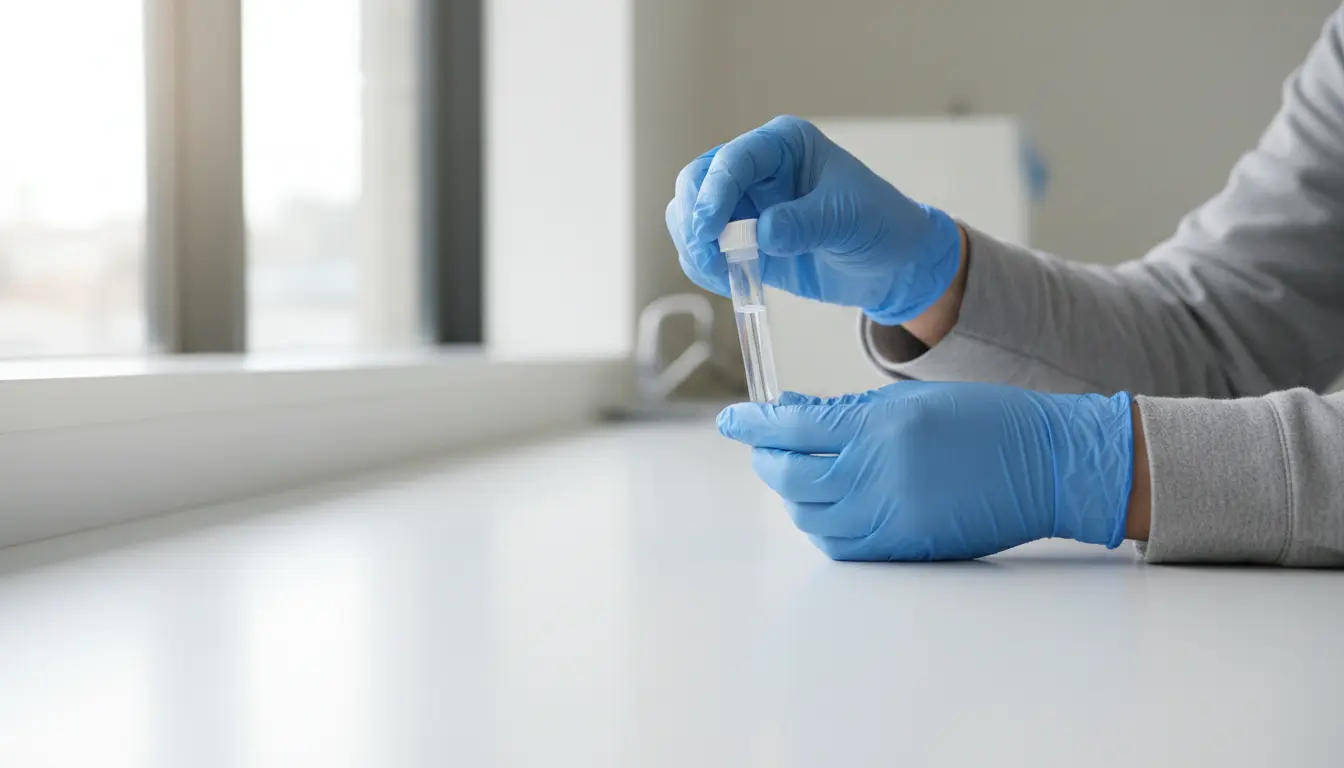
To state the conclusion first: a probability of paternity of 99.99% or higher is considered, for all practical purposes, extremely reliable. The specific grounds for this are given below.
- Standard paternity testing analyzes 20 to 25 or more STR markers. This lowers the probability that another, unrelated person would coincidentally match on all of them to the level of "one in several trillion" [ref:5].
- Japan's National Police Agency also adopts STR analysis as an effective method for individual identification, and its reliability is well established from a forensic standpoint as well [ref:1].
- At private testing institutions such as seeDNA, cases with a probability of paternity of 99.9999% or higher are common, and it is explained that "while it is not 100%, it is, in practical terms, certain" [ref:2].
- Under the paternity testing standards of the AABB (American Association of Blood Banks), a probability of paternity of 99.0% or higher is defined as meaning that "paternity is practically proven" [ref:3].
- A probability of paternity of 99.99% means that the Combined Paternity Index (CPI) is 10,000 or higher, which indicates that "the tested man is more than 10,000 times more likely to be the father compared with an unrelated man."
In this way, the figure of 99.99% does not mean "a slight uncertainty remains," but rather "it is simply not written as 100% as a matter of scientific integrity of expression, while in substance it is virtually certain." In legal proceedings as well (such as court cases or paternity acknowledgment claims), this probability is fully accepted as evidence of a paternal relationship.
\Paternity testing with a guaranteed minimum probability of paternity of 99.99% or higher/
How the probability of paternity is calculated, and its statistical background
 Understanding how the probability of paternity is calculated makes clearer still "why it doesn't reach 100%." Here, we walk through that calculation process step by step.
- Calculating the Paternity Index (PI) at each STR locus: We compare the probability (X) that the observed genotype would appear if the tested man is the father, with the probability (Y) that an unrelated man would carry that genotype, and calculate PI = X / Y.
- Calculating the Combined Paternity Index (CPI): The PIs from all tested loci are multiplied together to obtain the overall paternity index. The more loci tested, the more dramatically the CPI increases.
- Converting to a probability of paternity: Using Bayes' theorem, the CPI is converted into a probability. Generally, a prior probability of 0.5 (50%) is assumed, and the probability of paternity is calculated as CPI / (CPI + 1) × 100 (%) [ref:9].
- Judging the result: Under AABB standards, a probability of paternity of 99.0% or higher is judged as "paternity practically proven." seeDNA sets a guaranteed minimum value of 99.99% or higher [ref:2][ref:3].
For example, if a test at 20 loci yields an average PI of about 5 at each, the CPI = 520 ≒ roughly 95 trillion, giving a probability of paternity exceeding 99.9999999999%. In this way, increasing the number of tested loci brings the probability infinitely close to 100%, but mathematically it never becomes "exactly 100%." This is the essence of the statistical method, and an important principle for guaranteeing scientific accuracy.
What is a prior probability?
The "prior probability" in Bayes' theorem is the value assumed, before conducting the DNA test, for how likely it is that the tested man is the father. Typically, this is set fairly at 0.5 (50%). This assumption ensures that the results of the DNA test are not arbitrary and that an objective judgment is possible. Note that if the prior probability is set differently, the final probability of paternity will also change, but when the CPI is sufficiently large (for example, 10,000 or higher), the influence of the prior probability becomes nearly negligible.
Points for achieving a more accurate result
・Choose a trustworthy testing institution
Choose an institution with clear collection procedures, identity verification, and a sample management system (chain of custody). Chain of custody refers to a management system in which every step from sample collection through analysis to reporting is recorded — who handled the sample and when — thereby proving there was no sample swapping or contamination. In Japan, seeDNA operates in accordance with forensic standards, and warns that "you should be cautious of any provider claiming 100%" [ref:2].
Specifically, it is important to check the following points.
- Whether the institution holds an international quality standard certification such as ISO9001
- Whether it holds a Privacy Mark (P Mark) certification
- Whether 20 or more STR loci are used in testing
- Whether the CPI and data for each locus are clearly stated in the result report
- Whether a double-check (dual testing) is carried out during the testing process
・Correctly understand the meaning of the result
It does not simply mean "because it's 99.99%, there is a 1-in-10,000 chance someone else is the father." The probability of paternity is a statistical-model indicator of "how overwhelmingly more likely it is that the tested man is the father, compared with an unrelated man." Specifically, a CPI of 10,000 means "this man is 10,000 times more likely to be the father than a randomly chosen unrelated man."
・Submitting the mother's DNA too further improves accuracy
A paternity test can be conducted as a two-party test (duo test) between "father and child," but if testing is carried out as a three-party test (trio test) that also includes the mother's DNA, the child's alleles can be accurately separated into those derived from the mother and those derived from the father, greatly improving the CPI and yielding a more certain result [ref:9]. A trio test is especially strongly recommended in cases where a close relative is among the candidates being tested.
Summary
The reason the figure "100%" is not used in paternity DNA testing is to uphold statistical and theoretical principles. By the definition of probability theory, 100% would mean "absolutely certain," and it is not scientifically appropriate to make such an assertion. However, a result of "99.99% or higher" realistically demonstrates a paternal relationship with virtual certainty, and is sufficiently reliable evidence both legally and scientifically [ref:3].
With modern testing technology that analyzes 20 or more STR markers, the probability of an unrelated person coincidentally matching drops to less than one in several trillion [ref:5]. Since even the AABB's international standard judges paternity as practically proven at 99.0% or higher, a result of 99.99% or higher represents the highest level of reliability by international standards as well.
With correct understanding and the choice of a trustworthy institution, paternity DNA testing can be a powerful means of revealing a certain truth. seeDNA Genetic Medical Research Institute upholds a guaranteed minimum probability of paternity of 99.99% or higher, and carries out testing under a strict quality management system certified to ISO9001 and the Privacy Mark. If you have any concerns or questions, please feel free to consult us.
\Paternity testing with a guaranteed minimum probability of paternity of 99.99% or higher/
 Apply / Purchase kit
Frequently Asked Questions
Q1. Does a probability of paternity of 99.99% mean "wrong 1 time in 10,000"?
A. No, that is not what it means. A probability of paternity of 99.99% is a statistical indicator showing that the tested man is more than 10,000 times more likely to be the father compared with an unrelated man. The interpretation "it's wrong once every 10,000 times" is not accurate; it simply means that, as a matter of probability-theoretic expression, it is not written as 100%, while in practical terms the result is virtually certain.
Q2. Can a testing institution that states 100% be trusted?
A. From a scientific standpoint, asserting 100% goes against the principles of statistics. International testing standards (such as AABB) do not recognize a 100% notation either, and a trustworthy institution will always report its results as a probability [ref:3]. seeDNA also warns against providers who claim 100% [ref:2]. When choosing a testing institution, also check things such as ISO certification status and the number of loci tested.
Q3. If there is an identical twin brother, can DNA testing still identify the father?
A. With standard STR analysis, identical twins have identical DNA, so they cannot be distinguished. However, in recent years it has been reported that next-generation sequencing (NGS) technology can be used to detect somatic mutations, potentially allowing identical twins to be distinguished [ref:7]. In such cases, we recommend consulting with us in advance.
Q4. Does testing more STR markers improve accuracy?
A. Yes, in general the more STR markers tested, the more dramatically the CPI (Combined Paternity Index) increases, and the higher the probability of paternity becomes. seeDNA uses 20 or more STR markers and sets a guaranteed minimum probability of paternity of 99.99% or higher. NIST's publicly available STRBase also shows that multi-locus analysis greatly improves the power of individual identification [ref:5].
Q5. Is it better to also submit the mother's DNA?
A. Conducting a three-party test (trio test) that adds the mother's DNA allows the child's alleles to be accurately separated into those derived from the mother and those derived from the father, improving the CPI and yielding a more certain result [ref:9]. A trio test is especially strongly recommended when a close relative is among the candidates being tested. Sufficiently high accuracy can be obtained even with just the father and child, but submitting the mother's sample as well provides extra peace of mind if possible.
Q6. Can the results of DNA testing be used as evidence in court?
A. Yes, they can. However, in order for the results to have evidentiary standing in court, the test must be carried out as a "legal test" with a documented chain of custody for the samples. seeDNA also offers testing plans that comply with legal procedures, and accommodates requests from courts and attorneys.
The reassuring support of seeDNA Genetic Medical Research Institute
seeDNA Genetic Medical Research Institute is a trusted and reliable specialist institution for DNA testing and genetic testing that holds the international quality standard ISO9001 and the Privacy Mark for personal information protection.
If you are troubled by questions of family or parent-child blood relationships, or a partner's infidelity, our DNA testing experts will provide reassuring support, so please feel free to contact us.
[Free consultation with specialist staff]

If you have any questions,
please feel free to contact our toll-free number.
\Open every day, including weekends/
Business hours: Monday–Sunday 9:00-18:00
(excluding holidays)
 Author
Kihan Tomikane, Ph.D. (Medicine)
Graduate of the Master's/Doctoral program in Biosystem Studies/Molecular Information Medicine, University of Tsukuba
In 2017, developed Japan's first prenatal DNA test(Patent 7331325) using trace-DNA analysis technology(Patent 7121440)