
Last revised: April 17, 2025
Misdiagnoses by low-accuracy DNA testing providers are increasing rapidly. The seeDNA Genetic Medical Research Institute explains in detail the key points for identifying a trustworthy testing laboratory, the traits of disreputable providers to avoid, and the technical background behind why misdiagnoses occur.
- ・Misdiagnoses by low-accuracy testing providers are increasing rapidly
- ・Traits of DNA testing providers to avoid
- ・Why do misdiagnoses occur? The technical background
- ・Points for finding a trustworthy testing laboratory
- ・A comparison checklist for choosing a DNA testing provider
- ・Conclusion: Careful provider selection leads to accurate results
Misdiagnoses by low-accuracy testing providers are increasing rapidly
 In recent years, as demand for DNA testing has grown, so has the number of troubling cases involving misdiagnoses by providers with accuracy problems. seeDNA (seeDNA Co., Ltd.) has seen a growing number of requests for retesting from customers who feel uneasy about results obtained from other DNA testing providers, and in several serious cases, retesting has actually overturned the previous results.
DNA testing is a critical examination that can have a major impact on a person's life — confirming a parent-child relationship, verifying legal identity, or settling matters of inheritance, among other uses. Despite this, Japan lacks sufficiently developed legal regulation or certification systems for DNA testing providers, and low-accuracy or disreputable providers do exist in the market. In the United States and Europe, testing laboratories that perform DNA testing are subject to strict accreditation standards such as AABB accreditation and the ISO 17025 standard [ref:1]. In Japan, however, no equivalent public certification system has been established, meaning consumers must judge a provider's trustworthiness for themselves [ref:2].
Our company guarantees a paternity probability result that exceeds international standards, and we have been recognized as a supported enterprise by Adachi Ward and the Tokyo Metropolitan Government, among our ongoing efforts to improve trust in DNA testing. That said, the fact that providers with accuracy problems remain unregulated cannot be overlooked. Some disreputable providers exist purely for financial gain, and it is extremely difficult for the average person to identify them.
Because a DNA test can change the course of your life and that of your loved ones, we strongly urge you to use only a trustworthy testing laboratory. Specifically, we recommend avoiding providers with the following traits.
Traits of DNA testing providers to avoid
- Does not disclose an "exact figure" for the test result
For paternity test result reporting, the internationally recognized standard for a reliable parent-child DNA test is a paternity probability of 99.9% or higher. seeDNA determines a biological parent-child relationship to be confirmed only at a paternity probability of 99.99% or higher. Be sure to check the testing laboratory's accuracy for parent-child DNA testing and the number of misdiagnosis incidents it has had.
Be wary of any provider that does not disclose its testing accuracy or number of misdiagnoses.
Why is a trustworthy result possible even though 100% accurate DNA testing is theoretically impossible? - Publishes false information about competitors
There have been disreputable cases in which providers published data about competitors that was simply untrue, in order to make unfair comparisons. A provider that uses such false information to improperly promote its own advantage raises doubts about the reliability of its testing itself. It is important to check whether a provider offers fair, accurate comparative information. - Does not explain the limitations and risks of DNA testing
DNA testing is not always infallible, and there are cases where a result cannot be produced — for example, when a sample is poorly preserved or the DNA is significantly degraded. Extreme caution is warranted with any provider that claims it can always produce a result 100% of the time without explaining such limitations and risks. A trustworthy testing laboratory will carefully explain the risks in advance. - Reports a "negative" result after only a single test
If a testing error occurs, there is a risk that a genuine biological relationship could be wrongly reported as negative. For this reason, a negative result must always be confirmed with a second test to rule out error. A provider that skips this step may be prioritizing cost savings over accuracy.
Many providers run only a single test, which carries the risk of a mistakenly reported negative result due to testing error — caution is required.
Why do misdiagnoses occur? The technical background
 Misdiagnoses in DNA testing occur for several main reasons. First, when too few STR (Short Tandem Repeat) markers are used in testing, statistical confidence decreases. International standards recommend using 20 or more STR loci, but some providers test fewer loci in order to cut costs [ref:3][ref:4]. As the number of STR loci increases, the probability of a false match due to coincidence decreases exponentially, so securing a sufficient number of loci is fundamental to testing accuracy [ref:5].
Next, there is the risk of sample mix-ups or contamination. At facilities without proper lab management systems, accidents can occur in which samples become mixed together or swapped with another sample. seeDNA has introduced its own double-check system to minimize this risk. Contamination is also recognized as a serious issue in the field of forensic science, and ISO 17025-accredited labs have strict standards governing clean-room management and sample handling procedures [ref:6].
Finally, misreading of the analysis results is another contributing factor. DNA test results are output as graph data called an electropherogram, and correctly interpreting this requires advanced expertise and experience. When an inexperienced technician handles the analysis, an artifact (a false peak) can be mistaken for a genuine allele. To prevent such misreadings, having multiple technicians independently review the analysis is considered international best practice [ref:7].
Points for finding a trustworthy testing laboratory
Choosing a trustworthy DNA testing laboratory is the most important step toward obtaining an accurate result. Please check the following points.
- The paternity probability is clearly stated in the result report
seeDNA: We guarantee a minimum paternity probability of 99.99% or higher — ten times the international standard. - The website clearly explains the limitations and risks of DNA testing, and the measures taken to prevent misdiagnosis
seeDNA: Our proprietary double-check system verifies that there are no sample mix-ups or duplications. - Phone and email inquiries receive prompt, courteous responses
seeDNA: Feel free to contact us Monday through Sunday (business hours: 9:00 AM to 6:00 PM).*Excluding holidays - Customer support includes free retesting or a refund guarantee
seeDNA: If DNA cannot be extracted due to the condition of the sample, we offer a free retest or a partial refund guarantee. - Does not refuse in-person orders or sample submission
seeDNA: We accept orders and sample submissions in person at our office.*Advance reservation required - Has a track record of government support
① Support from the Japan External Trade Organization's "Overseas Application Support Program (1st round, 2022)"
② Support from the Tokyo Metropolitan Government's "Capital Investment Support Program for Business Growth (2021)"
③ Support from Tokyo's Adachi Ward "New Product and New Business Development Subsidy (2020)"
A comparison checklist for choosing a DNA testing provider
The table below is a simple checklist for comparing a trustworthy testing laboratory against a provider that requires caution.
| Check item | Trustworthy provider | Provider requiring caution |
|---|---|---|
| Stated paternity probability | Guarantees 99.99% or higher | Does not disclose a figure |
| Double-check on a negative result | Always runs a second test | Reports after a single test |
| Explanation of risk | Explained carefully in advance | No explanation, or claims 100% guarantee |
Conclusion: Careful provider selection leads to accurate results
DNA testing is directly tied to major life decisions, from confirming a parent-child relationship to legal proceedings. That is precisely why choosing a testing provider requires care. By checking, one by one, whether a provider discloses its testing accuracy figures, explains risks and limitations honestly, and performs a double-check on negative results, you can avoid disreputable providers.
After taking these points into account, please compare testing providers carefully. And should you choose to work with us, we are committed to resolving your concerns with the highest testing accuracy and customer support.
Related article: Learn more about paternity probability here
Frequently Asked Questions
Q1. How accurate is DNA testing?
A. The international standard requires a paternity probability of 99.9% or higher. seeDNA sets its minimum guaranteed value at 99.99% or higher — ten times that standard — providing industry-leading testing accuracy. That said, since 100% accuracy is theoretically impossible, it is important to choose a provider that guarantees high accuracy while honestly explaining the risks.
Q2. I'm uneasy about a DNA test result I received from another company. Can I get a retest?
A. Yes. seeDNA accepts retesting requests from customers who feel uneasy about results from other companies. In fact, there have been cases where retesting overturned a previous result. If you have any concerns, please feel free to consult with us.
Q3. Why can DNA testing sometimes produce an incorrect result (a misdiagnosis)?
A. The main causes of misdiagnosis include an insufficient number of STR markers used in testing, sample mix-ups or contamination, and misreading of the analysis results. In particular, providers that do not perform a double-check (retest) on negative results carry a higher risk of misdiagnosis due to testing error.
Q4. How can I identify a trustworthy DNA testing provider?
A. Check whether the paternity probability figure is clearly stated, whether the limitations and risks of DNA testing are explained honestly, whether a double-check is performed on negative results, whether the provider has a track record of government support, and whether in-person visits are accommodated. A provider that meets these criteria can be considered highly trustworthy.
Q5. Can DNA testing fail to produce a result?
A. Yes. If a sample is poorly preserved or the DNA is significantly degraded, insufficient DNA may be extracted and no result can be produced. In such cases, seeDNA offers a free retest or a partial refund guarantee. Be cautious of any provider that claims it will "always produce a result 100% of the time."
Q6. Can I visit seeDNA in person to consult or submit a sample?
A. Yes, we accept in-person orders and sample submissions by advance reservation. We are available Monday through Sunday (business hours: 9:00 AM to 6:00 PM, excluding holidays), so please feel free to make a reservation by phone or email.
Q7. What is an STR marker, and why does a higher number of loci improve accuracy?
A. An STR (Short Tandem Repeat) marker is a region of DNA where a short sequence repeats, and because the number of repeats varies between individuals, it is used for personal identification. As the number of loci tested increases, the probability of a coincidental match decreases exponentially, allowing for a more reliable test. Internationally, testing 20 or more loci is recommended.
Reassuring support from the seeDNA Genetic Medical Research Institute
The seeDNA Genetic Medical Research Institute is a trusted specialist institution for DNA testing and genetic testing, holding the international ISO 9001 quality standard and the Privacy Mark for personal information protection.
If you're concerned about a family or parent-child biological relationship, a partner's infidelity, or similar issues, our DNA testing experts are here to provide reassuring support — please feel free to contact us.
[Free consultation with specialist staff]

If you have any questions,
please feel free to contact our toll-free line.
/Open every day, including weekends/
Business hours: Mon-Sun 9:00 AM-6:00 PM
(excluding holidays)
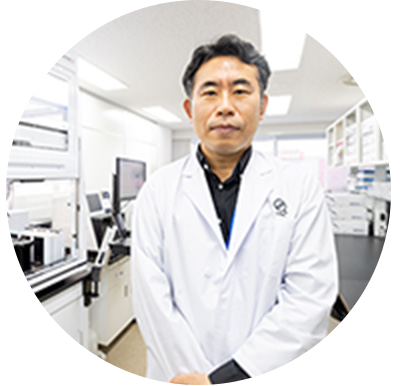 Author
Kihan Tomikane, M.D., Ph.D.
Completed the master's/doctoral program in Biosystems Regulation and Molecular Bioinformatics Medicine at the University of Tsukuba Graduate School
In 2017, developed Japan's first prenatal DNA test(Patent No. 7331325) using proprietary trace-DNA analysis technology(Patent No. 7121440)