
Rewritten on: July 15, 2024
seeDNA Genetic Medical Research Institute's "Identity Testing" is a service that determines whether two samples originate from the same person using DNA profiling. There are two methods—the two-stage method and the simultaneous method—allowing you to choose the optimal approach based on cost risk and speed.
- ・What Is Identity Testing? A Testing Service That Determines a Person's Identity Through DNA Profiling
- ・The Scientific Principles of DNA Profiling and STR Marker Analysis
- ・How Identity Testing Proceeds: Two Testing Methods and Their Characteristics
- └ The Two Basic Approaches to Identity Testing
- └ ① Advantages and Disadvantages of the Two-Stage Method
- └ ② Advantages and Disadvantages of the Simultaneous Method
- ・Choosing a Testing Method: Comparing Cost Risk and Speed
- ・Types of Samples That Can Be Used for Identity Testing and Points to Note
- ・Common Use Cases for Identity Testing
- ・Proposing the Optimal Testing Plan Tailored to Each Customer's Needs
What Is Identity Testing? A Testing Service That Determines a Person's Identity Through DNA Profiling
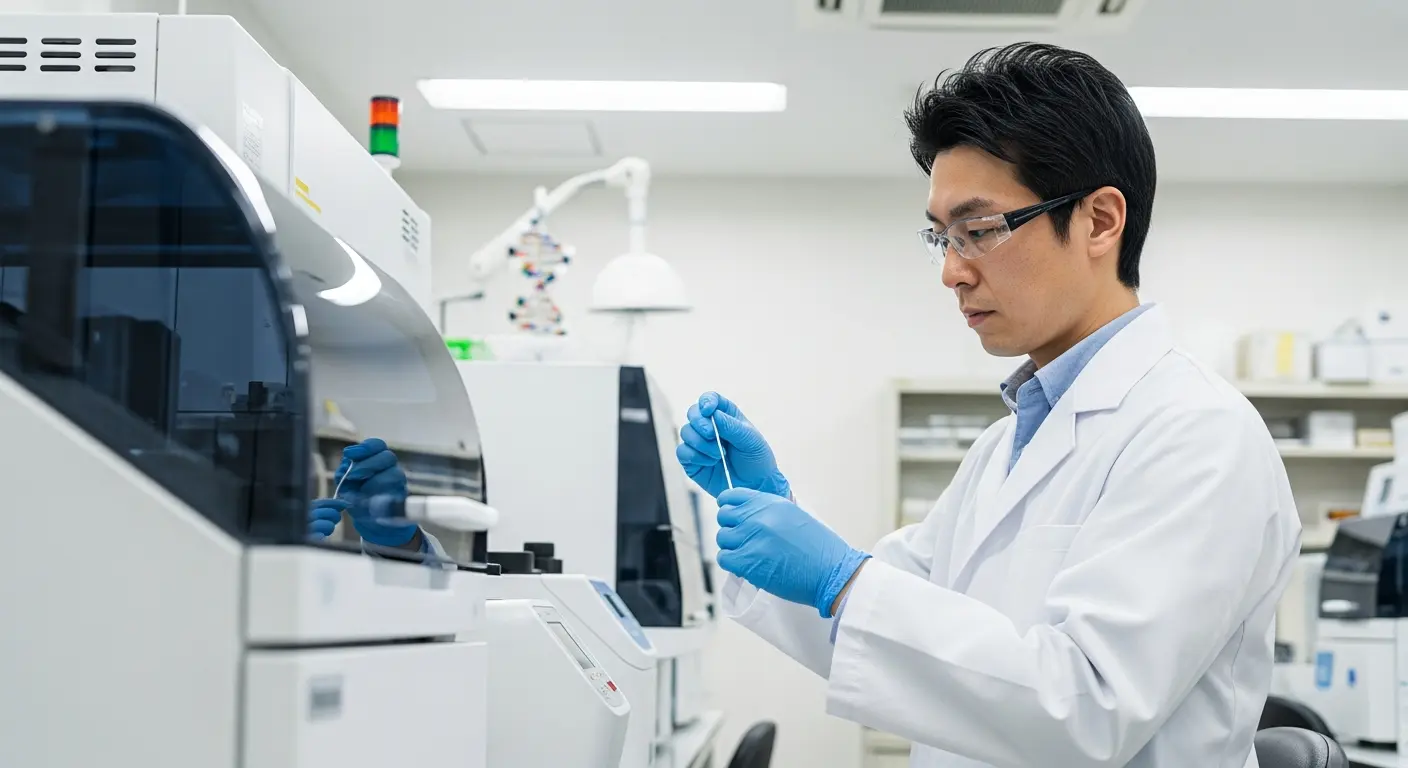 At seeDNA Genetic Medical Research Institute, we receive many requests from customers wanting to scientifically identify the cause of troubles such as infidelity or foreign object contamination. To meet these needs, we offer a testing service called "Identity Testing." This test is designed to determine, through DNA analysis, whether Sample A and Sample B originate from the same person.
For example, this test is used in a variety of situations, such as confirming whether hair or bodily fluid stains collected as evidence of infidelity belong to a specific person, or identifying whose DNA is contained in a foreign object found in food or a product. Identity Testing is based on techniques developed over many years in the field of forensic science, and it is a highly reliable method that is widely recognized as evidence in criminal investigations and court proceedings (1).
The core technology behind Identity Testing is called "DNA profiling," a method that analyzes data from DNA (DNA types) that can identify an individual. Human DNA contains repeat sequences (STR markers) that differ from person to person, and analyzing multiple such regions allows for extremely accurate identification of individuals. Currently, in the field of forensic science, multiplex kits that simultaneously analyze 16 to 24 or more STR markers are commonly used, achieving a remarkable accuracy where the probability of a coincidental match is less than one in several hundred trillion (2).
The Scientific Principles of DNA Profiling and STR Marker Analysis
 To understand the core of Identity Testing, it is important to know the scientific principles of DNA profiling. Human genomic DNA contains approximately 3 billion base pairs, and within it there are numerous regions called STRs (Short Tandem Repeats)—short sequences of 2 to 6 bases repeated in tandem. Because the number of repeats in these STRs varies from person to person, analyzing multiple STR regions makes it possible to construct a "DNA profile" unique to that individual (3).
The specific analysis process begins by extracting DNA from the sample, followed by amplifying the target STR regions using PCR (polymerase chain reaction). The amplified fragments are then precisely separated by size using capillary electrophoresis equipment, identifying the number of repeats (alleles) at each STR region. The data obtained through this series of analyses constitutes the DNA type profile.
In Identity Testing, DNA profiling is performed separately on two samples, and the resulting DNA type data are compared. If all STR markers match, the samples are determined to "originate from the same person," and if there are any mismatches, they are determined to "originate from different people." While this principle is simple, the optimal approach in actual testing varies depending on the type and condition of the sample and the customer's circumstances, which is why we offer multiple approaches.
In recent years, dramatic advances in DNA analysis technology have made it possible to achieve highly accurate profiling even from trace amounts of DNA (4). Cases where results can be obtained even from trace or degraded samples that were previously considered difficult to test are increasing, and the range of applications for Identity Testing continues to expand year by year.
How Identity Testing Proceeds: Two Testing Methods and Their Characteristics

The Two Basic Approaches to Identity Testing
Identity Testing can generally proceed using one of the following two methods. We will guide you to the optimal method based on your situation and requirements.
- Two-Stage Method (splitting the test into two rounds): First, DNA profiling is performed on Sample A to confirm that DNA data has been successfully obtained. Then, DNA profiling is similarly performed on Sample B, and the results are compared with those of Sample A to determine whether the two samples originate from the same person.
- Simultaneous Method (performing the test in one round): DNA profiling is performed on Sample A and Sample B at the same time, and the resulting data are compared together to determine whether the samples originate from the same person.
At first glance, these may seem to accomplish the same thing, but whether the test is split into two rounds or performed in one round makes a significant difference in cost risk and the time required for testing. We explain the advantages and disadvantages of each method in detail below.
① Advantages and Disadvantages of the Two-Stage Method
The two-stage method involves first analyzing the DNA of the reference sample (Sample A) and confirming that results have been obtained before proceeding to analyze the next sample (Sample B). This method is especially recommended for customers who are uncertain about the condition of their sample or who wish to minimize cost risk as much as possible.
- Advantage: Minimizes cost risk — If sufficient DNA cannot be extracted from the reference sample, or if no profiling data can be obtained, the test can be discontinued at that point, minimizing unnecessary costs. Note that if DNA analysis of Sample A succeeds and you proceed to testing of Sample B, you will only be billed for the difference, so the final basic testing fee remains the same regardless of whether you choose method ① or ②.
- Disadvantage: Longer testing period — Because the test is conducted in two separate rounds, the second round begins only after confirming the results of the first, resulting in a relatively longer overall testing period. This may be somewhat less suitable for those who need results urgently.
② Advantages and Disadvantages of the Simultaneous Method
The simultaneous method involves analyzing all samples together at once, making it suitable for customers who prioritize speed. It is especially effective when a court date is approaching or when quick results are needed to keep pace with an ongoing investigation.
- Advantage: Shorter testing period — Because DNA profiling is performed on all samples at the same time, the time required to obtain results is significantly reduced. This method is ideal for those who want results quickly.
- Disadvantage: Somewhat higher cost risk — Even if DNA cannot be extracted from the reference sample, testing on all samples has already progressed, resulting in a relatively higher cost risk. This is a point to consider especially when the condition of the sample is unknown.
Choosing a Testing Method: Comparing Cost Risk and Speed
Which of the two testing methods is right for you depends on your priorities. Please refer to the comparison table below to consider which method best suits your situation.
| Comparison item | Two-stage method | Simultaneous method |
|---|---|---|
| Testing period | Somewhat longer | Shorter |
| Cost risk | Low (can be discontinued) | Somewhat higher |
| Final cost | Same | Same |
As shown above, the final basic testing fee remains the same regardless of which method you choose, but we recommend the two-stage method if the condition of the sample is uncertain, and the simultaneous method if speed is your top priority. Regardless of which method you choose, our specialized staff will carefully listen to your circumstances and propose the optimal plan.
Types of Samples That Can Be Used for Identity Testing and Points to Note
A wide variety of items can be used as samples for Identity Testing. Anything that may contain DNA can generally be accommodated, but since the difficulty of DNA extraction and the success rate vary by sample type, we recommend consulting with us in advance.
- Oral mucosa (collected with a swab) — A standard sample that yields the most stable quality DNA. Collection is simple, and the success rate for DNA analysis is very high.
- Hair (with root attached) — DNA is extracted from cells attached to the hair root. If the hair has been cut without a root attached, analysis may be limited to mitochondrial DNA only, so please submit hair with the root attached whenever possible.
- Bloodstains/blood — Nuclear DNA contained in white blood cells is analyzed. DNA can also be extracted from dried bloodstains, but depending on storage conditions it may have degraded.
- Saliva — DNA is extracted from oral epithelial cells in saliva. It may also be detectable from partially consumed bottled drinks, cups, or the adhesive area of sealed envelopes.
- Nails — Nail tissue also contains DNA and can be used as a test sample.
- Used toothbrushes or razors — Everyday items also carry trace amounts of DNA and can be used as test samples.
However, depending on the storage condition of the sample and the amount of remaining DNA, it may not be possible to obtain sufficient DNA type data to produce a testing result. Samples stored for long periods in hot, humid environments, or samples exposed to chemicals, are particularly likely to have degraded DNA, so extra caution is needed. Please feel free to contact us if you have any questions.
Common Use Cases for Identity Testing
Identity Testing is used in a wide variety of situations. Because it can scientifically prove at the DNA level whether two samples originate from the same person, it carries high credibility as legal evidence, and it is increasingly being adopted as compelling evidence in court and mediation proceedings (5). Below are some representative use cases.
- Confirming evidence in infidelity investigations — By confirming whether hair or bodily fluid stains collected from a partner's clothing, sheets, or vehicle belong to a specific person, scientific evidence of infidelity can be obtained.
- Proving stalking damage — By confirming whether items left at or near a victim's home (hair, saliva stains, etc.) match the DNA of a suspected individual, this can help prove stalking behavior.
- Investigating the cause of foreign object contamination incidents — By identifying whether DNA contained in hair or other foreign objects found in food or products belongs to someone involved in the manufacturing process, this contributes to determining the contamination route.
- Identifying the owner of items left behind — By determining whether DNA detected from items left at the scene of an incident or accident belongs to a specific person, this contributes to resolving the case.
- Identity confirmation/personal identification — In the case of a disaster or accident, this technology is also applied to confirm identity by comparing DNA profiles obtained from remains or personal effects with records obtained during life.
Proposing the Optimal Testing Plan Tailored to Each Customer's Needs
As described above, Identity Testing involves two key considerations: "prioritizing a shorter testing period" and "prioritizing lower cost risk." At seeDNA Genetic Medical Research Institute, we carefully listen to each customer's individual circumstances and requirements and propose the optimal testing plan.
Our company has obtained ISO9001 international quality certification and maintains strict quality control throughout the entire DNA testing process. We have also obtained the Privacy Mark (P Mark) from a privacy protection standpoint, ensuring thorough confidentiality of customers' personal information and testing details. All staff involved in testing are bound by confidentiality obligations, and we maintain a system in which testing results are communicated only to the customer themselves.
Furthermore, our company's representative, Tomikane Kihan, developed Japan's first prenatal DNA testing (Patent 7331325) using trace DNA analysis technology (Patent 7121440) in 2017, and this cutting-edge DNA analysis technology is also applied to Identity Testing. This trace DNA analysis technology has increased the likelihood of obtaining DNA type profiles even from small sample amounts that were previously considered difficult to test, providing customers with more options than ever before.
If you are currently facing an issue that can be resolved through DNA testing, please feel free to make use of our Identity Testing or other testing services. Our specialized staff will do everything possible to support you in resolving your issue. If you have any questions about testing or would like a quote, please feel free to contact us first.
Frequently Asked Questions
Q1. What kinds of samples can be used for Identity Testing?
A. Identity Testing can use a variety of samples containing DNA, including oral mucosa (swab collection), hair (with root attached), bloodstains, saliva, nails, and used toothbrushes or razors. However, depending on the sample's storage condition and the amount of remaining DNA, a result may not always be obtainable. If you have any concerns about the type or condition of your sample, please feel free to consult with us in advance.
Q2. Does the final cost differ between splitting the test into two rounds and performing it in one round?
A. No, the final basic testing fee remains the same regardless of which method you choose. With the two-stage method, when proceeding to the second round after the first test, you will only be billed for the difference. However, this method has the advantage of allowing you to discontinue testing—and thereby minimize cost risk—if DNA cannot be obtained from the sample in the first round.
Q3. In what situations is Identity Testing used?
A. Identity Testing is used in a variety of situations, including confirming evidence in infidelity investigations, investigating the cause of foreign object contamination incidents, proving stalking damage, and identifying the owner of items left behind. Because it can scientifically prove at the DNA level whether two samples originate from the same person, it carries high credibility as legal evidence.
Q4. How accurate is Identity Testing?
A. Identity Testing analyzes 16 to 24 or more STR markers, achieving extremely high accuracy in personal identification, with the probability of a coincidental match being less than one in several hundred trillion. However, identical twins have identical DNA types, so they cannot be distinguished through Identity Testing.
Q5. How long does it take to get testing results?
A. The testing period varies depending on the method chosen. The simultaneous method produces results in a relatively short period, while the two-stage method takes somewhat longer overall, since the second round begins only after confirming the results of the first. Please contact us for detailed timing information based on your specific situation.
Q6. Can testing be done with hair that has no root attached?
A. If the hair has been cut without a root attached, extracting nuclear DNA is difficult, and analysis may be limited to mitochondrial DNA only. Because mitochondrial DNA is inherited maternally, its accuracy for uniquely identifying an individual is somewhat lower compared to nuclear DNA. Whenever possible, we recommend submitting hair with the root attached.
Reliable Support from seeDNA Genetic Medical Research Institute
seeDNA Genetic Medical Research Institute is a trusted and reliable specialized DNA testing and genetic testing institution that has obtained ISO9001 international quality certification and the Privacy Mark for privacy protection.
If you are troubled by issues involving family or parent-child relationships, or a partner's infidelity, our DNA testing experts are here to provide the support you need for peace of mind, so please feel free to contact us.
[Free Consultation with Specialized Staff]

If you have any questions,
please feel free to contact our toll-free number.
/Open every day, including weekends/
Business hours: Monday to Sunday 9:00 AM - 6:00 PM
(except holidays)
 Author
Dr. Kihan Tomikane, M.D., Ph.D.
Graduated from the Master's/Doctoral program in Biosystem Studies at the University of Tsukuba
In 2017, developed Japan's first prenatal DNA testing(Patent 7331325) using trace DNA analysis technology(Patent 7121440)