
Last rewritten: November 15, 2024
This article explains the scientific basis for how seeDNA Genetic Medical Research Institute's 700-point SNV analysis prevents "inconclusive results" and "ambiguous results" in grandparent-grandchild DNA testing (avuncular/generational testing), proving biological relationships with over 99.9% accuracy even without the parents present.
Last updated: 2026.02.02
"I want to confirm whether my grandchild, whom my son has not legally acknowledged, is truly biologically related"
"My grandchild's father has passed away, and I want to confirm whether this is truly my grandchild"——
In such cases, DNA testing (generational testing) between a grandfather or grandmother and grandchild is needed. Since a child inherits half of their DNA from each parent, analyzing DNA can clearly reveal whether a parent-child relationship is biological. However, because the average DNA sharing rate between a grandparent and grandchild is only about 25%, tests with insufficient analytical information often result in "inconclusive" or "ambiguous" results [ref:1].
For those troubled by "ambiguous results" from other companies' testing. A specialized DNA testing institution's high-precision test can clearly prove, in black and white, whether or not a biological relationship exists between a grandparent and grandchild.
Why can seeDNA Genetic Medical Research Institute's latest technology clearly determine biological relationships using only the grandparent and grandchild? This article explains the scientific basis in detail.
- ・Preventing "ambiguous results": 700 analysis points at seeDNA versus 24 at other companies
- ・No need for father/mother to participate — testing possible with just "grandfather and grandchild" or "grandmother and grandchild"
- ・Technology recognized by the Tokyo Metropolitan Government: achieving high accuracy at low cost through "full automation"
- ・DNA sharing rate between grandparents and grandchildren — why generational testing is difficult
- ・A thorough comparison of STR and SNV methods
- ・The flow of generational testing — a step-by-step explanation of the testing process
- ・For those who received an "inconclusive" result from another company — the case for a second opinion
Preventing "ambiguous results"
700 analysis points at seeDNA versus 24 at other companies
 The biggest point of comparison is "analytical accuracy."
Since the average DNA sharing rate between grandparents and grandchildren is only 25%, there are many cases where probability cannot be fully calculated if the number of analysis points is small. In the field of forensic genetics, it has long been reported that even a number of analysis points that poses no problem for parent-child testing can result in significantly reduced statistical power when determining a "second-degree" biological relationship such as grandparent and grandchild [ref:1].
- Typical other companies (STR method): Analyze 24 to 60 points.
This is originally a standard for parent-child testing, and it is a method with a high risk of "inconclusive" or "ambiguous" results due to insufficient information in generational testing [ref:1]. STR (Short Tandem Repeat) markers identify individuals by using differences in the length of repeating sequences, and are highly accurate for direct parent-child relationships. However, in relationships with greater genetic distance, such as grandparent and grandchild, it can be difficult to distinguish between a coincidental match in shared alleles (genotypes) and a match due to actual biological relationship. - seeDNA (SNV method): Analyzes 700 points.
This overwhelming number of genetic regions (SNV: Single Nucleotide Variant) — more than 10 times that of other companies — is cross-referenced. This makes it possible to identify biological relationships with over 99.9% accuracy based on the overall picture, even where some genetic connections are weak [ref:2]. SNV analysis is a technology that comprehensively detects single nucleotide polymorphisms scattered throughout the entire genome, and has recently drawn attention in forensic genetics as a next-generation method capable of accurately identifying distant biological relationships of second-degree or greater [ref:3].
In other words, while examining only 24 to 60 points with the STR method carries the risk of insufficient information to statistically significantly determine a grandparent-grandchild relationship, 700-point SNV analysis can secure sufficient statistical power even when the genetic sharing rate is as low as 25%. This difference is also why many people who were judged "inconclusive" by other companies are able to obtain a clear result when retested by seeDNA [ref:5].
No need for father/mother to participate
Testing possible with just "grandfather and grandchild" or "grandmother and grandchild"

You are often told, "Please also submit a sample from the mother to supplement accuracy." However, there are many cases where the mother's cooperation cannot be obtained for various reasons. Divorce, bereavement, being unable to make contact — there are no shortage of people who, for various reasons, cannot prepare a sample from the intermediate generation (parent).
With seeDNA Genetic Medical Research Institute, which analyzes 700 DNA regions, no additional sample (from the mother) is required. Recent research has demonstrated that SNV analysis achieves nearly 100% specificity (the ability to accurately distinguish) even in identifying "second-degree" relationships such as grandparent and grandchild [ref:2].
In other words, a definitive result regarding biological relationship can be obtained using only the "grandfather (or grandmother)" and the "grandchild."
With the conventional STR method, statistical power is typically insufficient with just a grandparent and grandchild, so an additional sample such as from the mother is commonly required. With the SNV method, however, the enormous amount of information obtained from 700 markers makes it possible to clearly detect the difference in genetic sharing patterns between biologically related and unrelated individuals. This is also supported by international forensic genetics research, which confirms that SNP-based analysis is extremely effective for identifying distant biological relationships beyond parent-child [ref:3] [ref:4].
Technology recognized by the Tokyo Metropolitan Government
Achieving high accuracy at low cost through "full automation"
 The old assumption that "high-precision generational testing is expensive" is a thing of the past. seeDNA Genetic Medical Research Institute's technological innovation was recognized, and it was selected for the Tokyo Metropolitan Government's "Innovative Service Commercialization Support Program."
The fully automated robotic system introduced with support from the Tokyo Metropolitan Government provides the following benefits.
- Low cost: Reduces labor costs and offers advanced SNV analysis at a reasonable price. Full automation has greatly increased sample processing throughput, lowering the cost per sample.
- High reliability: Completely eliminates human error and contamination. Contamination is a risk factor that fundamentally undermines the reliability of DNA testing results, but fully automated robotic processing reduces this risk to nearly zero.
- Fast results: Because the testing process is streamlined through automation, results can be delivered in a shorter period than usual.
Precisely because this is a difficult test that does not involve the parent, please choose the latest analytical technology, backed by public support. seeDNA Genetic Medical Research Institute holds the international quality standard ISO9001 and the Privacy Mark for privacy protection, maintaining a high standard in both testing quality and personal information protection.
DNA sharing rate between grandparents and grandchildren — why generational testing is difficult
To understand the basic principles of DNA testing, it is important to first understand the DNA sharing rate for each type of biological relationship. A child inherits 50% of their DNA from each of their father and mother. Therefore, the DNA sharing rate between parent and child is about 50%, and even a relatively small number of genetic markers can determine biological relationship with a high degree of probability [ref:4].
On the other hand, one generation is interposed between a grandparent and grandchild. A grandfather's DNA is first passed on at 50% to the father, and then 50% of that is passed from the father to the grandchild, so the proportion of the grandfather's DNA inherited by the grandchild averages only about 25%. Moreover, this 25% figure is only an average; because it is affected by genetic recombination, the actual sharing rate varies between individuals, ranging from roughly 15% to 35% [ref:4].
This low sharing rate and its range of variation are the fundamental factors that make DNA testing (generational testing) between grandparents and grandchildren difficult. With a small number of STR markers, there may not be enough data to statistically distinguish a coincidental match between biologically related individuals from a match due to true biological relationship. The 700-point SNV analysis adopted by seeDNA is an approach that overcomes this statistical challenge through an overwhelming volume of information.
A thorough comparison of STR and SNV methods
Here, we organize the differences between the conventional STR method and the SNV method adopted by seeDNA. Both are technologies widely used in DNA testing, but their characteristics differ greatly.
| Comparison item | STR method (typical other companies) | SNV method (seeDNA) |
|---|---|---|
| Number of analysis points | 24 to 60 points | 700 points |
| Accuracy of generational testing | Risk of inconclusive results | Over 99.9% |
| Need for additional samples | A sample from the mother, etc. is often needed | Possible with only 2 people: grandparent and grandchild |
The STR method is a technique that detects differences in the number of repetitions of short repeating sequences (Short Tandem Repeat) in DNA, and it has a long history in the field of forensic science. It is highly effective for criminal investigations and direct parent-child testing, but because the number of markers is limited, information tends to be insufficient for relationships of second-degree or more distant [ref:1].
The SNV method, on the other hand, selects and analyzes 700 points that are particularly effective for determining biological relationships, out of the several million or more single nucleotide polymorphisms (Single Nucleotide Variants) that exist throughout the genome. Because SNV markers are evenly distributed across the entire genome, they are less affected by genetic recombination, allowing for stable determinations. In the field of international forensic genetics as well, SNP-based approaches are rapidly becoming widespread as a method that complements or replaces the conventional STR method [ref:2] [ref:3].
The flow of generational testing — a step-by-step explanation of the testing process
Grandparent-grandchild DNA testing at seeDNA Genetic Medical Research Institute proceeds through the following simple steps.
- Application and purchase of the testing kit: Once you apply via the website or by phone, a DNA collection kit will be delivered to your home.
- Collection of the DNA sample: Gently rub the inside of your cheek with the enclosed cotton swab to collect a sample. It is painless and can easily be done by anyone from infants to the elderly.
- Return of the sample: Simply place the collected sample in the enclosed return envelope and drop it in a mailbox.
- 700-point SNV analysis: The DNA is analyzed using a fully automated robotic system, with no risk of contamination.
- Report of the test results: A test report clearly stating whether a biological relationship exists, along with the probability value, will be delivered to you.
As you can see, sample collection can be easily done at home, with no need to visit a clinic. The testing kit also includes detailed instructions for sample collection, so even first-time users can proceed with confidence.
For those who received an "inconclusive" result from another company — the case for a second opinion
For those who were notified of an "inconclusive" or "ambiguous" result from another company's DNA test, that is an extremely stressful experience. However, it does not necessarily mean that no biological relationship exists. In many cases, the cause is insufficient information (number of analysis points) in the method used for testing [ref:5].
seeDNA Genetic Medical Research Institute receives many requests for retesting (second opinions) from people who received inconclusive results from other companies, and has a track record of providing clear results through 700-point SNV analysis. In fact, this analytical technology, which can determine biological relationship with 99.9% accuracy using only a grandparent and grandchild, has been publicly announced in a press release as a new industry standard for 2026 [ref:5].
DNA testing is often needed at important junctures in life, such as inheritance matters or legal acknowledgment procedures. Before giving up on an "inconclusive" result, please consult a specialized institution with more advanced technology.
\Analyzing 700 DNA regions!/
 Apply / Purchase Kit
Frequently Asked Questions
Q1. Why do grandparent-grandchild DNA tests (generational testing) sometimes result in "inconclusive"?
A. This is because the average DNA sharing rate between grandparent and grandchild is about 25%, which is lower than the roughly 50% for parent and child. With a small number of genetic markers, such as the 24 to 60 points used in the STR method, there may not be enough information to statistically distinguish a match due to biological relationship from a coincidental match, creating a risk of "inconclusive" or "ambiguous" results [ref:1]. seeDNA's 700-point SNV analysis overcomes this challenge with an overwhelming amount of information.
Q2. Can accurate results be obtained even without a DNA sample from the father (or mother)?
A. Yes. With seeDNA Genetic Medical Research Institute's 700-point SNV analysis, biological relationship can be determined with over 99.9% accuracy using samples from just two people: the grandfather (or grandmother) and the grandchild [ref:2]. No additional sample submission is required, so please rest assured even if cooperation from the intermediate generation (parent) cannot be obtained.
Q3. What is the difference between the STR method and the SNV method?
A. The STR method detects differences in the number of repetitions of short repeating sequences in DNA, and typically analyzes 24 to 60 points. The SNV method, on the other hand, uses single nucleotide polymorphisms (Single Nucleotide Variants), and seeDNA analyzes 700 points. Because the number of markers is more than 10 times greater, statistically significant conclusions can be reached even for distant biological relationships such as grandparent and grandchild [ref:3].
Q4. If another company said the result was "inconclusive," can retesting with seeDNA produce a result?
A. In many cases, a clear result can be obtained. An "inconclusive" result from another company is most often due to insufficient information from the testing method used. seeDNA's 700-point SNV analysis has a strong track record as a second opinion for people who received inconclusive results elsewhere [ref:5]. Retesting is possible simply by collecting a new sample.
Q5. Is sample collection difficult? Is it painful?
A. Sample collection is very simple and painless. Simply rub the inside of your cheek gently with the enclosed cotton swab. Anyone, from infants to the elderly, can easily do this at home. Instructions for sample collection are also included, so please rest assured.
Q6. Are the test results legally valid?
A. seeDNA Genetic Medical Research Institute offers "legal testing" that supports legal uses such as court proceedings and legal acknowledgment procedures. Legal testing involves additional strict procedures, such as identity verification and sample collection by a third party. We will guide you to the plan best suited to your purpose, so please feel free to contact our toll-free number (0120-919-097) first.
Trusted support from seeDNA Genetic Medical Research Institute
seeDNA Genetic Medical Research Institute is a trusted and reliable specialized institution for DNA testing and genetic testing, holding the international quality standard ISO9001 and the Privacy Mark for privacy protection.
If you are troubled by concerns about family or parent-child biological relationships, or a partner's infidelity, our DNA testing experts will provide thorough support to give you peace of mind, so please feel free to contact us.
[Free consultation with specialized staff]

If you have any questions,
please feel free to contact our toll-free number.
\Open every day, including weekends/
Business hours: Monday to Sunday 9:00-18:00
(excluding holidays)
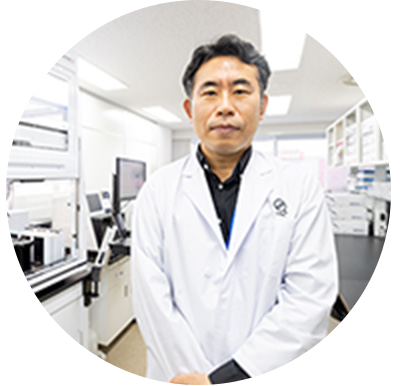 Author
PhD Yoshinori Tomikane
Graduate of the University of Tsukuba, Master's/Doctoral Program in Biological Systems and Molecular Medical Science
In 2017, developed prenatal DNA testing(Patent 7331325) using Japan's first trace-DNA analysis technology(Patent 7121440)