
Rewritten on: November 25, 2025
Whether a stain left on clothing is semen cannot be judged by the naked eye. This article explains six scientific methods—ultraviolet screening, acid phosphatase testing, PSA testing, RSID-Semen, microscopic observation, and DNA typing—and provides a detailed guide to choosing the right test for your purpose and preserving evidence properly.
- ・Introduction: The True Nature of a "Stain" That Cannot Be Judged by Appearance
- ・Main Scientific Methods for Confirming Semen
- └ 1. Ultraviolet (UV) and Visible-Light Screening
- └ 2. Acid Phosphatase (AP) Test: The Most Classic Simple Method
- └ 3. PSA (p30) Test: Detecting Prostate-Specific Antigen
- └ 4. RSID-Semen (Semenogelin Detection): A Highly Specific Modern Technique
- └ 5. Microscopic Confirmation of Sperm
- └ 6. DNA Typing: The Final Definitive Method
- ・Handling and Precautions on the Spot
- ・How to Choose the Right Forensic Test
- ・Conclusion: Only Science Can Establish the "Truth"
Introduction: The True Nature of a "Stain" That Cannot Be Judged by Appearance
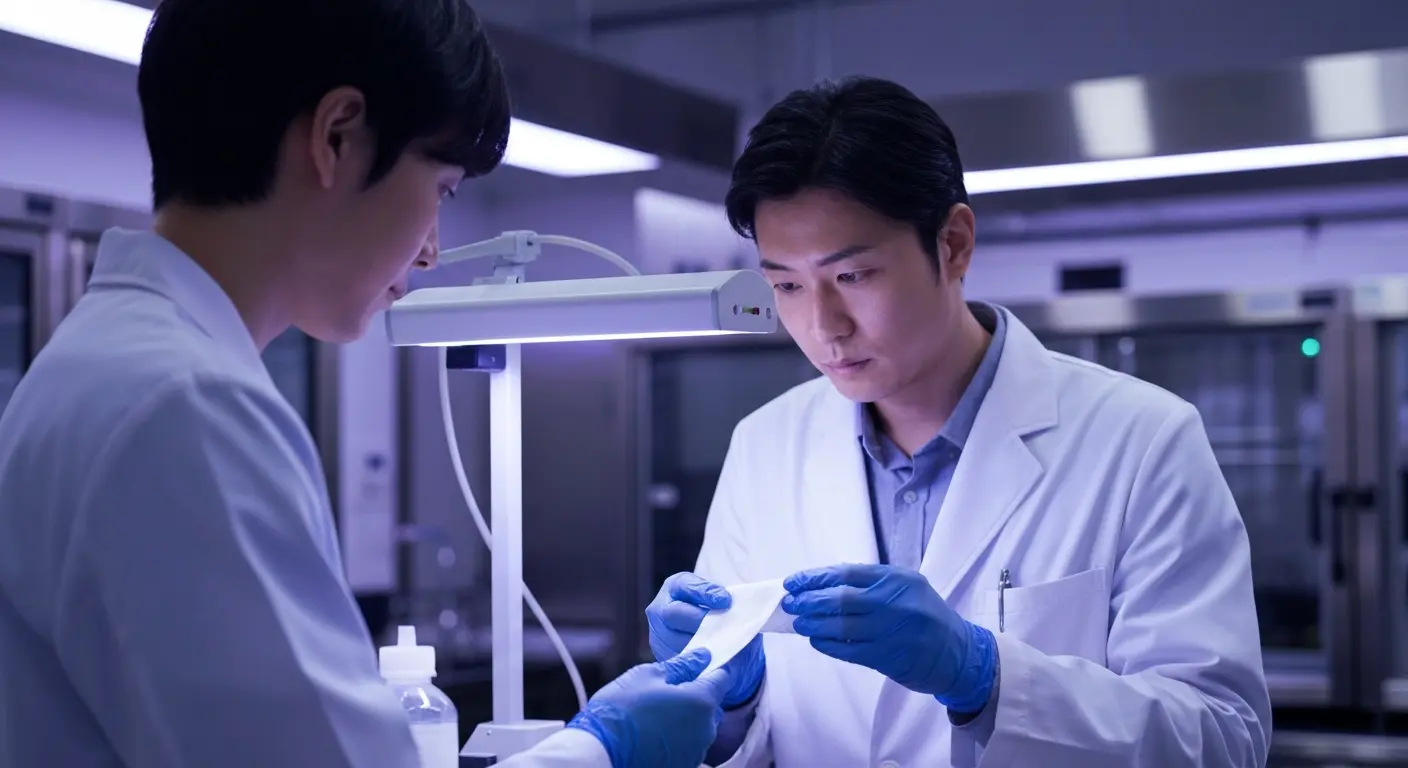
When you notice an unidentified stain on clothing and suspect it "might be semen," it's understandably unsettling. This question matters not only when suspecting a partner's affair, but also in sex-crime investigations and legal settings such as mediation or litigation, where "the true identity of the stain" becomes critically important information.
However, judging by the naked eye alone is impossible. A semen stain may turn whitish or yellowish when it dries, but due to light reflection and the effects of washing, it can be visually indistinguishable from other body fluids (saliva, sweat, vaginal secretions) or food stains (yogurt, cream-based products) [ref:1]. Depending on the fabric and color of the clothing, the stain itself may barely be visible at all.
In the field of forensic science, in such cases "chemical testing," "immunological testing," and "DNA analysis" are performed in stages to scientifically identify the presence and origin of semen. This article explains in detail the six major testing methods actually used in forensic practice, along with their respective advantages and disadvantages. We also cover preservation methods that maintain reliability as evidence, and how to choose the right test for your purpose.
Main Scientific Methods for Confirming Semen

Methods used to detect and confirm semen are broadly divided into two stages: "presumptive testing (screening)" and "confirmatory testing (definitive testing)." The typical flow is to proceed to a more specific confirmatory test once a presumptive test returns a positive result. Below, we explain six representative methods in order.
1. Ultraviolet (UV) and Visible-Light Screening
When a UV light (wavelength of roughly 350–450nm) is shone on clothing in a dark room, semen can fluoresce with a bluish-white glow. This occurs because flavins and proteins contained in semen absorb ultraviolet light and re-emit it as visible light [ref:2]. This method is convenient as a screening (first-line) test and is used to quickly locate stains across a wide area of clothing or fabric.
However, other substances (laundry detergent, fabric softener, sebum, certain beverages, lotions) also fluoresce, so this cannot provide confirmation. Fluorescence merely "suggests the presence of semen" and is prone to false positives. It is therefore wise to use UV testing only as a simple marker to identify fluorescing stain areas, which can then be advanced to the next stage of chemical testing.
2. Acid Phosphatase (AP) Test: The Most Classic Simple Method
The Acid Phosphatase (AP) test is one of the oldest presumptive semen tests in the history of forensic science. Semen contains the enzyme acid phosphatase at extremely high concentration, and when a reagent that reacts with it (such as alpha-naphthyl phosphate plus Fast Blue B) is applied, a purple or blue color change indicates a positive result [ref:3].
The advantages are that it is simple, inexpensive, and reacts even with a tiny sample. It is suitable not only for forensic labs but also for rapid field assessment. Typically, if color develops within 30 seconds to 2 minutes of applying the reagent to the stain, it is evaluated as "highly likely to be semen."
On the other hand, the disadvantage is that it can also react with saliva, vaginal secretions, and certain plant-derived substances (such as cauliflower or mushrooms). Therefore, even a positive AP result only constitutes a presumption that "a semen-like reaction is present" and does not serve as definitive evidence. The AP test is used as a "tentative determination" to decide whether to move on to the next confirmatory test.
3. PSA (p30) Test: Detecting Prostate-Specific Antigen
PSA (Prostate-Specific Antigen) is a protein secreted by the male prostate gland and is present in semen at very high concentrations. Methods for detecting PSA using immunological kits (a representative example being the ABAcard® p30) are currently used as a standard technique in many forensic labs worldwide [ref:4].
It is characterized by high specificity, with results available in a few to a dozen or so minutes. Since the mechanism involves dropping the sample onto a test strip and reading a line that appears via an antibody reaction, it can be performed without specialized equipment. It can sometimes detect semen even in highly diluted samples or samples that have degraded over time, making it highly useful in practice.
However, it has been reported that PSA can also be present in trace amounts in the urine of some men, and very rarely in women's body fluids (such as breast milk or amniotic fluid). For this reason, it is treated not as a definitive test but as a confirmatory test, and DNA typing is generally used in conjunction for final confirmation.
4. RSID-Semen (Semenogelin Detection): A Highly Specific Modern Technique
A method that has become mainstream in recent years is the RSID™-Semen kit, which detects the semen-specific protein "semenogelin." Semenogelin is a protein secreted by the seminal vesicles and is involved in the coagulation of semen immediately after ejaculation. Because this protein is almost exclusively present in semen, its major strength is that cross-reactivity with other body fluids is extremely rare [ref:5].
The RSID-Semen kit shows a reaction specific to human semen, and numerous studies have confirmed that false positives rarely occur with other body fluids such as blood, saliva, vaginal secretions, or sweat. It is internationally recognized as an extremely reliable method, is easy to handle both in the field and in the lab, and is widely used as a first-line confirmation in forensic analysis.
Note that RSID-Semen is a test that confirms "the presence of semen," not one that identifies "whose semen it is." DNA typing is required to identify an individual.
5. Microscopic Confirmation of Sperm
This method involves fixing the sample on a glass slide, staining it using a technique such as the Christmas tree stain (nuclear fast red and picroindigocarmine double staining), and then observing it under an optical microscope to confirm the morphology of the sperm head and tail [ref:2]. If sperm are confirmed, this is decisive evidence, because sperm cells have a very distinctive shape (an oval head and a long tail) that is extremely unlikely to be confused with other cells.
However, there are many cases in which no sperm are present. In men with azoospermia, sperm are naturally absent from the semen, and even when they are present, sperm may fail to be observed under the microscope if DNA or cells have degraded over time after ejaculation, or if the sperm were washed away by laundering or water exposure. Therefore, "no visible sperm" cannot be taken to mean "not semen."
Microscopic observation requires the skill and experience of a specialist, and the results can be affected by staining quality and magnification settings.
6. DNA Typing: The Final Definitive Method
This method extracts DNA from a suspected semen stain and analyzes it using STR (Short Tandem Repeat) or Y-STR typing. STR analysis examines multiple loci on the autosomes to build an individual's genetic profile. Y-STR analysis examines markers on the Y chromosome, making it possible to selectively detect male-derived DNA even when female-derived DNA is also mixed in the sample [ref:1].
This makes it possible to clearly determine "whether it is human body fluid," "whether it is male-derived," and "whose it is." By comparing against a known sample (the DNA of a reference individual), it can be scientifically proven whether a stain originates from a specific person. It is the strongest form of legal evidence and forms the basis of expert reports submitted in court or mediation proceedings.
However, DNA typing requires specialized equipment and expertise, along with a certain amount of cost and time. In litigation or investigative contexts, maintaining a chain of custody (a record of evidence management) is extremely important. If every step from sample collection through analysis and reporting is not properly documented and managed, the evidentiary value in court may be compromised.
The Staged Process of Testing Methods
In forensic practice, the typical approach is staged: first, UV screening or the AP test is used to estimate the stain's location and the possibility of semen; next, PSA testing or RSID-Semen is used to confirm that it is indeed semen; and finally, DNA typing is performed when individual identification or legal evidence is required.
Handling and Precautions on the Spot

If you want to check whether semen is present, how the sample is handled is extremely important for maintaining the accuracy of test results and their validity as legal evidence. Following these four points can minimize DNA degradation and contamination.
- Do not wash or rub it: Washing with water or detergent will cause the cells and proteins in the semen to be washed away, destroying the DNA. Once you discover a stain, leave it untouched and preserve it as is.
- Dry it before storing: Moisture accelerates DNA degradation and mold growth. Air-dry the stained garment indoors, then store it in a paper bag or paper envelope. Avoid sealing it in a plastic bag, as this traps moisture [ref:1].
- Photograph it for the record: Take both an overall photo and a close-up photo of the stain. Adding notes on the date, time, and location will be helpful for later analysis or legal proceedings.
- Consult a public institution or forensic lab: Using a commercially available kit based on your own judgment may compromise the sample's evidentiary value. If you need legally usable evidence, always consult a specialized testing institution.
Especially if you anticipate using the results as legal evidence, a chain of custody (a record of evidence management) documenting each stage—collection, shipment, receipt, analysis, and reporting—is essential. If you commission a specialized institution, they can issue an official report that includes this chain-of-custody documentation.
How to Choose the Right Forensic Test
The optimal testing method depends on your purpose. The table below summarizes recommended tests by objective.
| Purpose | Recommended Test | Reason |
|---|---|---|
| Personal confirmation | RSID-Semen or PSA test | High specificity, results in a short time |
| Investigation / legal evidence | DNA typing + microscopic observation | Highest scientific certainty; also enables individual identification |
If you personally want to first find out "whether it is semen," using RSID-Semen or a PSA test to confirm the presence of semen is fast and practical. On the other hand, if you plan to use the results as evidence in litigation, mediation, or divorce proceedings, it is strongly recommended to go as far as DNA typing and obtain a formal expert report.
- Want to know only whether semen is present, while keeping costs down → PSA test / RSID-Semen
- Want to confirm it is semen and also identify whose it is → DNA typing (STR/Y-STR)
- Anticipating submission as court evidence → DNA typing with chain of custody
- Want to check for semen from a partner who may have azoospermia → PSA/RSID-Semen are more effective than microscopic observation
- Want to test an old garment or a stain that has aged → DNA typing (may still work even with some degradation)
Conclusion: Only Science Can Establish the "Truth"
Whether a stain on clothing is semen cannot be judged by feel or appearance. You may find claims online such as "you can tell by the smell" or "you can tell by the texture," but these have no scientific basis and cannot serve as legal evidence.
Only chemical and forensic methods can provide reliable evidence. By progressing step by step—from presumptive testing with UV screening and the AP test, to confirmatory testing with PSA and RSID-Semen, and finally to individual identification via DNA typing—you can obtain highly accurate results [ref:1].
The method you choose should depend on your purpose (personal confirmation versus legal evidence). If it is to be used in a legal setting, preserving the sample properly and maintaining a chain of custody are essential, and commissioning a reliable, specialized institution is the best choice. Correct knowledge and a calm approach help prevent unnecessary misunderstandings and disputes, leading to appropriate decisions based on scientific fact.
 Apply / Purchase Kit
Frequently Asked Questions
Q1. Can I tell for myself whether a stain on clothing is semen?
A. It is not possible to determine whether something is semen by sight or smell alone. A semen stain may appear white to yellow after drying, but food and other body fluids (saliva, sweat, vaginal secretions) can produce similar-looking stains, making visual distinction impossible. An accurate determination requires scientific testing such as a PSA test, RSID-Semen, or DNA typing.
Q2. If it glows under an ultraviolet (UV) light, can it be confirmed as semen?
A. No, this cannot confirm it. Many substances other than semen fluoresce under UV light, including laundry detergent, fabric softener, sebum, certain beverages, and cosmetics. UV testing is merely a screening (first-line) test to locate a stain; PSA testing, RSID-Semen, or DNA typing is needed for a definitive result.
Q3. Can semen still be detected from clothing that has already been washed?
A. Washing significantly reduces and degrades DNA and proteins, but it does not necessarily eliminate them completely. If trace amounts of DNA remain deep within the fibers, a highly sensitive DNA typing test may still be able to detect it. However, whether detection is possible depends on factors such as the number of washes, the type of detergent used, temperature, and elapsed time, so consulting a specialized institution is essential.
Q4. Can semen from a man with azoospermia still be detected?
A. Yes, it can be detected. Even without sperm present, semen contains proteins such as prostate-specific antigen (PSA) and semenogelin, so the presence of semen can be confirmed with a PSA test or RSID-Semen test. Since microscopic sperm observation may not confirm it in such cases, combining immunological testing with DNA typing is recommended.
Q5. Can the results of a semen forensic test be used as evidence in court?
A. Results from a DNA typing test conducted through proper procedures at a specialized forensic lab can be submitted as evidence in court or mediation. However, for the results to be accepted as legal evidence, it is important that a "chain of custody" (a record of evidence management) documenting the entire process—from sample collection through analysis and reporting—has been properly maintained. seeDNA Genetic Medicine Institute also supports the issuance of legally valid expert reports.
Q6. How long does testing take?
A. This varies depending on the type of test. For semen determination using only PSA testing or RSID-Semen, results are generally available within a few days to about a week after the sample arrives. If DNA typing is included, it may take about 1 to 3 weeks. Please check the detailed schedule at the time of application.
Reliable Support from seeDNA Genetic Medicine Institute
seeDNA Genetic Medicine Institute is a trusted and reliable specialist institution for DNA testing and genetic testing, holding the international quality standard ISO 9001 certification and the Privacy Mark for personal information protection.
If you are concerned about family or parent-child biological relationships, or a partner's infidelity, our DNA testing specialists are here to provide reassuring support, so please feel free to contact us.
[Free Consultation with Specialist Staff]

If you have any questions,
please feel free to contact our toll-free number.
/Open every day, including weekends/
Business hours: Monday–Sunday 9:00 AM–6:00 PM
(except public holidays)
 Author
Kihan Tomikane, M.D., Ph.D.
Graduate of the Master's/Doctoral Program in Biosystem Studies (Molecular and Biological Sciences), University of Tsukuba
In 2017, developed Japan's first prenatal DNA testing(Patent No. 7331325) using trace-DNA analysis technology(Patent No. 7121440)