
Last revised: March 9, 2025
Even for dogs with pedigree papers, scientifically proving parentage through DNA testing helps ensure accurate breed identification, prevention of hereditary diseases, and appropriate training. Here we explain in detail the benefits of canine DNA parentage testing.
- ・What Is a "Pedigreed Dog"? Its System and Limitations
- ・The Benefits of Proving a Dog's Pedigree
- └ Key Benefits of Pedigree Verification by DNA Testing
- ・Personality, Traits, and Disease Susceptibility Vary by Breed
- └ Examples of Hereditary Diseases to Watch for by Breed
- ・The Process of Canine DNA Testing
- ・About seeDNA's Canine DNA Parentage Testing
What Is a "Pedigreed Dog"? Its System and Limitations
 Hearing the phrase "pedigreed dog" alone conjures an image of an excellent, trustworthy animal. A pedigree certificate is like a family register for humans — an official registration document listing the lineage of the parents, grandparents, and great-grandparents going back three generations. In Japan, breed registry organizations such as the Japan Kennel Club (JKC) issue pedigree certificates, which record the breed name, registration number, coat color, breeder information, and more [ref:1].
However, having a pedigree certificate does not necessarily guarantee peace of mind. The reason is that pedigree certificates are issued based on the breeder's application, and most organizations issue them exactly as applied for. In other words, in most cases there is no built-in process to scientifically verify the accuracy of the application content. As a result, whether the puppy was truly born from the parent dogs listed on the certificate ultimately comes down to trusting the breeder.
In fact, it is not uncommon for breeding facilities to keep multiple breeds at once, and the possibility of mix-ups or unintended mating is never zero. Some owners may feel uneasy about whether the pedigree certificate is truly accurate, for instance, if a dog's face or build seems to differ from what would be expected of its stated breed as it grows. In recent years, the market for canine genetic testing has been expanding rapidly, especially in the United States, and there is a growing movement to scientifically verify pedigree accuracy [ref:2].
This time, we introduce in detail the benefits of conducting canine DNA testing. Canine DNA testing is a parentage test for dogs that confirms whether a parent dog and puppy share the same bloodline. As with human parentage testing, it is possible to scientifically determine parentage based on genetic evidence by analyzing genetic polymorphisms such as microsatellite (STR) markers [ref:3].
The Benefits of Proving a Dog's Pedigree
 When is a pedigree certificate actually needed in the first place? It is mainly required as proof when entering a dog show or during breeding, and in reality there may be few occasions where a typical breeder raising a pet dog actually needs one.
However, being able to definitively prove a bloodline offers major benefits in many respects. If canine DNA testing confirms the parent-child relationship between the parent dogs and puppy listed on the pedigree certificate, then as long as they share the same bloodline, the breed is clearly confirmed to match the pedigree certificate.
Dogs also vary considerably in personality and traits depending on the breed. Therefore, correctly confirming the breed makes it easier to understand the dog's personality and to learn about genetically susceptible diseases and food allergies, making prevention easier. Cornell University's College of Veterinary Medicine has also reported that canine DNA testing is useful not only for breed identification but also for understanding genetic health risks [ref:4].
Key Benefits of Pedigree Verification by DNA Testing
- Scientifically verify the parent-child relationship listed on the pedigree certificate
- Accurately identify the breed and understand breed-specific personality and temperament
- Identify hereditary disease risks in advance for preventive health management
- Understand sensitivity to medications (such as heartworm preventives) for safer dosing
- Use accurate pedigree information for dog shows and breeding plans
- Serve as objective evidence to prevent future disputes
Personality, Traits, and Disease Susceptibility Vary by Breed
 For example, if you know that a breed is prone to biting or barking habits, you can train your dog with that in mind. Biting habits often become a problem once a dog reaches adulthood, and biting another person could develop into a serious issue. Excessive barking can also become a noise problem. Understanding breed-specific behavioral traits is the first step toward a less stressful life for both owner and dog.
Additionally, knowing that a breed requires a lot of exercise allows you to secure sufficient walking time, which can help reduce stress caused by lack of exercise. For example, herding and working breeds such as the Border Collie and Jack Russell Terrier are said to need 1-2 hours or more of exercise per day. Conversely, brachycephalic (short-nosed) breeds such as the French Bulldog and Shih Tzu should avoid strenuous exercise and require particular care with heat management.
Examples of Hereditary Diseases to Watch for by Breed
| Breed Group | Representative Breeds | Diseases to Watch For |
|---|---|---|
| Large breeds | Golden Retriever, Labrador | Hip dysplasia, malignant lymphoma |
| Small breeds | Chihuahua, Toy Poodle | Patellar luxation, hydrocephalus |
| Brachycephalic breeds | French Bulldog, Pug | Brachycephalic airway syndrome, intervertebral disc herniation |
Hereditary diseases and susceptibility to toxicity from medications such as ivermectin (a heartworm preventive commonly used in dogs) also vary by breed, which can be useful reference information when your dog becomes ill. In particular, many Collie-type breeds carry the MDR1 gene mutation and are known to show severe toxic reactions to ivermectin [ref:5]. Since the presence of this gene mutation can also be checked in advance through DNA testing, medication safety can be dramatically improved.
As this shows, since personality, traits, and disease susceptibility vary so much by breed, there are many benefits to be gained from confirming a dog's breed.
The Process of Canine DNA Testing
Canine DNA testing proceeds through the following steps. Sample collection can be easily performed by the owner at home.
- Application and receiving the sample kit: A dedicated sample collection kit is delivered to your home.
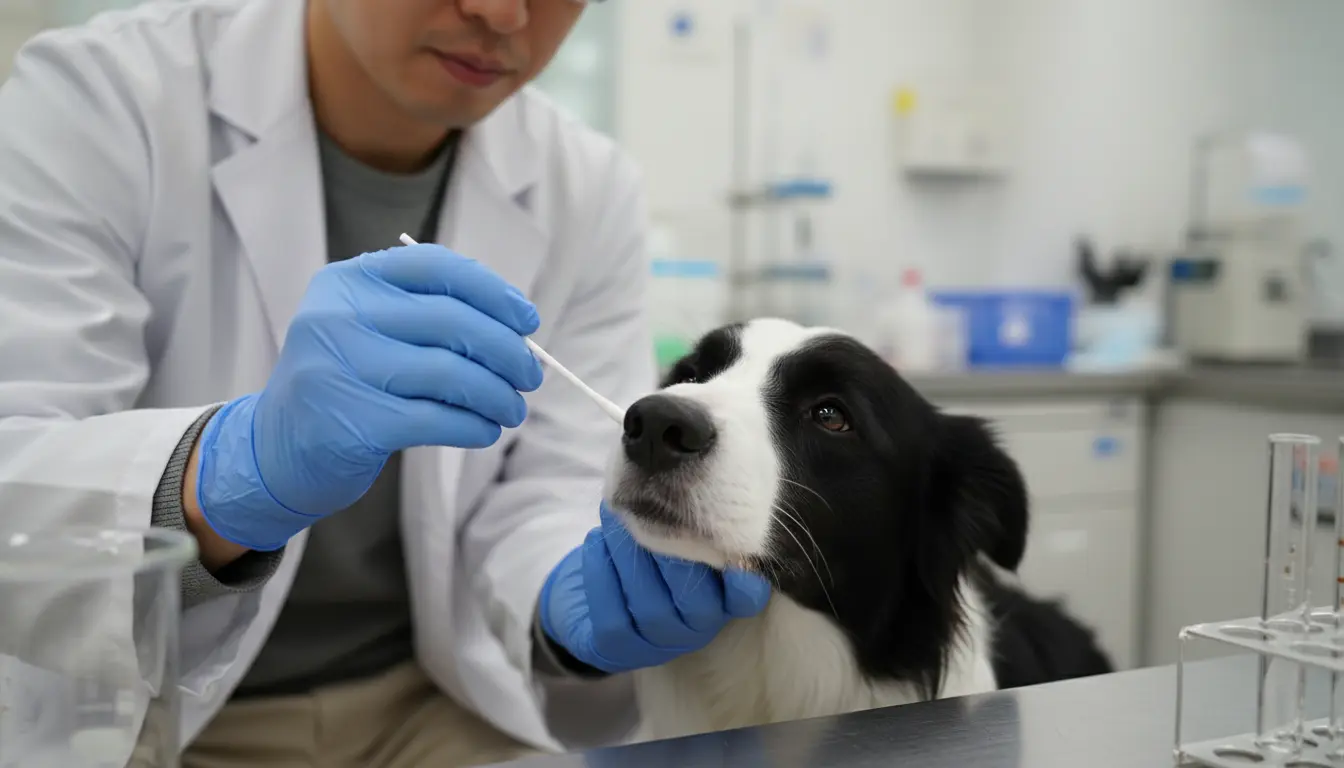
- Sample collection: Using an oral swab (cotton swab), you collect oral mucosal cells from your dog. It is painless and completed in a short time.
- Returning the sample: The collected sample is sent to the laboratory using the enclosed return envelope.
- DNA analysis: The laboratory performs genetic analysis using STR markers and other methods.
- Reporting the results: The test results are delivered to you in writing or by email. The result clearly states whether parentage is confirmed or excluded.
About seeDNA's Canine DNA Parentage Testing
seeDNA has a strong track record not only in human DNA testing but also in canine DNA testing. With a testing system that complies with international standards, we deliver accurate and prompt results. If you have any concerns about your dog's pedigree, please feel free to contact us. By obtaining scientific backing that a pedigree certificate alone cannot provide, you can make life with your dog more secure and fulfilling.
Canine DNA Parentage Testing
Contact Us
Frequently Asked Questions
Q1. What can canine DNA testing tell us?
A. In canine DNA parentage testing, the genotypes of the parent dog and puppy are compared to scientifically determine whether a blood relationship (parentage) exists. It is used as a means of objectively verifying whether the parentage listed on a pedigree certificate is correct.
Q2. How is a sample collected from a dog? Is it painful?
A. Samples can be collected simply by gently rubbing the inside of the dog's cheek with a dedicated oral swab (cotton swab). There is no need to draw blood, and there is almost no pain, so the burden on your dog is minimal. Owners can easily perform this themselves at home.
Q3. If I have a pedigree certificate, is DNA testing unnecessary?
A. Because pedigree certificates are issued based on the breeder's self-declaration, the accuracy of the listed content is not 100% guaranteed. Since the risk of breed mix-ups or unintended mating is never zero, DNA testing offers the benefit of scientifically confirming an accurate pedigree.
Q4. How does knowing the breed help with health management?
A. Genetically susceptible diseases (such as hip dysplasia and patellar luxation) and drug sensitivities (such as ivermectin toxicity due to the MDR1 gene mutation) vary by breed. Accurately identifying the breed makes it possible to establish an appropriate prevention and treatment plan in coordination with a veterinarian.
Q5. How many days does it take to receive the test results?
A. Results are typically delivered within about 5-10 business days after the sample arrives at the laboratory. An express plan is also available for those in a hurry, so please contact seeDNA for details.
Q6. Can DNA testing be done for mixed-breed dogs?
A. Yes, it is possible. Even for mixed-breed dogs, parentage DNA testing to confirm the relationship with a parent dog can be performed. However, this is a different service from "breed identification testing," which examines breed composition ratios, so please consult us according to your purpose.
Reliable Support from seeDNA Genetic Medical Research Institute
seeDNA Genetic Medical Research Institute is a trusted DNA testing and genetic testing specialist certified with the international quality standard ISO9001 and the Privacy Mark.
If you have concerns about family or parent-child blood relationships, or a partner's infidelity, our DNA testing experts are here to support you with reassurance, so please feel free to contact us.
[Free Consultation with Specialist Staff]

If you have any questions,
please feel free to contact our toll-free number.
/Open every day, including weekends/
Business hours: Mon-Sun 9:00 AM-6:00 PM
(excluding holidays)
 Author
Dr. Kihan Tomikane, M.D.
Completed his Master's/Doctoral program in Biological and Molecular Information Medicine at the University of Tsukuba Graduate School
In 2017, developed Japan's first prenatal DNA testing(Patent 7331325) using low-quantity DNA analysis technology(Patent 7121440)