
Rewritten: August 18, 2025
A thorough comparison of the accuracy of ultrasound, combined testing, and NIPT in terms of sensitivity, specificity, and predictive value. We explain how each test works, its cost, and which type of expectant mother it best suits, to help you choose a prenatal test with confidence.
- ・The First Step Toward Turning Anxiety into Reassurance — Understanding Non-Invasive Prenatal Testing
- ・The Basic Differences Between the Three Tests
- └ Ultrasound (Sonography)
- └ Combined Test
- └ NIPT (Non-Invasive Prenatal Testing)
- ・Comparing Test Accuracy — Understanding Sensitivity, Specificity, and Predictive Value Correctly
- └ Accuracy of Ultrasound
- └ Accuracy of the Combined Test
- └ Accuracy of NIPT
- ・Summary of Accuracy Comparison
- ・Choosing the Right Test for Your Situation
- └ NIPT for Those Who Want Highly Accurate Results
- └ The Combined Test for Those Who Want to Keep Costs Down
- └ Ultrasound for Those Who Want to Start with a Standard Test
- ・What to Know Before Undergoing Testing
- ・Choosing the Right Test for You Leads to a Confident Birth
- ・Screen for the Risk of 8 Genetic Diseases at Japan's Lowest Price with "NIPT (Non-Invasive Prenatal Testing)"
The First Step Toward Turning Anxiety into Reassurance — Understanding Non-Invasive Prenatal Testing

Along with the joy of learning you are pregnant, it is natural for many expectant mothers to feel anxious about whether "the baby will be born healthy." In particular, it is well known that the risk of chromosomal abnormalities such as Down syndrome (trisomy 21) increases with maternal age, and interest in testing has been growing year by year, especially among expectant mothers aged 35 and older. [ref:1]
Currently, the three main non-invasive prenatal screening tests available in Japan are ultrasound (sonography), the combined test, and NIPT (non-invasive prenatal testing). All of these are "non-invasive tests" that pose extremely low risk to the mother and fetus, but they differ greatly in their testing principles, timing, detection accuracy, and cost. As a result, many people say things like "I don't know which test to choose" or "I don't understand the differences in accuracy."
This article provides a thorough comparison of the features and accuracy of ultrasound, the combined test, and NIPT (non-invasive prenatal testing), and explains in detail which type of person each test is best suited for. We hope this will help expectant mothers and their partners who are unsure which test to choose make a confident decision.
The Basic Differences Between the Three Tests
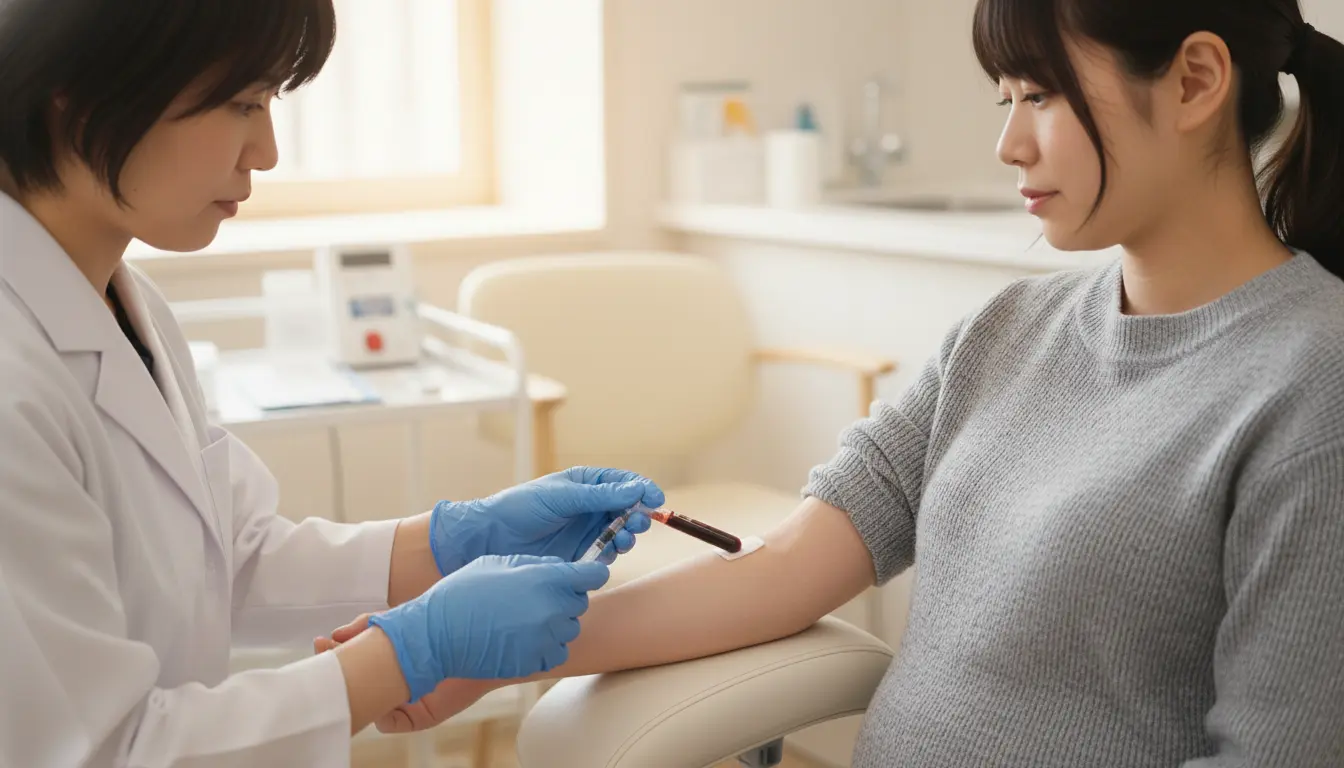 The quality and accuracy of information obtained from prenatal screening tests vary greatly depending on the testing principle used. Here, we explain in detail how ultrasound, the combined test, and NIPT work and what characterizes each.
Ultrasound (Sonography)
Ultrasound is a test that uses sound waves to visually assess the fetus's form. By measuring the fluid buildup at the back of the neck (NT: Nuchal Translucency) from 11 weeks of pregnancy onward, it can estimate the risk of chromosomal abnormalities, including Down syndrome. [ref:3]
The greatest feature of this test is that it allows direct observation of the fetus's "shape." Besides Down syndrome, it plays an important role in detecting structural abnormalities such as heart defects (congenital heart disease), brain development abnormalities (such as anencephaly), and congenital abnormalities of the kidneys or digestive tract. It is also usually performed as part of routine prenatal checkups, so it typically involves no additional cost.
However, ultrasound is merely a test that observes structural changes and does not directly detect chromosomal abnormalities themselves. There are cases where the NT measurement is thick but no chromosomal abnormality is present, and conversely, cases where the NT measurement is within the normal range but a chromosomal abnormality does exist. It should also be understood that results can vary depending on the examiner's skill and experience.
Combined Test
The combined test is a composite screening test performed around 11 to 13 weeks of pregnancy. It combines the NT measurement from ultrasound with the levels of fetal/placental-derived hormones in maternal blood (free β-hCG, PAPP-A, etc.), and further factors in maternal age to statistically calculate the risk of chromosomal abnormalities, including Down syndrome. [ref:3]
In this test, results are presented as a "probability." For example, results might be given as "a 1 in 250 risk of Down syndrome," making it easier to grasp the degree of risk for an individual pregnancy as a numerical value. Because it achieves higher detection accuracy than ultrasound alone, it is considered a highly useful screening test.
On the other hand, because it is based on statistical probability, there is a possibility of false positives, where a fetus is judged "high risk" despite not actually having Down syndrome, and conversely false negatives, where a fetus is judged "low risk" despite actually having Down syndrome. The false-positive rate is said to be about 5%, and if a positive result is obtained, a confirmatory test such as amniocentesis or chorionic villus sampling may be recommended. [ref:4]
NIPT (Non-Invasive Prenatal Testing)
NIPT is the most advanced test, analyzing fetal-derived cell-free DNA (cfDNA) contained in maternal blood. It can be performed from 10 weeks of pregnancy onward, and its greatest feature is that, while being a non-invasive test requiring only a blood draw, it can assess chromosomal abnormalities more directly. [ref:7]
cfDNA refers to DNA fragments released into the mother's bloodstream as placental cells naturally break down. NIPT analyzes these minute DNA fragments using advanced molecular biology techniques such as next-generation sequencing, detecting quantitative abnormalities in specific chromosomes (such as trisomies) with high precision. Unlike ultrasound or the combined test, which indirectly estimate risk from imaging findings or blood markers, NIPT directly analyzes genetic material (DNA), giving it overwhelmingly higher detection accuracy compared to other screening tests. [ref:8]
However, NIPT is also a screening test, not a definitive diagnosis. If a positive result is obtained, a confirmatory diagnosis via amniocentesis or similar procedures is recommended. In addition, depending on the mother's condition (such as very high body weight), the proportion of fetal-derived cfDNA may be low, and in rare cases no result can be obtained (an "indeterminate" result).
Comparing Test Accuracy — Understanding Sensitivity, Specificity, and Predictive Value Correctly
 When choosing a prenatal test, what concerns most expectant mothers the most is "how accurately can it detect an abnormality?" This is where the various indicators that show a test's "accuracy" become important. The following four are especially worth noting.
- Sensitivity (detection rate)
- : This is the ability to properly identify babies who "do" have an abnormality. The higher the sensitivity, the fewer cases are "missed." For example, with a test that has 99% sensitivity, 99 out of 100 babies who have an abnormality will be correctly identified as positive.
- Specificity
- : This is the ability to correctly judge babies who "do not" have an abnormality as abnormality-free. The higher the specificity, the fewer cases of "false positives" there are. With a specificity of 99.9%, 999 out of 1,000 babies without an abnormality will be correctly judged negative.
- Positive Predictive Value (PPV)
- : This is the actual probability that a positive result is truly correct. In other words, it indicates whether you can trust that "positive = an abnormality is present." This value is influenced not only by the test's accuracy but also by the prevalence of the condition in the population being tested (such as maternal age).
- Negative Predictive Value (NPV)
- : This is the actual probability that a negative result truly means no abnormality is present. The higher this is, the more it can be said that "negative = you can be reassured." NIPT is known for having an extremely high value here.
As shown above, it is very important for choosing a test and making subsequent decisions to understand not just the "positive or negative" result itself, but also "how reliable that result is." Let's look in detail at the accuracy of each test below.
Accuracy of Ultrasound
The sensitivity of ultrasound alone for detecting Down syndrome is said to be around 70%. In other words, about 30% of fetuses with Down syndrome may be missed by ultrasound alone. Because it is an indirect assessment based on imaging findings, specificity also has its limits, and a certain proportion of "false positive" cases occur where the NT measurement is thick but no chromosomal abnormality is present. Results are also affected by the examiner's skill and the performance of the ultrasound equipment used, so it is considered desirable for the test to be performed by an examiner who has received specialized training. [ref:2] [ref:3]
Accuracy of the Combined Test
The combined test is reported to have a sensitivity of 82–87% and a specificity of about 95%. Compared to ultrasound alone, combining it with blood markers improves the detection rate by about 10 to 17 percentage points. However, positive predictive value is greatly influenced by maternal age. In expectant mothers aged 40 and older, the prevalence of Down syndrome is higher, so positive predictive value also rises, but in younger expectant mothers in particular, the false-positive rate tends to be relatively higher. The false-positive rate is said to be about 5%, meaning that among those who receive a positive result, some will not actually have a chromosomal abnormality. [ref:3] [ref:4]
Accuracy of NIPT
NIPT shows a sensitivity of 99.3% and an extremely high specificity of 99.9% for Down syndrome (trisomy 21). Among the three screening tests, it has the highest detection power, and its false-positive rate is also far lower than the other tests. The positive predictive value for Down syndrome is said to be over about 90% for expectant mothers aged 40, making it a particularly reliable test for expectant mothers aged 35 and older. [ref:6] [ref:8]
Of particular note is that its negative predictive value is close to nearly 100%. In other words, if NIPT gives a negative result, that result is extremely reliable, offering the psychological reassurance that "if you tested negative, you can feel nearly certain." This is one of the major reasons NIPT is chosen by so many expectant mothers.
Summary of Accuracy Comparison
The accuracy of the three tests can be summarized as follows.
| Indicator | Ultrasound | NIPT |
|---|---|---|
| Sensitivity | About 70% | 99.3% |
| Specificity | Limited | 99.9% |
| Timing | From 11 weeks | From 10 weeks |
*Combined test: sensitivity 82–87%, specificity about 95%, timing 11–13 weeks
As is clear from the figures above, in terms of detection accuracy, NIPT far outperforms the other two tests. That said, it is important not to choose a test based solely on accuracy, but to consider cost, timing, the scope of information obtained, and your own values as a whole.
Choosing the Right Test for Your Situation
Once you understand the accuracy and features of each test, it is important to choose the one best suited to your own circumstances. Here we introduce recommended tests for representative situations.
NIPT for Those Who Want Highly Accurate Results
For expectant mothers aged 35 and older, or those who want to know their risk as accurately as possible, we recommend NIPT. It can be performed from 10 weeks of pregnancy and boasts a detection rate of over 99% for Down syndrome. Its negative predictive value is also extremely high, offering the major benefit of psychological reassurance that "a negative result means you can feel nearly certain." [ref:7]
Furthermore, with a single blood draw, it can check not only for Down syndrome but also for the risk of Edwards syndrome (trisomy 18), Patau syndrome (trisomy 13), Turner syndrome, Klinefelter syndrome, Triple X syndrome, XYY syndrome, and whole-chromosome numerical abnormalities all at once.
- Can be tested as early as 10 weeks of pregnancy
- Requires only a blood draw, placing minimal burden on mother and fetus
- High accuracy with 99.3% sensitivity and 99.9% specificity
- Negative predictive value of nearly 100% for high peace of mind
- Can simultaneously evaluate the risk of up to 8 chromosomal abnormalities from a single blood draw
The Combined Test for Those Who Want to Keep Costs Down
Although NIPT covers many test items, even the cheapest plan costs 79,800 yen. For those who prioritize cost and prefer to be tested at a public medical institution, the combined test is a good fit.
It can be performed at 11 to 13 weeks of pregnancy, offering the same early risk assessment as NIPT. It has the advantage of being relatively inexpensive and available at many medical institutions, but it should be understood that its accuracy is lower than that of NIPT. In many cases where a positive result is obtained, a confirmatory amniocentesis is required, and the psychological and physical burden of that procedure should also be taken into account.
Ultrasound for Those Who Want to Start with a Standard Test
For those who first want to obtain basic information within the scope of routine prenatal checkups, we recommend starting with ultrasound.
It allows you to check the fetus's growth and form, and a specialized ultrasound exam can include NT measurement and detailed observation of organs. Since it is included in routine prenatal checkups in many cases, it involves no additional cost, making it the option with the least financial burden. However, since ultrasound alone cannot detect chromosomal abnormalities with high accuracy, if a more detailed risk assessment is needed, adding NIPT or the combined test should be considered.
What to Know Before Undergoing Testing
When undergoing prenatal testing, it is important to understand not only the test's accuracy but also how to respond after the results come back. Use the steps below as a guide to prepare for testing.
- Gather information: Understand the features, accuracy, and cost of each test, and consider which one suits you
- Genetic counseling: Consult with a specialist to correctly understand the meaning of the test and how to interpret the results
- Discuss with your partner: Talk thoroughly with your partner in advance about whether to undergo testing and how to respond if the result is positive
- Undergo the test: Take the chosen test at the appropriate time
- Accept the results and decide next steps: If the result is positive, consider whether a confirmatory diagnosis is needed and consult a specialist as necessary
What is especially important is that the results of a screening test are merely a "risk assessment" and not a definitive diagnosis. If any screening test, including NIPT, comes back positive, undergoing a confirmatory test such as amniocentesis or chorionic villus sampling is recommended. Conversely, a negative result does not guarantee 100% that there is no abnormality, but especially for NIPT, the negative predictive value is extremely high and is a reliable enough basis for reassurance.
Also, according to a large-scale follow-up survey of NIPT in Japan published by the Japan Association of Obstetricians and Gynecologists' prenatal testing certification operating committee, many expectant mothers who underwent NIPT have properly accepted their test results and used them in their subsequent pregnancy management. [ref:2] Testing is not something that "increases anxiety" — when approached with correct knowledge, it can be an effective means of "gaining reassurance."
Choosing the Right Test for You Leads to a Confident Birth
Ultrasound, the combined test, and NIPT are each tests with different features and accuracy. What matters is choosing the test best suited to you by considering your age, weeks of pregnancy, family history, values, and financial circumstances as a whole.
It is important to understand that every test has its limits, and there may be situations where a confirmatory diagnosis is needed. It is not at all rare for a case where a screening test came back positive to turn out, upon confirmatory testing, to have no chromosomal abnormality after all. Conversely, even if a screening test is negative, there remains, in very rare cases, a possibility that something was missed.
Psychological preparation for the test results is also important. We recommend fully understanding, before undergoing testing, how you would respond to a positive result, whether you would undergo further testing, and what kind of support would be available to you. Receiving genetic counseling beforehand can help you correctly understand the significance and limitations of the test, allowing you to accept the results more calmly. [ref:5]
Choosing a test with confidence eases anxiety during pregnancy and leads to a reassured pregnancy and birth. Whichever test you choose, "knowing" is never something to fear — it is a positive step toward protecting your baby's health.
Screen for the Risk of 8 Genetic Diseases at Japan's Lowest Price with "NIPT (Non-Invasive Prenatal Testing)"
Learn about your baby's genetic disease risk
Frequently Asked Questions
Q1. What is the biggest difference between NIPT and ultrasound?
A. The biggest difference is the testing principle. Ultrasound uses sound waves to observe the fetus's form (appearance) and indirectly estimates chromosomal abnormalities. NIPT, on the other hand, directly analyzes fetal-derived cell-free DNA (cfDNA) in maternal blood, assessing chromosomal abnormalities at the genetic material level. As a result, NIPT has significantly higher detection accuracy for chromosomal abnormalities, including Down syndrome, showing high figures of 99.3% sensitivity and 99.9% specificity.
Q2. If the combined test shows a "high risk" result, does that necessarily mean Down syndrome?
A. No, it does not necessarily mean Down syndrome. The combined test is a screening test based on statistical probability, and a "high risk" result may include the possibility of a false positive. The false-positive rate is said to be about 5%, and among those judged positive, there are not a few cases with no actual chromosomal abnormality. A confirmatory diagnosis requires amniocentesis or chorionic villus sampling.
Q3. From when can NIPT be performed?
A. NIPT can be performed from 10 weeks of pregnancy onward. This is earlier than ultrasound (from 11 weeks) or the combined test (11–13 weeks). Being able to receive a highly accurate risk assessment early in pregnancy is one of NIPT's major benefits. Since the test only requires a blood draw, it places almost no physical burden on the mother or fetus.
Q4. If NIPT comes back negative, can I be 100% reassured?
A. NIPT's negative predictive value is extremely high, close to nearly 100%, so a negative result provides a very high degree of reassurance. However, since it is a screening test, it does not guarantee 100% certainty. Also, since conditions or structural abnormalities not covered by NIPT (such as structural heart defects) cannot be assessed by this test, it is recommended to also undergo regular ultrasound (as part of prenatal checkups) in parallel.
Q5. How much does NIPT cost?
A. The cost of NIPT varies depending on the testing institution and plan, but generally runs around 100,000 to 200,000 yen. At seeDNA, it is available from one of Japan's lowest prices, 79,800 yen, and a single blood draw can simultaneously test for the risk of up to 8 chromosomal abnormalities, including Down syndrome. Compared to the combined test or ultrasound, the cost is higher, but in exchange you get higher accuracy and a broader range of test items.
Q6. Can expectant mothers under 35 also undergo NIPT?
A. Yes, it can be undergone regardless of age. It used to be recommended mainly for expectant mothers aged 35 and older, but in recent years more people wish to be tested regardless of age. However, since the prevalence of Down syndrome is lower in expectant mothers under 35, the positive predictive value (the probability that a positive result is truly correct) tends to be lower compared to those aged 35 and older. We recommend receiving genetic counseling beforehand to properly understand the meaning of the test and how to interpret the results.
The Trusted Support of seeDNA Genetic Medical Institute
seeDNA Genetic Medical Institute is a trusted and reliable specialist institution for DNA testing and genetic testing, certified with the international quality standard ISO 9001 and the Privacy Mark for privacy protection.
If you have concerns about family or parent-child blood relationships, or a partner's infidelity, our DNA testing specialists are here to support you with peace of mind, so please feel free to contact us.
[Free Consultation with Specialist Staff]

If you have any questions,
please feel free to contact our toll-free number.
/Open every day, including weekends/
Business hours: Monday–Sunday 9:00 AM–6:00 PM
(excluding holidays)
Author
Doctor of Medical Science, Physician
Tasuku Hiroshige
Doctor of Medical Science; specialist and instructor certified by the Japanese Urological Association; certified physician by the Japanese Society of Medical Oncology; specialist certified by the Japanese Society of Anti-Aging Medicine; industrial physician certified by the Japan Medical Association; certified physician by the Japanese Society of Chemotherapy; certified physician by the Japanese Society for Sexually Transmitted Infections; Certificate of da Vinci system
Training As a Console Surgeon, and more
After graduating from Kagoshima University Faculty of Medicine in 2010, he has built extensive clinical experience as a urologist. In addition to clinical work, he is also actively engaged in academic activities such as presenting at conferences, writing papers, and securing research funding. He holds specialist qualifications across a wide range of fields, including urology, cancer treatment, anti-aging medicine, and infectious disease treatment. Drawing on his extensive medical knowledge and skills, he provides care tailored to each individual patient.
[References]
(2) Cleveland Clinic, August 2023
(3) NIPT Non-Invasive Prenatal Testing, Results in as Little as 2 Days - Hiro Clinic, September 2021
(4) Med J Aust, July 2015
(5) Chem Biol Drug Des, April 2017
(6) Follow-up Survey of 100,000 Expectant Mothers Who Underwent NIPT | Prenatal Testing Certification System Operating Committee, March 2021
(7) Ministry of Health, Labour and Welfare, "Encountering Life: The Current State and Challenges of Prenatal Testing"
(8) Int J Mol Med, May 2018