
 rheumatoid arthritis

- Rheumatoid arthritis (RA) is an autoimmune disease in which the immune system attacks joint tissues.The incidence rate in Japan is approximately 0.5-1.0% of the population.
- C-type mutation in DNA region rs4239702A Harvard Medical School study found that people with the disease tend to have a higher risk of developing the disease
- Early diagnosis and appropriateDrug therapy/rehabilitationIt is possible to suppress the progression of joint destruction by
Overview ,p>Rheumatoid arthritis (RA) is an autoimmune disease that causes inflammation in the joints, resulting in chronic pain. It often affects the joints of the hands, wrists, and feet, but can also affect other joints. Stiffness and pain are especially strong in the morning and after long periods of inactivity. RA affects not only the joints but also the whole body, causing various symptoms such as fatigue, fever, and loss of appetite. Over time, the structures within the joint can change, reducing mobility and possibly leading to deformity. Additionally, characteristic lumps called rheumatoid nodules may appear in RA, and although these are often painless, they may indicate progression of the disease. When RA symptoms occur in one hand, they tend to affect the other hand as well. However, the severity of symptoms varies from person to person and can range from mild to severe. Research by Yukinori Okada and colleagues at Harvard Medical School revealed that the risk of developing rheumatoid arthritis is associated with a DNA region called rs4239702. There are three genotypes in this DNA region: TT, TC, and CC, and it was found that people with the C genotype tend to have a higher risk of rheumatoid arthritis.
What is rheumatoid arthritis?
Rheumatoid Arthritis (RA) is an autoimmune disease in which the immune system mistakenly attacks the synovium of one's own joints.It causes chronic joint inflammation, which progresses to joint destruction and deformity. In Japan, approximately 0.5 to 1.0% of the population (approximately 600,000 to 1 million people) is affected (1).
Causes and mechanisms of rheumatoid arthritis
Rheumatoid arthritis is caused by an abnormality in the immune system. The following factors are involved in a complex manner:
- Autoimmune reaction:Immune cells mistake joint synovium as a "foreign object" and attack it, leading to chronic inflammation.
- Genetic predisposition:Multiple genes are involved, including the HLA-DR4 gene, and familial incidence is 2-3 times higher
- Environmental factors:Smoking increases the risk of developing the disease by approximately 1.5 to 2.0 times.
- Hormones:The incidence rate in women is 3 to 4 times that in men, suggesting that female hormones are involved.
Main symptoms of rheumatoid arthritis
The symptoms areappear symmetricallyThe points are distinctive. Symptoms in one hand tend to affect the other hand as well.
- Morning stiffness:A feeling of stiffness in the joints that lasts for more than 30 minutes when you wake up
- Joint swelling/pain:Often affects the small joints of the hands, wrists, and feet.
- Systemic symptoms:Fatigue, slight fever, loss of appetite
- Rheumatoid nodules:A painless lump that appears on the elbow or finger (an indicator of disease progression)
- Joint deformity:In advanced stages, joint range of motion decreases and deformities (swan neck deformity, buttonhole deformity)
Difference between rheumatoid arthritis and osteoarthritis
| Comparison items | Rheumatoid arthritis (RA) | Osteoarthritis (OA) |
|---|---|---|
| cause | autoimmune reaction | Cartilage degeneration due to aging and wear |
| Age of onset | 30s to 50s | Over 60 years old |
| Onset pattern | Symmetrical onset | Frequently used joints |
| morning stiffness | Lasts over 30 minutes | Improvement in less than 30 minutes |
| Inflammatory findings | Positive blood test (CRP/RF) | Blood tests are often negative |
| treatment | Immunosuppressants (methotrexate, etc.) | Painkillers, exercise therapy, surgery |
Treatment for rheumatoid arthritis
Early treatment is important to prevent joint destruction. The following treatments may be used:
- Antirheumatic drugs (DMARDs):Methotrexate is the first-line drug and suppresses the immune response.
- Biological products:Target specific immune molecules, such as TNF inhibitors and IL-6 inhibitors
- JAK inhibitors:Oral drugs that inhibit intracellular signaling
- Steroids:Used for short-term control of acute inflammation
- Rehabilitation:Maintaining joint range of motion and strengthening muscle strength
Diagnostic method
A comprehensive diagnosis is made using the following tests.
- Rheumatoid factor (RF) test
- Anti-CCP antibody test (specificity approximately 95%)
- CRP/ESR test
- Joint ultrasound/MRI
- X-ray examination (confirmation of bone erosion and joint space narrowing)
Relationship between genes and rheumatoid arthritis
Relationship between DNA region rs4239702 and onset risk
Research by Yukinori Okada and colleagues at Harvard Medical School (1) revealed that the DNA region rs4239702 is associated with the risk of developing rheumatoid arthritis.
- There are three genotypes of rs4239702: TT, TC, and CC.
- Genotype with type C mutationpeople tend to be at higher risk of rheumatoid arthritis
Genotype distribution in Japanese (rs4239702)
| Genotype | Percentage of Japanese people | percentage of the world |
|---|---|---|
| TT type | 21.3% | 7.3% |
| TC type | 49.7% | 39.5% |
| CC type | 28.9% | 53.0% |
Rationale for testing
Surface DNA region: Rheumatoid arthritis
The gene region that most strongly affects rheumatoid arthritis is rs4239702. The distribution of isomorphic genotypes in Japan is as follows.
- TT
21.3 % - TC
49.7 % - CC
28.9 %
Another gene region involved in rheumatoid arthritis is rs9603616. The distribution of isomorphic genotypes in Japan is as follows
- CC
57.7 % - CT
36.5 % - TT
5.7 %
Another gene region involved in rheumatoid arthritis is rs13397. The distribution of isomorphic genotypes in Japan is as follows
- GG
10.8 % - GA
44.1 % - AA
45.0 %
Another gene region involved in rheumatoid arthritis is rs2476601. The distribution of isomorphic genotypes in Japan is as follows
- AA
0.1%以下 - AG
0.1%以下 - GG
99.9 %
Basis for inspection
Research by Yukinori Okada and colleagues at Harvard Medical School revealed that the risk of developing rheumatoid arthritis is related to genes. There is a region called rs4239702 in the human genome, and there are two types of mutations, T and C, in the gene in this region. It has been found that people with the type C mutation tend to have an increased risk of rheumatoid arthritis (1).
The DNA region investigated this time
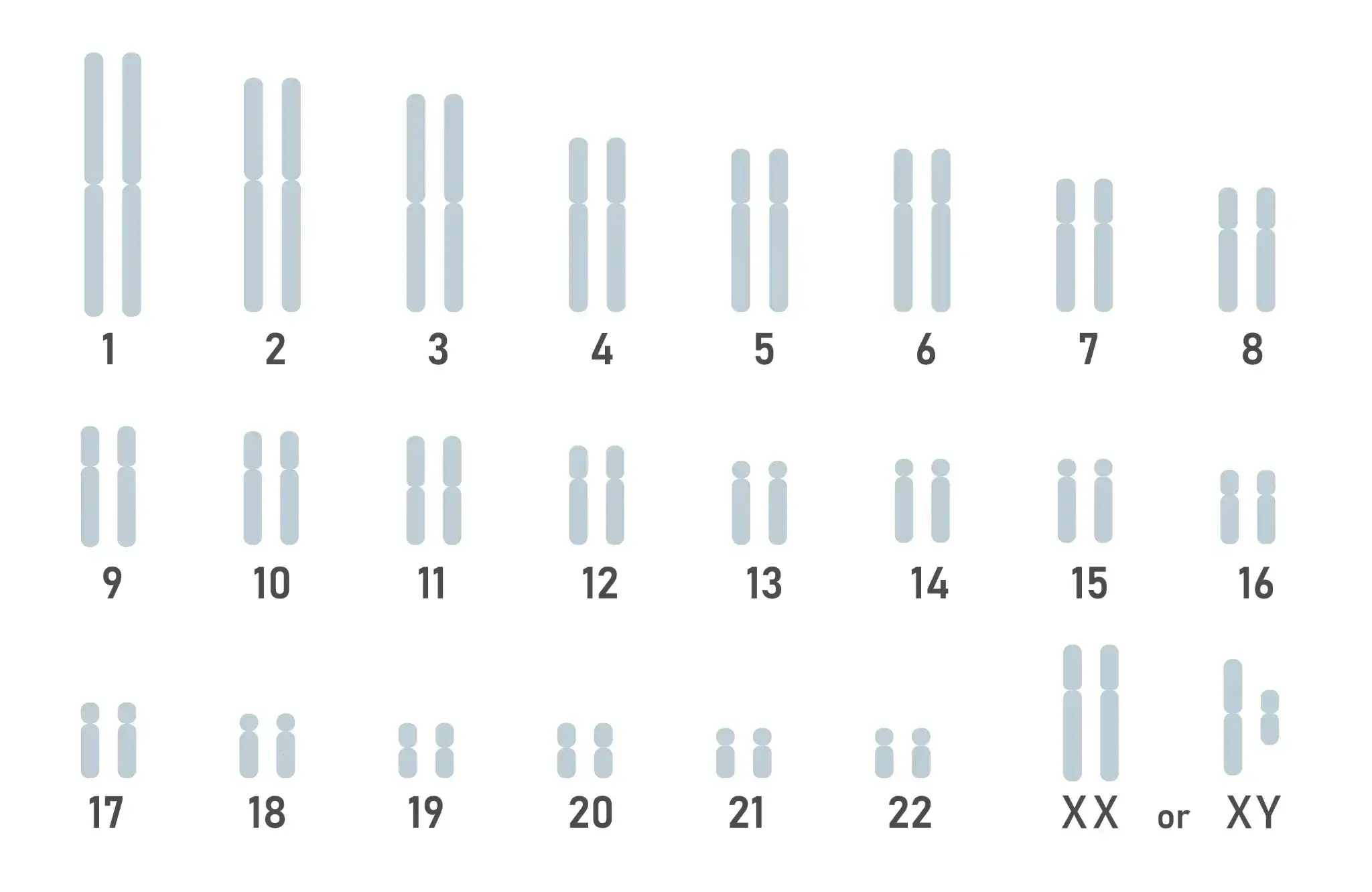
Schematic diagram of DNA map present in cells
- ■
- ■
- ■
- ■
- ■
- ■
- ■
- ■
- ■
Related genes
| Related genes | CD40 |
|---|---|
| Related genes | COG6 |
| Related genes | TMEM187 |
| Related genes | PTPN22 |
Frequently asked questions (FAQ)
Q1. What is rheumatoid arthritis?
Rheumatoid arthritis (RA) is an autoimmune disease in which the immune system mistakenly attacks its own joint tissues.It causes chronic inflammation and pain in the joints of the hands, wrists, and feet, and as it progresses, it leads to joint deformity and functional impairment. Approximately 0.5-1.0% of the population in Japan is affected (1).
Q2. What is the cause of rheumatoid arthritis?
The main cause isAutoimmune reaction due to abnormality of the immune systemIt is. Genetic factors (HLA-DR4 gene, etc.), environmental factors (smoking, infectious diseases), and hormonal balance are all involved. Carriers of type C mutation in the DNA region rs4239702 tend to be at higher risk (1).
Q3. What is the difference between rheumatoid arthritis and osteoarthritis?
Rheumatoid arthritis isautoimmune diseaseThe immune system then attacks the joints. Osteoarthritis (OA) isDegeneration of cartilage due to aging and wearis the cause. RA tends to occur symmetrically, whereas OA occurs in commonly used joints.
Q4. Can genetic testing determine the risk of rheumatoid arthritis?
By examining the genotype of DNA region rs4239702,Understanding trends in the risk of developing rheumatoid arthritisYou can. A Harvard Medical School study found that people with the C mutation genotype tend to be at increased risk (1).
References
- Reference link 1: 2014 Feb., Yukinori Okada, Nature
- Reference link 2: 2012 Dec., Steve Eyre, Nat Genet
- Reference link 3: 2019 Mar., Vincent A Laufer, Hum Mol Genet