
 tendency to be nervous

- A tendency to have a nervous personality is a psychological characteristic that makes it easy to feel strong negative emotions such as anxiety, worry, and irritation.and affects daily life as an anxiety disorder.
- Type A mutation in DNA region rs12961969is involved in the risk of developing neuropathy, and the gene CELF4 influences neuropathy through the formation of brain neurons
- Cognitive behavioral therapy, exercise habits, mindfulness, early medical careIt is possible to improve nervous tendencies and reduce anxiety.
Overview "Did I lock the door? Did I forget anything? Even though I've checked many times, I still feel anxious..." If you frequently experience something like this, you may not be a worrier but have an "anxiety neurosis." Anxiety neurosis is a type of neurosis, and is a disease in which feelings of anxiety and fear have a negative impact on daily life. Recent research has reported that a certain region near the gene CELF4 influences the risk of developing neurosis. Neurosis is a disease that affects physical and mental health as well as the economy, and it is known that it develops through a mechanism similar to that of depression. Depression is a disease for which early treatment is important, so knowing the genetic type of neurosis may be useful for prevention and early treatment of depression. 2. Rationale A study conducted by a British biobank project revealed that some people are more likely to develop neurosis depending on the specific type of gene around the CELF4 gene. The DNA region "rs12961969" has three genotypes: "CC," "CA," and "AA." The "AA type" is said to be more likely to develop neurosis, and the "CA type" is slightly more likely to develop neurosis. Among Japanese people, the most common genotype is ``CC type'' at 99.0%, and ``CA type'' is the least common at 1.0%.Worldwide, the genotypes are 67.6% with ``CC type,'' 29.3% with ``CA type,'' and 3.1% with ``AA type.'' However, there are multiple sites other than "rs12961969" related to neurosis, so it is necessary to take these into consideration when measuring the degree of neurosis. Confirming this genetic type is one indicator of how sensitive you are to anxiety, and applying this knowledge to your future actions may give you peace of mind. 3. Mechanism of action Mechanism The gene "CELF4" is a gene associated with neurosis and is located on chromosome 18 of the 24 human chromosomes. DNA conveys genetic information as a sequence of bases, but it also contains bases that are not involved in protein production or regulation. The gene "CELF4" has the role of removing regions that are not expressed or involved in regulation from DNA, limiting it to only the genetic information that creates brain nerve cells (neurons). Since the brain is composed of neurons, the action of the gene ``CELF4'' is thought to affect brain volume. Recent research has revealed that the volume of the cerebellum, a part of the brain, is correlated with neuroticism, and the gene ``CELF4'' has been reported to be associated with the onset of neuroticism. 4. References:
What is the tendency to have a nervous personality?
A tendency to be nervous is a psychological characteristic in which people tend to feel negative emotions such as anxiety, worry, and irritation more strongly than positive emotions.If you frequently find yourself checking over and over again, ``Did I lock the door? Did I forget anything?'', it may be a sign of ``anxiety neurosis'' rather than worry. Anxiety neurosis is a type of neurosis in which feelings of anxiety and fear have a negative impact on daily life. A study by Okbay et al. of Erasmus University Rotterdam reported that the DNA region rs12961969 near the gene "CELF4" influences the risk of developing neurosis (1) (5).
What is the cause of nervous personality?
The tendency to develop a nervous personality is due to a combination of the following three factors:
- Genetic factors:Type A mutation in the DNA region rs12961969 is associated with neuroticism risk. The gene CELF4 is located on chromosome 18 and affects the formation of brain neurons
- Influence of brain structure:Research reveals that cerebellum volume is correlated with neuroticism (4)
- Environmental factors:Stressful environments, traumatic experiences, and lifestyle habits amplify the occurrence of negative emotions
What are the main symptoms of a nervous personality?
neurotic tendenciesproceed in stagesTherefore, there are cases where it is difficult for the person in question to notice. The five typical symptoms are shown below.
- Persistent anxiety/increased excessive worry
- Repetition of fear (repetition of confirmation)
- Frequent bouts of depression
- Increased irritability/irritability
- Chronic sleep disorders and fatigue
What is the difference between nervous personality and anxiety neurosis?
There is a clear difference between normal worry and anxiety. The comparison table below summarizes the differences between the two.
| Comparison items | Nervous personality (usually) | anxiety neurosis |
|---|---|---|
| degree of anxiety | Moderate anxiety depending on the situation | Excessive anxiety persists on a daily basis |
| Impact on daily life | No problem with functionality | Problems with work/personal relationships |
| physical symptoms | temporary tension | Chronic headache, palpitations, insomnia |
| behavior pattern | Possible to take reasonable measures | Repeated confirmation actions/avoidance actions |
| genetic factors | There are individual differences | rs12961969 type A mutation is involved |
How to prevent and improve a nervous personality
To reduce neuroticismcomprehensive approachis essential. The following four measures are considered effective.
- Cognitive behavioral therapy (CBT):Correct cognitive distortions related to anxiety and acquire stress coping skills
- Regular exercise:Reducing stress hormones through walking, yoga, etc. (recommended at least 3 times a week for at least 30 minutes each time)
- Mindfulness meditation:Reduce repetitive anxiety by focusing on the present moment
- Medical support:If symptoms interfere with daily life, early consultation with a psychiatrist or psychosomatic physician is necessary.
Neurosis develops through a mechanism similar to that of depression, so knowing your genetic type is useful for prevention and early treatment of depression.
Mechanism of action of the gene CELF4 that influences the risk of neuroticism
The gene CELF4 is located on chromosome 18 and is a gene associated with neurosis. The main features and impacts of CELF4 are listed below.
| element | Content | degree of influence |
|---|---|---|
| Role of CELF4 | Remove non-expressing regions from DNA and limit genetic information to create brain nerve cells (neurons) | high |
| Effect on the brain | Affects brain volume (especially cerebellum) (4) | high |
| Mutation of rs12961969 | People with the type A mutation tend to have a higher risk of neuroticism (1)(5) | high |
| Association with depression | Neurosis and depression develop through similar mechanisms | Medium to high |
The relationship between genes and nervous personality
What is the relationship between the DNA region rs12961969 and the risk of developing the disease?
A study by Okbay et al. (2016) (5) at Erasmus University Rotterdam found that the DNA region rs12961969 is associated with a tendency to have a nervous personality.
- There are three genotypes of rs12961969: CC, CA, and AA.
- Genotype with type A mutation(AA type/CA type) people tend to have a high risk of developing a nervous personality.
- Among Japanese people, the CC type is the most common type.99.0%, and the number of type A mutation carriers (AA type + CA type) is extremely low at 1.0%.
However, since there are multiple DNA regions other than rs12961969 that are involved in neurosis, a comprehensive evaluation that also takes into account rs34220720 is required.
Genotype distribution in Japanese (rs12961969)
| Genotype | Percentage of Japanese people | percentage of the world | risk trends |
|---|---|---|---|
| AA type | 0.1%以下 | 3.1% | high risk |
| AC type | 0.9% | 29.2% | medium risk |
| CC type | 99.0% | 67.6% | low risk |
Genotype distribution in Japanese (rs34220720)
| Genotype | Percentage of Japanese people | percentage of the world |
|---|---|---|
| TT type | 44.0% | 49.5% |
| TC type | 44.6% | 41.6% |
| CC type | 11.3% | 8.7% |
Rationale for testing
Typical DNA region: Tendency to be nervous
The gene region that most strongly influences the tendency to be nervous is rs12961969. The distribution of isomorphic genotypes in Japan is as follows.
- AA
0.1%以下 - AC
0.9 % - CC
99.0 %
Another gene region associated with a tendency to be nervous is rs34220720. The distribution of isomorphic genotypes in Japan is as follows
- TT
44.0 % - TC
44.6 % - CC
11.3 %
Basis for inspection
A study by Okbay et al. (2016) from Erasmus University Rotterdam revealed that the tendency to be neurotic is linked to genes. There is a region called rs12961969 in the human genome, and there are two types of mutations, A and C, in the gene in that region. It has been found that people with the type A mutation are more likely to have a nervous personality (5).
The DNA region investigated this time
Schematic diagram of DNA map present in cells
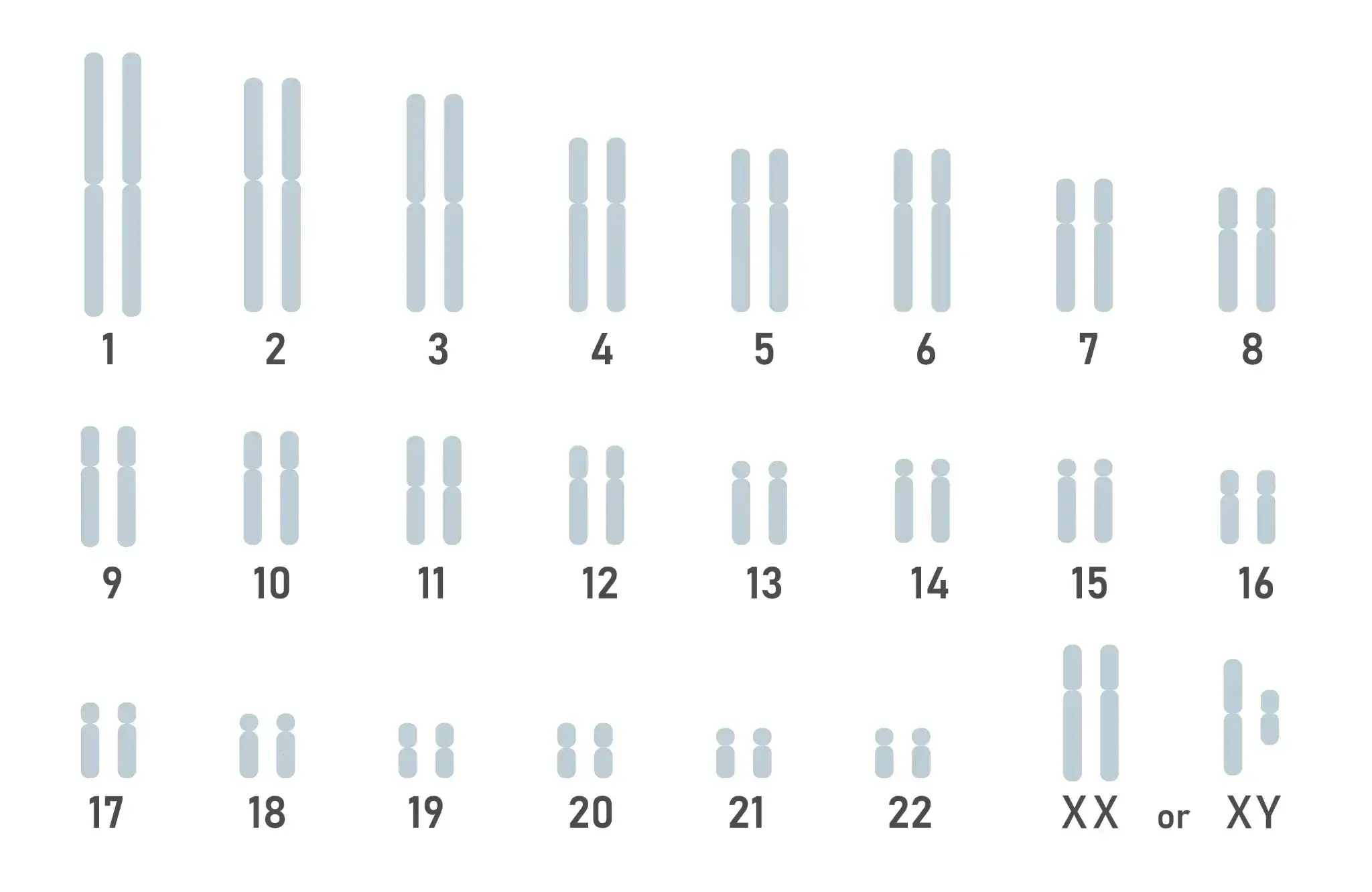
- ■
- ■
- ■
- ■
- ■
- ■
- ■
- ■
- ■
Related genes
| Related genes | RPL12P40 |
|---|---|
| Related genes | LINC01929 |
Frequently asked questions (FAQ)
Q1. What is the tendency to have a nervous personality?
A tendency to be nervous is a psychological characteristic in which people tend to feel negative emotions such as anxiety, worry, and irritation more strongly than positive emotions.Anxiety neurosis is a type of neurosis in which feelings of anxiety and fear have a negative impact on daily life. The DNA region rs12961969 near the gene CELF4 is involved in the risk of developing the disease (1) (5).
Q2. What is the cause of your nervous personality?
The main cause isA combination of genetic and environmental factorsIt is. The gene CELF4 is located on chromosome 18 and is involved in the formation of brain nerve cells (neurons). People with type A mutation in the rs12961969 DNA region tend to have a higher risk of neuropathy. In Japanese, 99.0% are CC type, and 1.0% are carriers of type A mutation (1)(5).
Q3. Can the risk of having a nervous personality be determined through genetic testing?
By examining the genotype of the DNA region rs12961969,Understand the risk of becoming a nervous personYou can. A study by Okbay et al. from Erasmus University Rotterdam confirmed that people with blood type AA tend to have a higher risk, and those with blood type AC tend to have a slightly higher risk (5).
Q4. What is the relationship between nervous personality and the gene CELF4?
The gene CELF4 isLocated on chromosome 18, plays a role in limiting the genetic information that creates brain nerve cells (neurons) from DNAI have Studies have shown that the action of CELF4 affects brain volume (especially the cerebellum), and that cerebellum volume is correlated with neuroticism (3) (4).
Q5. Is there a way to prevent or improve a nervous personality?
Cognitive behavioral therapy (CBT), regular exercise (3 or more times a week, 30 minutes or more each time), mindfulness meditation, and getting enough sleepFour approaches are valid. Neurosis develops through a mechanism similar to that of depression, so knowing your genetic type can be helpful in preventing and early treatment of depression.
References
- Reference link 1: 2017 Dec., Michelle Luciano, Nature Genetics
- Reference link 2: Information on DNA region “rs12961969” NIH
- Reference link 3: Information on the gene “CELF4” NIH
- Reference link 4: 2011 Jul., Schraa-Tam, Caroline KL, The Cerebellum
- Reference link 5: 2016 Jun., Aysu Okbay, Nat Genet