
 myopia

- Myopia is a refractive error disease that occurs due to the elongation of the axial length of the eye, which disrupts focus adjustment and makes it difficult to see in the distance.It is reported that 60.3% of Japanese junior high school students have unaided visual acuity of less than 1.0.
- GG type of DNA region rs2823141 near gene NRIP1Erasmus Medical Center study finds that people are more likely to develop myopia
- Progressing to severe myopiaGlaucoma/retinal detachmentEarly preventive measures are important as it can cause complications such as, and there is a risk of blindness.
Overview Nearsightedness is a disease in which the eyes cannot focus properly, making it difficult to see things that are close up and things that are far away. The number of people affected by this disease has increased worldwide in recent years, and it has become a major social problem. In Japan, the proportion of people with myopia has increased rapidly in recent decades, and the increase in the number of myopia among young people, including elementary school to high school students, has become particularly serious. According to the 2021 School Health Statistics Survey, the proportion of people with unaided visual acuity of less than 1.0 accounted for 36.9% of elementary school students, 60.3% of junior high school students, and 64.4% of high school students, and exceeded 60% of junior high school students, a new record high. (Reference link 1) Myopia is thought to be a disease caused by a combination of environmental and genetic factors. Recent family surveys and twin studies have reported multiple related genes. A recent research report has revealed that a certain region near the gene "NRIP1" is likely to influence the risk of developing myopia. Myopia progresses more easily the younger you are at onset, and severe myopia can lead to complications such as glaucoma and retinal detachment. Therefore, if left untreated, there is a risk of blindness, so care must be taken. For this reason, it is important to learn about your own genetic type through genetic testing and to know your risk of developing myopia, which will lead to prevention and early measures. 2. Rationale According to a study conducted at the Erasmus Medical Center Ophthalmology Department in the Netherlands, it was revealed that some people are more likely to develop myopia depending on the genotype of the DNA region rs2823141 near the NRIP1 gene. (Reference link 2) There are three genotypes in this DNA region: ``AA type,'' ``GA type,'' and ``GG type.'' GG types tend to be more likely to develop myopia, while GA types are slightly more likely to develop myopia. The most common genetic type among Japanese people is the GA type at 48.8%, followed by the AA type at 36.0% and the GG type at 15.2%. (Reference link 3) Approximately 80% of Japanese people have the ``AA type'' or ``GA type'' genetic type, so the possibility of developing myopia is somewhat low, but it is necessary to pay attention to environmental factors, including those with the ``GG type'' who tend to be at higher risk. For example, using smartphones or gaming devices for long periods of time, or reading in dark places, are known to cause myopia to progress. To prevent this, it is important to keep the distance between your eyes and your smartphone (or small game device) at least 30 cm, use it in moderate brightness, and if you use it for a long time, give your eyes time to rest every hour. Additionally, research at Keio University School of Medicine (Department of Ophthalmology) has shown that violet light contained in sunlight can inhibit the progression of myopia in children. Therefore, it is important to create an environment where you can get sunlight by doing outdoor activities and walking. (Reference link 4) It is important to keep these things in mind to prevent the onset of myopia. 3. Mechanism of action The gene "NRIP1" is located on chromosome 21 of the 24 human chromosomes, and is associated with the onset of "myopia." This gene is present in all cells, and is present in large amounts in tissues such as adipose tissue and the colon, but it has also been found to be present in the retina. (Reference links 5, 6) The gene "NRIP1" directly interacts with the retinoic acid receptor and has the function of regulating the transcriptional signal of retinoic acid, a derivative of vitamin A. Currently, it is not known how NRIP1 is related to the onset of myopia, but since the gene NRIP1 exists in the retina and is involved in transcriptional signals for vitamin A derivatives, it is thought that depending on the genotype of the DNA region rs2823141, NRIP1 in the retina does not work properly, resulting in a state of vitamin A deficiency. Since vitamin A deficiency leads to decreased visual acuity, there is a possibility that NRIP1 is associated with decreased visual acuity. In other words, the DNA region "rs2823141" is one of the single nucleotide polymorphisms that is attracting attention and is closely related to the onset of myopia. 4. References
What is myopia?
Myopia is a refractive error disease in which near objects can be seen clearly but distant objects become blurry and difficult to see due to elongation of the eye axis length and abnormal focus adjustment.It is caused by a combination of environmental and genetic factors.
Reasons why the number of myopic patients is increasing
The number of people affected by myopia is increasing worldwide, and it has become a serious problem, especially among young people in Japan. According to the Ministry of Education, Culture, Sports, Science and Technology's ``School Health Statistics Survey'' for 2021, the percentage of students with unaided visual acuity of less than 1.0 is as follows.
| age group | Percentage of unaided visual acuity less than 1.0 |
|---|---|
| Elementary school student | 36.9% |
| junior high school student | 60.3% (highest ever) |
| high school student | 64.4% |
Prolonged use of smartphones and gaming devices, as well as decreased outdoor activities, have been identified as environmental risk factors.
Causes and mechanisms of myopia
Myopia develops due to the combination of the following factors:
- Genetic factors:Multiple gene regions are involved in the risk of developing the disease, including the DNA region rs2823141 near the gene NRIP1
- Environmental factors:Prolonged use of short-term tasks (smartphones, reading), working in the dark, lack of outdoor activities
- Physiological mechanism:As the axial length of the eye increases, images are focused in front of the retina, resulting in decreased distance vision.
What happens as myopia progresses?
Myopia tends to progress more quickly the younger the age of onset. When severe myopia develops, the following complications occur:
| complications | risk |
|---|---|
| glaucoma | Optic nerve damage due to increased intraocular pressure |
| retinal detachment | Loss of vision when the retina separates from the eye wall |
| macular degeneration | decreased central vision |
In the worst case, it can lead to blindness, so early detection and early measures are essential.
Specific ways to prevent myopia
The following measures are effective for preventing the onset and slowing the progression of myopia.
- Distance to eyes:Keep your eyes and smartphones or game consoles at least 30cm apart
- Ensuring rest:Give your eyes time to rest every hour
- Moderate brightness:Read and work in an environment with sufficient lighting
- Outdoor activities:Violet light contained in sunlight suppresses the progression of myopia (research by the Department of Ophthalmology, Keio University School of Medicine)
- Walking:Spend more time outdoors and create an environment where you can get more sunlight.
The relationship between genes and myopia
Relationship between DNA region rs2823141 and risk of developing myopia
Research at the Erasmus Medical Center Ophthalmology Department in the Netherlands has revealed that the DNA region rs2823141 near the gene NRIP1 is involved in the risk of developing myopia.
- There are three genotypes of rs2823141: AA, GA, and GG.
- GG typetend to develop myopia
- GA typetend to be more likely to develop
Genotype distribution in Japanese (rs2823141)
| Genotype | Percentage of Japanese people | risk trends |
|---|---|---|
| AA type | 36.0% | low risk |
| GA type | 48.8% | somewhat likely to develop |
| GG type | 15.2% | easy to develop |
Approximately 84.8% of Japanese people have type AA or GA, and the risk of developing myopia is somewhat low, but attention should be paid to environmental factors, including those with type GG.
Mechanism of action of gene NRIP1
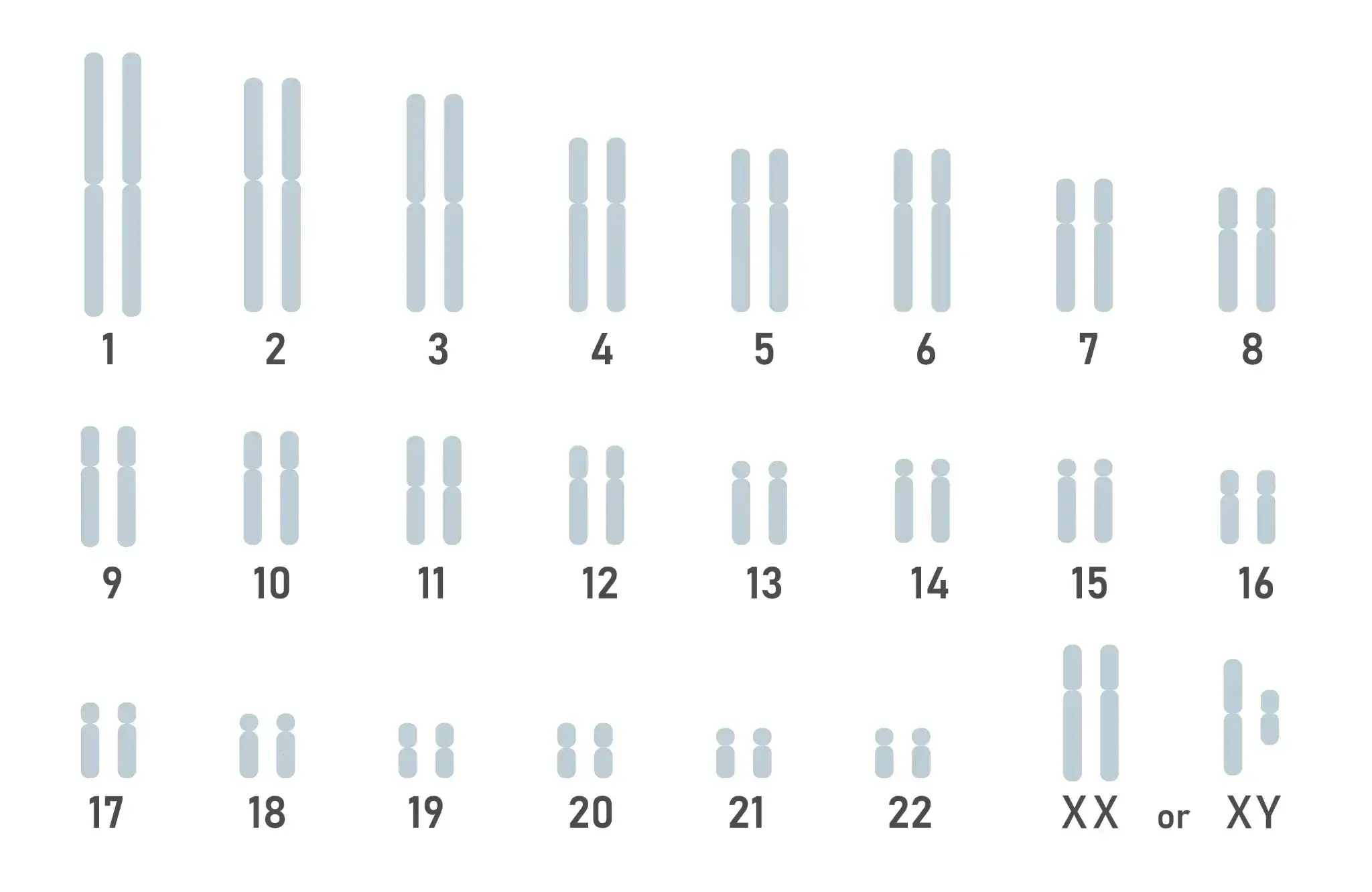
The gene NRIP1 is located on chromosome 21 and is associated with the development of myopia.
- NRIP1 is present in all cells, including adipose tissue and the colon.Also expressed in the retinaare doing
- Directly interacts with retinoic acid receptors and regulates transcriptional signals of retinoic acid, a vitamin A derivative
- The rs2823141 genotype may reduce NRIP1 function, leading to a condition similar to vitamin A deficiency.
- Since vitamin A deficiency leads to decreased visual acuity, the relationship between NRIP1 and myopia is attracting attention.
Rationale for testing
Surface DNA region: myopia
The gene region that most strongly influences myopia is rs2823141. The distribution of isomorphic genotypes in Japan is as follows.
- GG
21.3 % - GA
49.7 % - AA
28.9 %
Another gene region related to myopia is rs2150458. The distribution of isomorphic genotypes in Japan is as follows
- GG
2.2 % - GA
25.3 % - AA
72.4 %
Another gene region related to myopia is rs11872104. The distribution of isomorphic genotypes in Japan is as follows
- AA
36.6 % - AG
47.7 % - GG
15.5 %
Another gene region associated with myopia is rs7067005. The distribution of isomorphic genotypes in Japan is as follows
- CC
76.5 % - CT
21.8 % - TT
1.5 %
The DNA region investigated this time
Schematic diagram of DNA map present in cells
- ■
- ■
- ■
- ■
- ■
- ■
- ■
- ■
- ■
Related genes
| Related genes | LINC02920 |
|---|---|
| Related genes | PCBP3 |
| Related genes | ANKRD20A5P |
| Related genes | RN7SL727P |
Frequently asked questions (FAQ)
Q1. What is myopia?
Myopia is a refractive error disease in which near objects can be seen clearly but distant objects become blurry and difficult to see due to elongation of the eye axis and abnormal focus adjustment.According to the 2021 School Health Statistics Survey, 36.9% of elementary school students, 60.3% of junior high school students, and 64.4% of high school students have unaided visual acuity of less than 1.0.
Q2. Are genes involved in the development of myopia?
Research from the Erasmus Medical Center shows thatDNA region rs2823141 near gene NRIP1 is involved in the risk of developing myopiaIt turns out that it does. People with type GG tend to develop myopia, and the percentage of Japanese people with type GG is 15.2%.
Q3. Is there any way to prevent myopia?
To prevent myopia,Keep your eyes at least 30cm away from your smartphone or game console, give your eyes a break every hour, and expose yourself to violet light during outdoor activities.is valid. Research at Keio University has confirmed that violet light in sunlight suppresses the progression of myopia.
Q4. What happens as myopia progresses?
When severe myopia progresses,Glaucoma, retinal detachment, macular degenerationThis can lead to complications such as. In the worst case, there is a risk of blindness, so early detection and early measures are important.
Q5. What can we learn from genetic testing related to myopia?
In genetic testing,Four DNA regions: rs2823141, rs2150458, rs11872104, rs7067005You can assess your genetic risk for myopia by examining Knowing your own genotype can be used for prevention and early measures.
References
- Reference link 1: FY2020 School Health Statistics Survey Ministry of Education, Culture, Sports, Science and Technology
- Reference link 2: 2018 May., Milly S. Tedj, Nature Genetics.
- Reference link 3: Information on DNA region “rs2823141” NIH
- Reference link 4: 2021 Nov., Mori, Kiwako, Journal of clinical medicine.
- Reference link 5: 2020 Dec., Appelbaum, Tatyana, Investigative Ophthalmology & Visual Science.
- Reference link 6: Information on the gene "NRIP1" NIH
- Reference link 7: 2018 Jun., Milly S Tedja, Nat Genet
- Reference link 8: 2021 Jun., J Willem L Tideman, JAMA Ophthalmol