
 Ease of losing sexual desire

- Proneness to decreased sexual desire is a constitutional tendency for sexual desire to decrease due to decreased testosterone levels.This is influenced by aging, lifestyle, and genetic factors.
- T-type mutation in DNA region rs10168169A study by the University of Exeter (2020) found that people who have a tendency to have a decreased sexual desire
- The prevalence of type T mutation (CT+TT) in Japanese people is71.9%This is a low percentage compared to the global average of 93.1%.
Overview Testosterone is the main sex hormone produced primarily in the male body and is responsible for the development of masculine characteristics (muscle mass, body hair, deep voice, etc.), but it is also present in small amounts in the female body. Testosterone levels affect various functions in the body, so measuring them is extremely important in evaluating health conditions and hormonal balance. Testosterone exists in three states in the blood. The first is a form bound to sex hormone binding globulin (SHBG), which accounts for about 60% of cases. The second state is weakly bound to a protein called albumin, which accounts for about 40%. The third is unbound testosterone, which is about 1-2%. Free testosterone is the most active state in the body and it is here that it actually affects how the body functions. Testosterone levels are measured by a blood test. This test evaluates total testosterone, SHBG-bound testosterone, and free testosterone levels. Total testosterone levels indicate the total amount of testosterone in your body, but you also need to consider free testosterone levels and SHBG levels to know how much testosterone is actually available. For men, testosterone levels fluctuate depending on age, lifestyle, health status, etc. Testosterone levels generally peak between adolescence and adulthood, and then gradually decline with age. Low testosterone levels can cause symptoms such as decreased libido and muscle weakness. Research by Ruth et al. at the University of Exeter revealed that susceptibility to decreased sexual desire is associated with a DNA region called rs10168169. There are three genotypes in this DNA region: CC, CT, and TT, and it has been found that people with the T genotype tend to have a decreased sexual desire.
What is the ease with which sexual desire decreases?
Susceptibility to decreased sexual desire refers to a constitutional tendency for sexual desire to decrease as testosterone levels decline.Testosterone is the main sex hormone in men and is also present in small amounts in women's bodies. This hormone is involved in the expression of masculine characteristics such as muscle mass, body hair, and deep voice.
What is testosterone? Three forms of existence in the blood
Testosterone exists in the blood in three forms:
| form of existence | percentage | Features |
|---|---|---|
| SHBG bond type | Approximately 60% | Bound to sex hormone binding globulin (SHBG) |
| Albumin-bound type | Approximately 40% | Weakly bound to a protein called albumin |
| free testosterone | Approximately 1-2% | Most active when unbound |
Free testosterone is the most active state in the body.This is the part of the body that actually affects how the body functions.
Why testosterone levels fluctuate
Testosterone levels fluctuate depending on the following factors:
- Aging:It reaches its peak between adolescence and adulthood, and then declines by about 1-2% per year with age.
- Lifestyle:Lack of sleep, lack of exercise, excessive drinking, and obesity promote decline.
- Stress:Chronic stress increases cortisol and suppresses testosterone production
- Health status:Associated with diabetes, metabolic syndrome, and hypothyroidism
Comparison of symptoms caused by low testosterone
| classification | Main symptoms | degree of influence |
|---|---|---|
| sexual function | Decreased libido/erectile dysfunction | expensive |
| physical aspect | Muscle weakness, increase in body fat, decrease in bone density | medium to high |
| mental aspect | Fatigue, loss of concentration, depression symptoms | medium |
| metabolic aspect | Increased insulin resistance/metabolic syndrome | medium |
The relationship between genes and susceptibility to decreased sexual desire
Relationship between DNA region rs10168169 and decreased libido
Research by Ruth et al., University of Exeter (2020, Nature (published in Medicine) revealed that susceptibility to decreased sexual desire is associated with the DNA region rs10168169.
- There are three genotypes of rs10168169: CC, CT, and TT.
- Genotype with T-type mutation(CT type/TT type) people tend to have a decrease in sexual desire
Comparison of genotype distribution in Japanese and the world (rs10168169)
| Genotype | Percentage of Japanese people | percentage of the world |
|---|---|---|
| CC type | 27.9% | 6.7% |
| CT type | 49.8% | 38.4% |
| TT type | 22.1% | 54.7% |
The T mutation prevalence rate (CT+TT) in Japanese people is71.9%, which is lower than the global average of 93.1%. Japanese people are characterized by a prevalence of CC type (a type that is less susceptible to decreased sexual desire) at 27.9%, which is approximately 4.2 times higher than the world average of 6.7%.
Other related gene regions
In addition to rs10168169, the following genetic regions are associated with the tendency to decrease sexual desire.
| gene region | Major genotypes of Japanese people | Major genotypes of the world |
|---|---|---|
| rs1180894 | GG 99.9% | GG 56.1% |
| rs147676232 | CC 99.9% | CC 97.5% |
| rs6031598 | GG 40.8% | TT 33.7% |
| rs35318931 | GG 99.9% | GG 86.1% |
| rs4092465 | AA 59.9% | AG 47.7% |
| rs55771168 | TC 48.5% | TT 49.6% |
Rationale for testing
Surface DNA region: susceptibility to decreased sexual desire
The gene region that most strongly influences susceptibility to decreased sexual desire is rs10168169. The distribution of isomorphic genotypes in Japan is as follows.
- CC
27.9 % - CT
49.8 % - TT
22.1 %
Another gene region associated with susceptibility to decreased sexual desire is rs1180894. The distribution of isomorphic genotypes in Japan is as follows
- GG
99.9 % - GA
0.1%以下 - AA
0.1%以下
Another gene region related to susceptibility to decreased sexual desire is rs147676232. The distribution of isomorphic genotypes in Japan is as follows
- CC
99.9 % - CT
0.1%以下 - TT
0.1%以下
Another gene region associated with susceptibility to decreased sexual desire is rs6031598. The distribution of isomorphic genotypes in Japan is as follows
- GG
40.8 % - GT
46.1 % - TT
13.0 %
Another gene region associated with susceptibility to decreased sexual desire is rs35318931. The distribution of isomorphic genotypes in Japan is as follows
- GG
99.9 % - GA
0.1%以下 - AA
0.1%以下
Another gene region associated with susceptibility to decreased sexual desire is rs4092465. The distribution of isomorphic genotypes in Japan is as follows
- AA
59.9 % - AG
34.9 % - GG
5.1 %
Another gene region associated with susceptibility to decreased sexual desire is rs55771168. The distribution of isomorphic genotypes in Japan is as follows
- TT
34.4 % - TC
48.5 % - CC
17.0 %
Basis for inspection
Research by Ruth et al. at the University of Exeter has revealed that susceptibility to decreased sexual desire is linked to genes. There is a region called rs10168169 in the human genome, and the gene in that region has two types of mutations, C and T. It has been found that people with the T-type mutation tend to have a decreased sexual desire.
The DNA region investigated this time
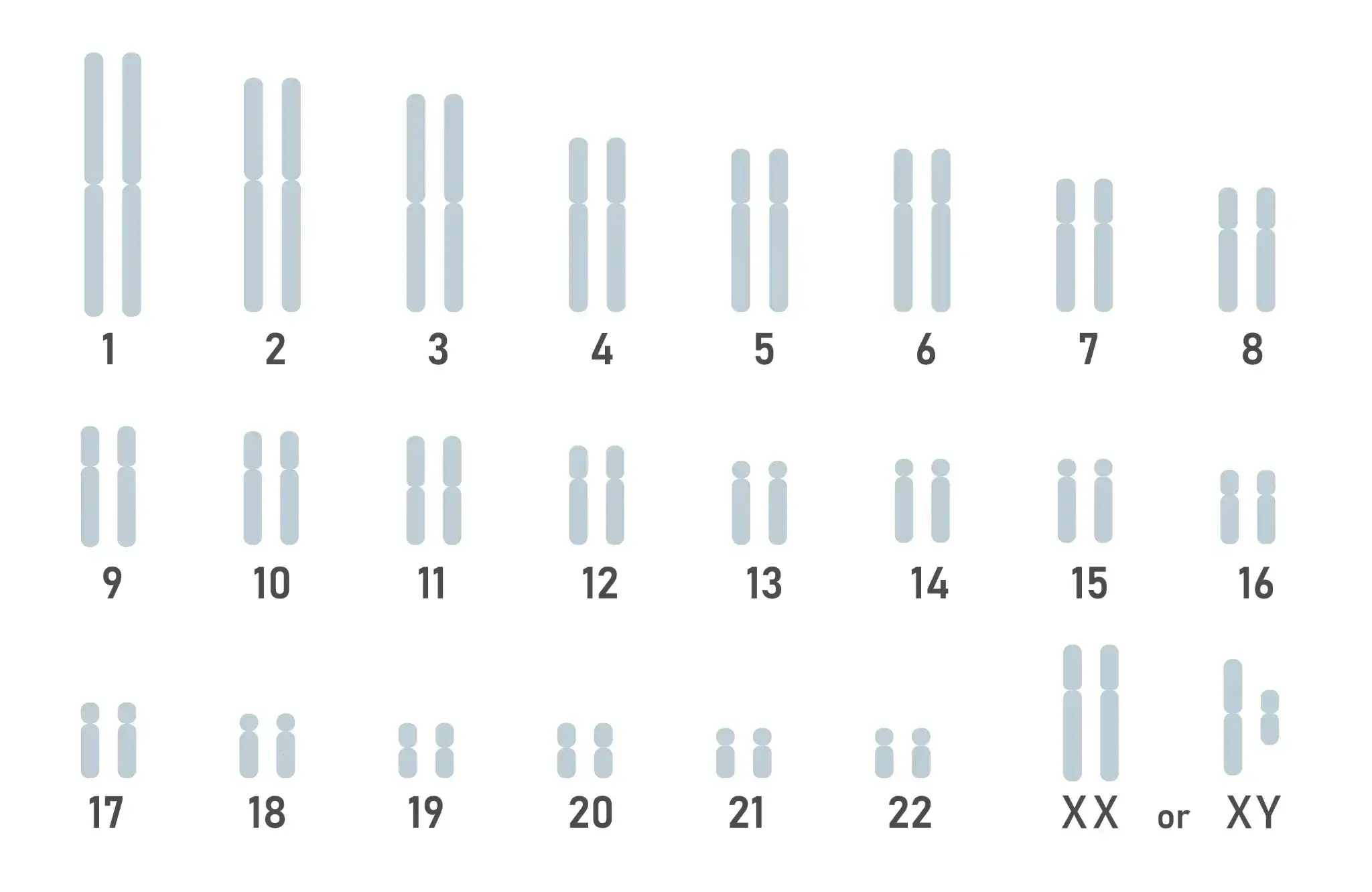
Schematic diagram of DNA map present in cells
- ■
- ■
- ■
- ■
- ■
- ■
- ■
- ■
- ■
Related genes
| Related genes | ANAPC1 |
|---|---|
| Related genes | BEX3 |
| Related genes | STARD8 |
| Related genes | HNF4A |
| Related genes | SRPX |
| Related genes | ST8SIA3 |
| Related genes | CCDC153 |
Frequently asked questions (FAQ)
Q1. What is the susceptibility to decreased sexual desire?
Proneness to decreased sexual desire refers to a constitutional tendency for sexual desire to decrease due to decreased testosterone levels.Testosterone is the main sex hormone for men and decreases with age, lifestyle, and genetic factors. About 1-2% of the testosterone in the blood actually affects the body's functions (free testosterone).
Q2. Is susceptibility to decreased sexual desire related to genes?
Yes.Research by Ruth et al., University of Exeter (2020, Nature (published in Medicine) found that the DNA region rs10168169 is associated with susceptibility to decreased sexual desire.There are three genotypes of rs10168169: CC, CT, and TT, and people with the T mutation (CT type and TT type) tend to have a decreased sexual desire.
Q3. What is the normal level of testosterone?
Testosterone exists in three forms in the blood.About 60% is SHBG-bound, about 40% is albumin-bound, and about 1-2% is free testosterone. Values reach their peak during adolescence and adulthood, and then decline by approximately 1-2% per year with age. The amount of available testosterone can be assessed by measuring total, SHBG, and free testosterone levels with blood tests.
Q4. What is the distribution of genetic regions associated with decreased sexual desire in Japanese people?
The genotype distribution of rs10168169 in Japanese people isCC type 27.9%, CT type 49.8%, TT type 22.1%It is. Worldwide, 6.7% are CC type, 38.4% CT type, and 54.7% TT type, and Japanese people have a characteristic that the prevalence of CC type (the type that is less likely to reduce sexual desire) is approximately 4.2 times higher than the world average.
Q5. Is there any way to prevent a decrease in sexual desire?
The following measures are effective in maintaining testosterone levels:
- Moderate exercise:Strength training increases testosterone secretion
- Adequate sleep:7-8 hours of sleep is important for maintaining hormonal balance
- Balanced diet:Actively intake foods containing zinc and vitamin D
- Stress management:Reduces chronic stress and suppresses rise in cortisol
References
- Reference link 1: 2020 Feb., Katherine S Ruth, Nat Med
- Reference link 2: 2021 Feb., Nasa Sinnott-Armstrong, Nat Genet
- Reference link 3: 2022 Apr., Cameron B Haas, Endocrinology