
 hair color (black)

- Black hair is a hair color rich in eumelanin (black melanin pigment).It is the most common hair color in Asia, Africa, and Central and South America.
- G-type mutation in DNA region rs1426654People with this type are more likely to have black hair, and 99.0% of Japanese people have the GG type.
- Related genesSLC24A5is involved in melanin synthesis and plays an important role in determining hair color.
Overview Black hair refers to hair color that is primarily rich in black melanin pigment. This melanin is a type of pigment called eumelanin, which darkens hair color, especially producing shades of black and brown. Black hair is a hair color that is widely seen in regions such as Asia, Africa, and Central and South America, and is considered the most common hair color in these regions. Black hair has a higher density and tends to be thicker and stronger, so it is less prone to breakage and often has a healthy, shiny appearance. Genetically, black hair is determined by a dominant gene, so if either parent has dark hair, their child is more likely to have dark hair as well. Hair color varies depending on the combination of genes, but black hair is known to be the most dominant color. Research by Jiang et al. at the University of Queensland revealed that black hair is associated with a DNA region called rs1426654. There are three genotypes in this DNA region: AA, AG, and GG, and it was found that people with the G type mutation tend to have black hair.
What is black hair?
Black hair is a hair color rich in eumelanin (black melanin pigment) and is the most common hair color determined by genetically dominant genes.It is widely found in regions of Asia, Africa, and Central and South America, and it is estimated that approximately 75-85% of the world's population has black hair.
Characteristics and reasons for black hair
The reason black hair is so widely distributed is because the production of eumelanin is genetically dominant. The main features are as follows.
- High melanin density:Contains abundant eumelanin, which gives hair a deep black to dark brown color.
- Hair type trends:It tends to be dense, thick, and strong, and has a healthy and glossy appearance that is difficult to break.
- UV protection effect:Eumelanin has the ability to absorb ultraviolet rays, reducing UV damage to the scalp.
- Dominant inheritance:If either parent has dark hair, there is a good chance that the child will also have dark hair.
Differences between black hair and other hair colors
| Comparison items | black hair | blonde | redhead |
|---|---|---|---|
| main pigment | Eumelanin (high concentration) | Pheomelanin (predominant) | Pheomelanin (MC1R mutation) |
| genetic pattern | dominant inheritance | recessive inheritance | recessive inheritance |
| Distribution area | Asia, Africa, Central and South America | Scandinavian focus | Centered on northwest Europe |
| world population percentage | Approximately 75-85% | Approximately 2-3% | Approximately 1-2% |
| UV protection | expensive | low | low |
Genetic mechanism that determines black hair
A 2021 study by Jiang et al. from the University of Queensland revealed that black hair is associated with the DNA region rs1426654.
- There are three genotypes of rs1426654: AA, AG, and GG.
- People with type G mutation tend to have black hairIt turns out that there is
- The gene SLC24A5 is involved in calcium ion transport within melanosomes (pigment organelles) and controls melanin synthesis.
- Type A mutation reduces melanin synthesis and is associated with lighter hair color (blonde/light brown)
The product of the SLC24A5 gene is localized within the melanosomes of melanocytes (pigment cells) and regulates the amount of melanin synthesis through calcium ion transport. If you carry the G-type mutation, eumelanin production is stimulated, resulting in dark hair color.
The relationship between genes and black hair
Relationship between DNA region rs1426654 and black hair
Research by Jiang et al. at the University of Queensland has scientifically proven that the DNA region rs1426654 is associated with hair color (black).
- There are two types of mutations in rs1426654, G and A.
- people with blood type Ghas active eumelanin synthesis and is more likely to turn black.
- In Japanese99.0% are GG type, and almost all of them have the genetic characteristic of having black hair.
- On average worldwide, type AA is the most common type at 85.0%, with significant genetic variation depending on region.
Genotype distribution comparison between Japanese and the world (rs1426654)
| Genotype | Percentage of Japanese people | percentage of the world |
|---|---|---|
| AA type | 0.1%以下 | 85.0% |
| AG type | 0.9% | 14.3% |
| GG type | 99.0% | 0.6% |
This distribution data isAlmost all Japanese people have both alleles of type G (GG type)This shows that the characteristic of black hair is genetically fixed. On the other hand, on average around the world, type A hair types are overwhelmingly common, indicating a great diversity in hair color.
Rationale for testing
External DNA region: Hair color (black)
The gene region that most strongly influences hair color (black) is rs1426654. The distribution of isomorphic genotypes in Japan is as follows.
- AA
0.1%以下 - AG
0.9 % - GG
99.0 %
Basis for inspection
A 2021 study by Jiang et al. at the University of Queensland revealed that hair color (black) is associated with genes.There is a region called rs1426654 in the human genome, and there are two types of mutations, A and G, in the gene in this region. People with type G mutation tend to have black hair, and 99.0% of Japanese people have type GG. This genotype distribution differs significantly from the global average, indicating the genetic homogeneity of black hair in the Japanese population.
The DNA region investigated this time
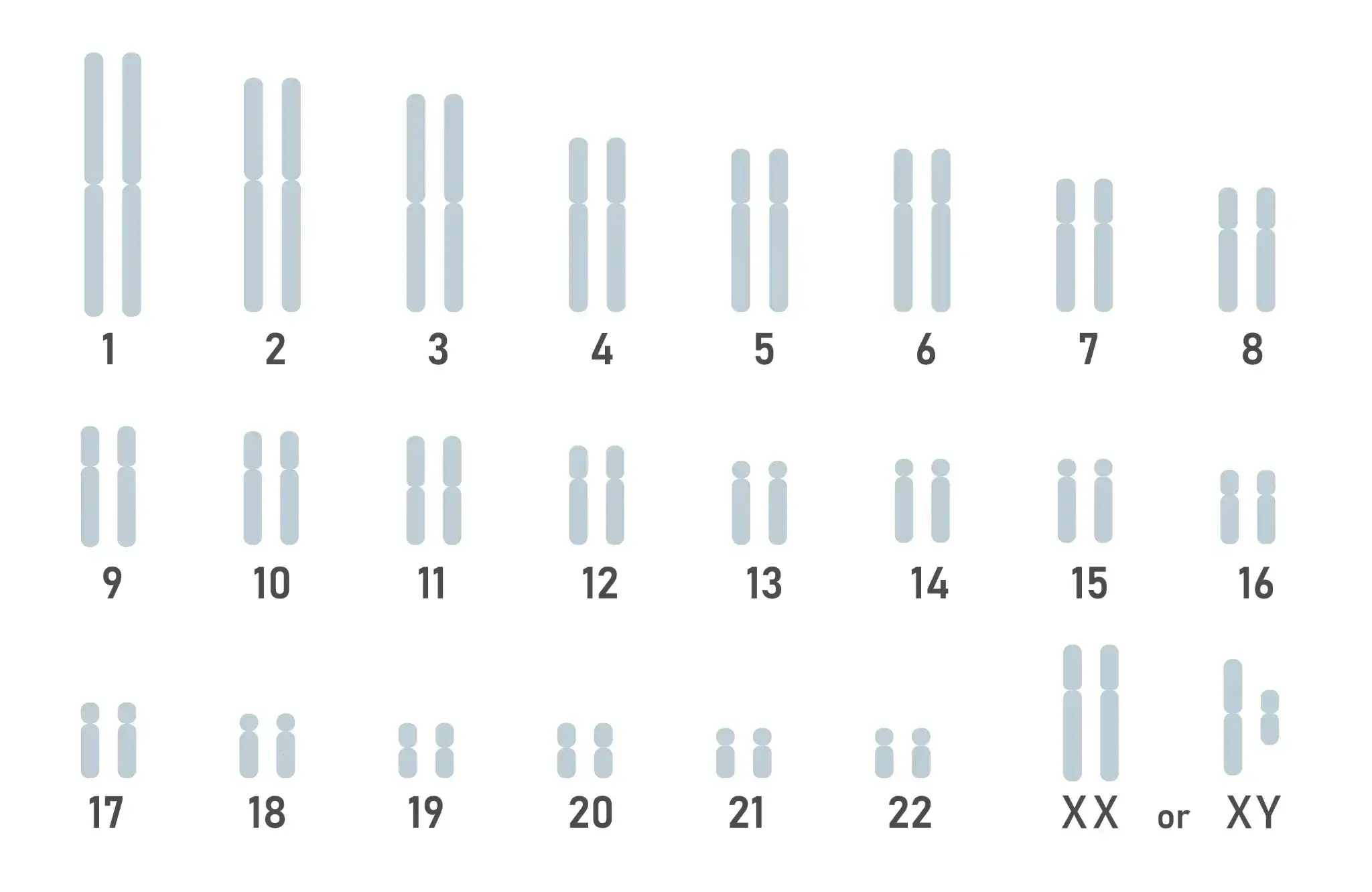
Schematic diagram of DNA map present in cells
- ■
- ■
- ■
- ■
- ■
- ■
- ■
- ■
- ■
Related genes
| Related genes | SLC24A5 |
|---|
Frequently asked questions (FAQ)
Q1. What is black hair?
Black hair is a hair color that is rich in eumelanin (black melanin pigment).It is the most common hair color in Asia, Africa, and Central and South America, and it is estimated that approximately 75-85% of the world's population has black hair. Genetically determined by a dominant gene, it has dense, thick, and strong characteristics.
Q2. What genes are associated with black hair?
The gene most strongly associated with black hair isSLC24A5The DNA region rs1426654 is involved in determining hair color. A 2021 study by Jiang et al. at the University of Queensland found thatPeople with type G mutation are more likely to have black hair.It turns out that.
Q3. What is the genotype distribution of Japanese black hair?
The genotype distribution of the Japanese DNA region rs1426654 isGG type 99.0%, AG type 0.9%, AA type 0.1%以下It is. Almost everyone has both type G alleles, which is significantly different from the world average (GG type 0.6%).
Q4. What is the difference between black hair and other hair colors?
black hair isRich in eumelaninIt has a deep color. Blonde hair is dominated by pheomelanin and has a lighter tone, while red hair is caused by an increase in pheomelanin due to the MC1R gene mutation. Black hair is genetically dominant, meaning that if either parent has dark hair, there is a higher chance that the child will also have dark hair.
Q5. Are there any health characteristics of black hair?
black hair isHigh content of eumelaninTherefore, it tends to have a high protection effect from UV rays. Studies have shown that hair is denser, thicker, and stronger, making it less prone to breakage and looking healthy and shiny.
References
- Reference link 1: 2021 Nov., Longda Jiang, Nat Genet