
 Down syndrome (chromosomal abnormality)
- Down syndrome is a chromosomal disorder in which there are three copies of chromosome 21 (trisomy 21).The birth frequency is 1 in 600 to 800 people.
- G-type mutation in DNA region rs1801394Research reveals that children of people with a child tend to have a higher risk of developing the disease
- Intake of folic acid and vitamin B groupThe risk of developing the disease is expected to be reduced by avoiding smoking and alcohol.
Overview Down syndrome is a chromosomal abnormality called trisomy 21, in which there are three copies of the 21st chromosome instead of the usual two. Children may have a distinctive facial appearance from birth, delayed development of muscle strength and intelligence, and complications such as heart disease. They are also more likely to develop hearing loss, endocrine disorders, and leukemia later in life. According to a survey by the Children's Chronic Disease Information Center, the birth frequency is estimated at 1 in 600 to 800 births. (Reference link 1) The mechanism by which Down syndrome develops is not clear, but it is thought to be caused by the chromosomes not being separated properly when eggs and sperm are produced. This is thought to be related to age and environmental factors. Additionally, children with Down syndrome can be born even if no family member has Down syndrome, so it is generally thought that it is not inherited, but in recent years multiple related genes have been reported. According to a recent research report, it has become clear that a certain region near the gene ``MTRR'' is likely to influence the risk of developing Down syndrome. v We also know that the chances of having a child with Down syndrome increase as a woman gets older. We need to be careful as more women are getting married as they enter the workforce, and the number of pregnancies and births at older ages is increasing. Based on the above, by finding out your own genetic type through genetic testing, you can learn about the tendency of your unborn child to develop Down syndrome. This is expected to be useful in preventing the onset of the disease and taking early measures. /p> 2. Rationale Research conducted by the Manobikas Biomedical Research and Diagnostic Center in India has revealed that some people are more likely to develop Down syndrome depending on the specific type of MTRR gene. One of those parts is a DNA region called "rs1801394." (Reference link 2) The DNA region "rs1801394" has three genotypes: "AA", "AG", and "GG". Regarding Japanese genetic types, the "AA" type is the most common at 48.4%, the "AG" type at 42.3%, and the "GG" type at the least at 9.3%. (Reference link 3) It is known that children of people with the ``GG'' genotype, which has the risk allele G, are more likely to develop Down syndrome, and children of people with ``AG'' are slightly more likely to develop Down syndrome. However, children with GG/AG types do not necessarily develop Down syndrome. Environmental factors should be kept in mind, including for people with AA types. Several studies have shown that parents with high blood levels of the amino acid homocysteine are more likely to give birth to a child with Down syndrome. (Reference link 4) Factors that increase homocysteine levels in the blood include aging, lack of B vitamins such as folic acid, smoking, and alcohol intake. Therefore, it is recommended that you avoid smoking and alcohol before trying to conceive, and make sure that you are not deficient in nutrients such as folic acid and B vitamins. Furthermore, according to the Ministry of Health, Labor and Welfare, the probability of having a child with Down syndrome increases as the mother gets older: 0.3% if the mother is 35 years old, 0.9% if the mother is 40 years old, and 3.3% if the mother is 45 years old, so it is important for couples to discuss this in order to decide when to start trying to conceive as early as possible. By performing early genetic testing to understand the tendency for children to develop Down syndrome, it is possible to manage risks in terms of lifestyle and environment. 3. Mechanism of action The MTRR gene is known to be involved in the development of Down syndrome, one of the most common health problems worldwide, and is located on the fifth chromosome of the 24 human chromosomes. This gene contains genetic information for the MTRR enzyme, which regulates methionine synthase, an enzyme that synthesizes the amino acid methionine. The MTRR enzyme may not function properly in people who have a G genotype in the DNA region rs1801394, which is located near MTRR. In this case, methionine synthase ceases to function, causing an increase in homocysteine and hypomethylation of DNA, indicating that Down syndrome may develop as trisomy 21, which has one extra chromosome. In other words, the DNA region "rs1801394" is deeply related to the onset of Down syndrome, and is one of the single nucleotide polymorphisms that is attracting attention.
What is Down syndrome?
Down syndrome is a chromosomal disorder called trisomy 21, in which there are three copies of the 21st chromosome instead of the usual two.According to research by the Pediatric Chronic Specified Disease Information Center, the frequency is 1 in 600 to 800 births.
Causes and mechanisms of Down syndrome
The onset mechanism of Down syndrome is not completely understood, but the main causes are as follows.
- Chromosome nondisjunction:Chromosome 21 is not separated properly when eggs and sperm are formed, resulting in three copies.
- Effect of maternal age:The probability of developing the disease increases with age
- Genetic factors:The DNA region rs1801394 near the MTRR gene is involved in the risk of developing the disease.
Maternal age and probability of developing Down syndrome
According to data from the Ministry of Health, Labor and Welfare, the relationship between a mother's gestational age and the probability of having a baby with Down syndrome is as follows.
| mother's age | Probability of onset |
|---|---|
| 35 years old | 0.3% (approximately 1 in 333 people) |
| 40 years old | 0.9% (approximately 1 in 111 people) |
| 45 years old | 3.3% (approximately 1 in 30 people) |
Main characteristics and complications of Down syndrome
Down syndrome has the following characteristics and complications:
- Distinctive facial features:Flat face, slanted eyes, low nose bridge
- Developmental delay:Delays in the development of muscle strength and intelligence
- Congenital heart disease:Approximately 40-50% of children have heart disease
- Hearing loss:There is a risk of developing acquired hearing loss.
- Endocrine diseases:Thyroid function abnormalities, etc.
- Leukemia:Higher risk of developing leukemia than usual
Prevention and countermeasures for Down syndrome
The following measures are recommended to reduce the risk of Down syndrome:
- Intake of folic acid and B vitamins:Effective in keeping blood homocysteine levels low
- Avoiding smoking and alcohol:Avoid as it may increase homocysteine concentration.
- Early pregnancy planning:Discuss the timing with your spouse, considering the risks of giving birth at an older age.
- Utilization of genetic testing:Understand risk trends early and use them to take countermeasures for lifestyle and environment.
The relationship between genes and Down syndrome
Relationship between DNA region rs1801394 and onset risk
A study by Manobikas Biomedical Research and Diagnostic Center in India revealed that the DNA region rs1801394 near the MTRR gene is associated with the risk of developing Down syndrome.
- There are three genotypes of rs1801394: AA, AG, and GG.
- GG type (Risk Allele G)Children of people with Down syndrome tend to be at higher risk of developing Down syndrome.
- AG typeChildren of people with this condition tend to be more likely to develop the disease.
However, this does not necessarily mean that children of people with type GG or type AG will develop the disease, and environmental factors, including those of type AA, need to be taken into account.
Mechanism of action of MTRR gene
The MTRR gene is located on chromosome 5 and contains genetic information for the MTRR enzyme, which is responsible for regulating methionine synthase.
- If the DNA region rs1801394 has the G type, the MTRR enzyme may not function properly.
- Due to decreased function of methionine synthaseHomocysteine increases
- causing DNA hypomethylation,Trisomy 21 (Down syndrome)Increased risk of developing
Genotype distribution in Japanese (rs1801394)
| Genotype | Percentage of Japanese people | percentage of the world |
|---|---|---|
| AA type | 48.5% | 23.5% |
| AG type | 42.2% | 49.9% |
| GG type | 9.1% | 26.5% |
What is the relationship between homocysteine and Down syndrome?
Studies have shown that parents with high levels of homocysteine in their blood are more likely to give birth to a child with Down syndrome.
The main factors that increase blood homocysteine levels are:
- aging
- Deficiency of B vitamins such as folic acid
- smoking
- alcohol intake
Rationale for testing
Physical DNA region: Down syndrome (chromosomal abnormality)
The gene region that most strongly affects Down syndrome (chromosomal abnormality) is rs1801394. The distribution of isomorphic genotypes in Japan is as follows.
- AA
48.5 % - AG
42.2 % - GG
9.1 %
Basis for inspection
A study by Chatterjee and colleagues at Manobikas Biomedical Research and Diagnostic Center in India revealed that the risk of developing Down syndrome is linked to genes. There are two types of mutations in the rs1801394 region, A and G, and children of people with type G mutations tend to have a higher risk of Down syndrome.
The DNA region investigated this time
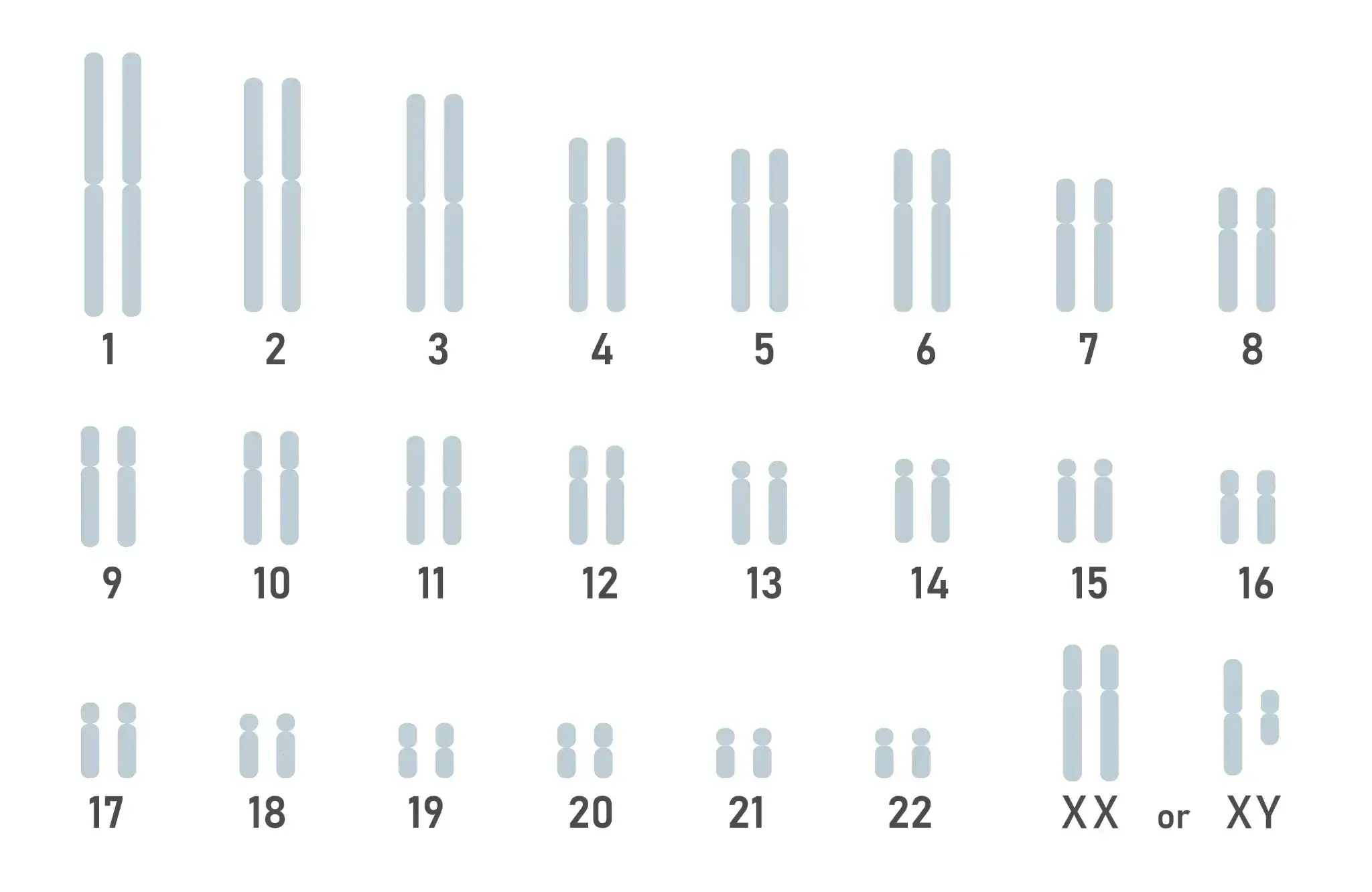
Schematic diagram of DNA map present in cells
- ■
- ■
- ■
- ■
- ■
- ■
- ■
- ■
- ■
Related genes
| Related genes | MTRR |
|---|
Frequently asked questions (FAQ)
Q1. What is Down syndrome?
Down syndrome is a chromosomal disorder called trisomy 21, in which there are three copies of the 21st chromosome.The birth frequency is 1 in 600 to 800, and it is accompanied by complications such as a characteristic facial appearance, developmental delay, and heart disease.
Q2. What is the cause of Down syndrome?
The main cause isChromosome nondisjunction during egg and sperm formationIt is. The probability of developing the disease increases as the mother's age increases. The rate is 0.3% for 35-year-olds, 0.9% for 40-year-olds, and 3.3% for 45-year-olds. The G-type mutation in the DNA region rs1801394 near the MTRR gene is also associated with the risk of developing the disease.
Q3. Can genetic testing determine the risk of Down syndrome?
By examining the genotype of the DNA region rs1801394,Understanding risk trends for Down syndromeYou can. Studies have shown that children of people with type GG tend to be at higher risk, and children of people with type AG tend to be at slightly higher risk.
Q4. Is there any way to prevent Down syndrome?
Adequate intake of folic acid and B vitamins, avoidance of smoking and alcoholis considered effective for prevention. It is important to keep blood homocysteine levels low. In addition, you can expect to reduce risks by planning your pregnancy early.
References
- Reference link 1: Information on “Down syndrome” Pediatric Chronic Disease Information Center
- Reference link 2: 2020 Nov., Mahasweta Chatterjee, Int J Mol Cell Med.
- Reference link 3: Information on the gene “MTRR” NIH
- Reference link 4: 2003 Feb., Jayesh J Sheth, Indian Pediatr.