
 chronic renal failure
- Chronic kidney disease (CKD) affects more than 13 million people in Japan.However, in the early stages, there are no symptoms, and as the disease progresses, it becomes difficult to recover kidney function.
- G-type mutation in DNA region rs3116613is associated with increased ACR (urinary albumin/creatinine ratio), and the GG type tends to have a higher risk of CKD.
- The prevalence of TT type (low-risk type) among Japanese people is94.3%, the risk allergy prevalence is lower than the global average of 69.1%.
Overview There is a disease called ``chronic kidney disease (CKD)'' in which kidney function chronically declines. CKD is a relatively new disease concept, and it has been pointed out that there are actually more than 13 million patients in Japan. In the early stages of CKD, there are almost no symptoms, so it is difficult to notice the disease. However, as CKD progresses and the condition worsens, there is a risk that kidney function will not recover. CKD is a curable disease if treated early, and albuminuria is used as a biomarker to indicate the presence or absence of the disease. Albumin is a type of protein that is normally not excreted in the urine if kidney function is normal. On the other hand, it is known that urinary albumin concentration tends to fluctuate due to the effects of exercise, blood pressure, etc., and it is generally corrected using the concentration of a substance called creatinine in urine. This corrected value is called the "urinary albumin/creatinine ratio (ACR)." Recent research has revealed that "ACR" is also related to the function of genes. (Reference link 1) Investigating your own genetic type through genetic testing may lead to a more accurate understanding of your kidney function status, and may also be helpful in the early detection of CKD. Rationale A study conducted by researchers at the University of Exeter in the UK shows a link between ACR and genes. According to the report, when a specific region of the gene called rs3116613 is at risk, ACR tends to increase. Human genetic information is determined by the sequence of the base components adenine (A), thymine (T), guanine (G), and cytosine (C), and "A", "T", "G", and "C" are also arranged in the DNA region "rs3116613". When one of the bases, "T", is replaced with "G", there is a tendency for "ACR" to increase (reference link 2). In this case, "G" is called a risk allele. The genotype of the DNA region "rs3116613" can be classified into three types: "TT type", "TG type", and "GG type". The genetic type of Japanese people is 97.3% TT type, 2.7% TG type, and 0.02% GG type. It is also known that the ``GG type'' is more likely to increase the ``ACR'', and the ``TG type'' is slightly more likely to increase the ACR. Mechanism of action The DNA region "rs3116613" is present in the gene "DLEU1", and DLEU1 is located on the 13th chromosome among the 46 chromosomes in humans. The gene DLEU1 acts on the production of a substance called lncRNA (long non-coding RNA) (reference link 1), and RNA is the basis for cells to make proteins. Among these, lncRNAs are thought to play a role in controlling gene expression, but there are still many aspects that are still unclear. It has also been reported that other genes associated with increased ACR are also involved in the development of cardiovascular diseases, and further elucidation of DLEU1 is expected in the future.
What is chronic kidney disease (CKD)?
Chronic Kidney (CKD) disease) is a disease in which kidney function chronically declines.The number of patients in Japan is estimated to be more than 13 million, with approximately one in eight adults suffering from the disease. If CKD is treated early, kidney function can be expected to recover, but as the disease progresses, recovery becomes difficult.
What is the CKD early detection index “ACR”?
ACR (urinary albumin/creatinine ratio)is a biomarker that determines the presence or absence of CKD.
- albuminis a type of protein that is not excreted in the urine if kidney function is normal.
- When kidney function declines, albumin leaks into the urine, resulting in albuminuria.
- Urinary albumin concentration fluctuates due to the effects of exercise and blood pressure, soValue corrected by creatinine concentration (ACR)is used
Progressive stages and symptoms of CKD
| stage | Kidney function (GFR) | Main symptoms |
|---|---|---|
| G1~G2 (initial) | 90〜60 mL/min | Almost no symptoms |
| G3a-G3b (mid-term) | 59〜30 mL/min | Nocturnal urination, swelling, fatigue |
| G4 (advanced stage) | 29〜15 mL/min | Anemia, decreased appetite, electrolyte abnormalities |
| G5 (late stage) | Less than 15 mL/min | Requires dialysis or kidney transplant |
Relationship between genes and chronic renal failure
Relationship between DNA region rs3116613 and ACR
Research by Casanova et al., University of Exeter (2019, Human Molecular (Published in Genetics) revealed that increased ACR is associated with the DNA region rs3116613.
- There are three genotypes of rs3116613: TT, TG, and GG.
- ACR tends to increase when a single base “T” is replaced with “G”
- In this case“G” is a risk allelecall it
- GG typeThe more ACR increases,TG typetends to rise slightly
Comparison of genotype distribution in Japanese and the world (rs3116613)
| Genotype | Percentage of Japanese people | percentage of the world |
|---|---|---|
| TT type | 94.3% | 69.1% |
| TG type | 5.6% | 28.0% |
| GG type | 0.1%以下 | 2.8% |
The risk allele (G type) prevalence rate (TG+GG) of Japanese people is5.6%, which is significantly lower than the global average of 30.8%. Japanese94.3%They are characterized by being the TT type (low risk type), and can be said to be a population with a genetically low risk of increasing ACR.
Relationship between DNA region rs2837554 and CKD
In addition to rs3116613,DNA region rs2837554is also a genetic region involved in chronic renal failure.
Comparison of genotype distribution in Japanese and the world (rs2837554)
| Genotype | Percentage of Japanese people | percentage of the world |
|---|---|---|
| AA type | 13.3% | 1.2% |
| AG type | 46.3% | 20.1% |
| GG type | 40.2% | 78.5% |
Japanese people have type AA13.3%, AG type is46.3%It is characterized by a high prevalence of type A allele compared to the world average.
Mechanism of gene action
What is the role of the DLEU1 gene?
The DNA region rs3116613 is located in the gene "DLEU1" located on chromosome 13.
- DLEU1 islncRNA (long non-coding RNA)involved in the generation of
- RNA is a substance that serves as the basis for cells to produce proteins.
- lncRNA isControl of gene expressionAlthough it is believed that this is responsible for the
- Other genes associated with elevated ACR areDevelopment of cardiovascular diseaseThere are also reports that it is related to
Involvement of DSCAM gene
DNA region rs2837554 isDSCAM generelated to. DSCAM is a gene located on chromosome 21 and is involved in nervous system development and signal transmission. Further research is expected to elucidate the detailed mechanism related to renal function.
Rationale for testing
Surface DNA region: chronic renal failure
The gene region that most strongly influences chronic renal failure is rs3116613. The distribution of isomorphic genotypes in Japan is as follows.
- TT
94.3 % - TG
5.6 % - GG
0.1%以下
Another gene region involved in chronic renal failure is rs2837554. The distribution of isomorphic genotypes in Japan is as follows
- AA
13.3 % - AG
46.3 % - GG
40.2 %
Basis for inspection
Research by Casanova et al. at the University of Exeter revealed that ACR (urinary albumin/creatinine ratio) is associated with genes. When the single base "T" in the DNA region rs3116613 is replaced with "G", ACR tends to increase. It has been found that the GG type is more likely to increase ACR, and the TG type is slightly more likely to increase it. Determining your own genetic type through genetic testing may help in the early detection of CKD.
The DNA region investigated this time
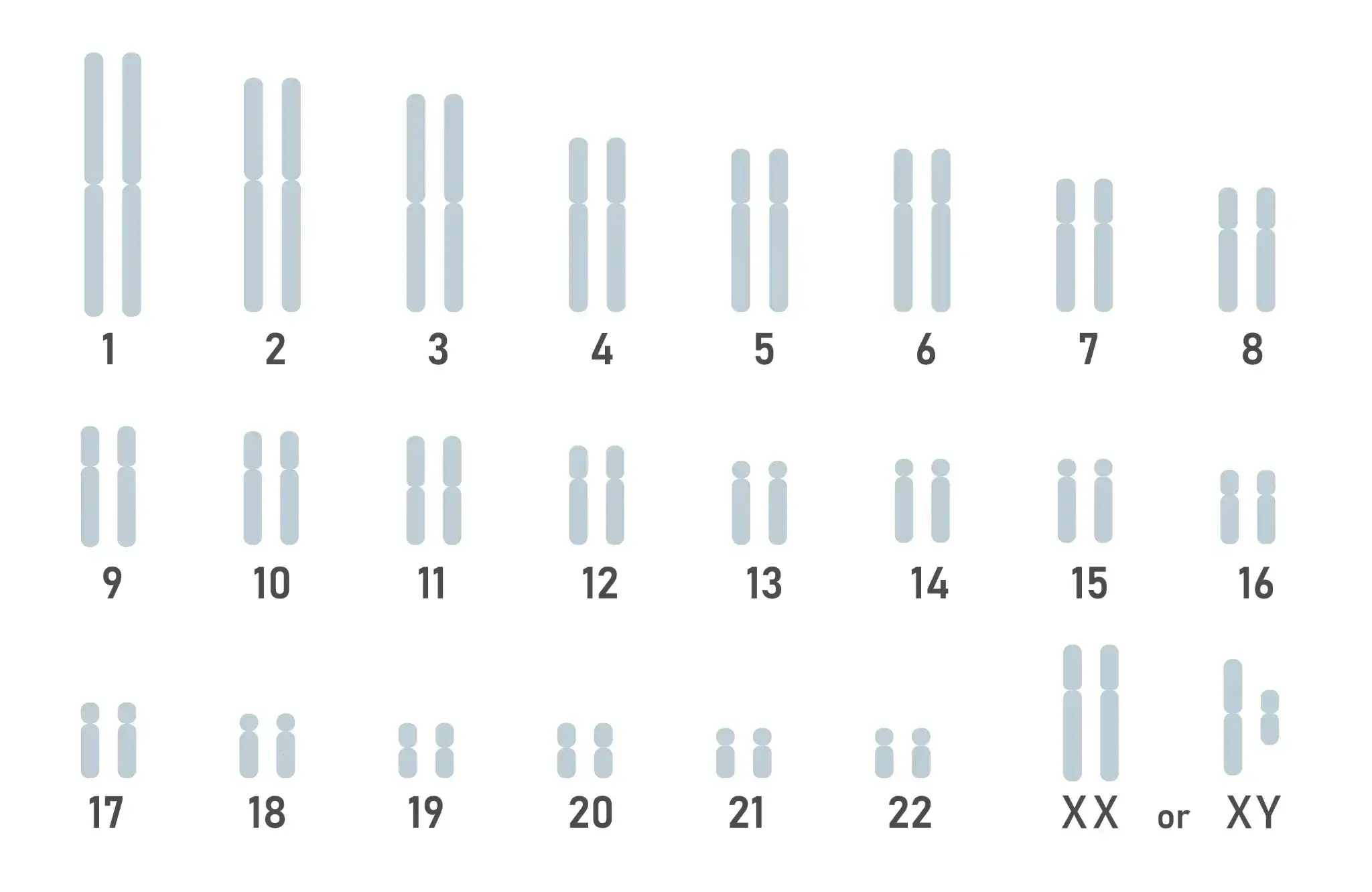
Schematic diagram of DNA map present in cells
- ■
- ■
- ■
- ■
- ■
- ■
- ■
- ■
- ■
Related genes
| Related genes | DLEU1 |
|---|---|
| Related genes | DSCAM |
Frequently asked questions (FAQ)
Q1. What is chronic kidney disease (CKD)?
Chronic Kidney (CKD) disease) is a disease in which kidney function chronically declines.The number of patients in Japan is estimated to be over 13 million. In the early stages, there are almost no symptoms, so detection is likely to be delayed, but if treated early, kidney function can be expected to recover. ACR (urinary albumin/creatinine ratio) is an important biomarker for early detection.
Q2. Is there a genetic relationship with chronic renal failure?
Yes.Research by Casanova et al., University of Exeter (2019, Human Molecular Genetics) found that the DNA region rs3116613 is associated with increased ACR.There are three genotypes of rs3116613: TT, TG, and GG, and people with the G mutation genotype tend to have increased ACR.
Q3. What is the distribution of the genotype (rs3116613) associated with chronic renal failure in Japanese people?
The genotype distribution of rs3116613 in Japanese people isTT type 94.3%, TG type 5.6%, GG type 0.1%以下It is. Worldwide, 69.1% are TT type, 28.0% are TG type, and 2.8% are GG type, and Japanese people have a low risk allele (G type) prevalence rate, which is about one-fifth of the world average.
Q4. What is ACR (urinary albumin/creatinine ratio)?
ACR is a value obtained by correcting the albumin concentration in urine by the creatinine concentration.It is a useful biomarker for early detection of CKD. When renal function is normal, albumin is not excreted in the urine, but when renal function declines, albumin leaks and the ACR value increases. When combined with genetic testing, more accurate assessment of kidney function is possible.
References
- Reference link 1: 2019 Dec., Francesco Casanova, Human Molecular Genetics
- Reference link 2: DNA Information on region “rs3116613” NIH
- Reference link 3: 2019 Dec., Francesco Casanova, Hum Mol Genet
- Reference link 4: 2019 May., Bridget M Lin, Front Genet