
2026.05.28
- ・Is There a Risk of Pregnancy Complications from NIPT?
- ・What Is NIPT? How the Test Works and Why It's Safe
- ・Differences from Amniocentesis and Chorionic Villus Sampling: Why NIPT Has No Complications
- ・Medical Evidence and Research Data Supporting the Safety of NIPT
- ・Points to Note When Undergoing NIPT
- ・FAQ (Frequently Asked Questions)
Conclusion
There is no medical evidence that NIPT (Non-Invasive Prenatal Testing) causes pregnancy complications or miscarriage. This is because the test only requires drawing a small amount of blood from the pregnant woman's arm, meaning there is no direct invasion of the uterus.
Is There a Risk of Pregnancy Complications from NIPT?
NIPT (Non-Invasive Prenatal Genetic Testing) is a highly safe test that is completed with just a blood draw from the mother's arm. In principle, the test procedure itself cannot cause pregnancy complications such as miscarriage or infection.
What Is NIPT? How the Test Works and Why It's Safe
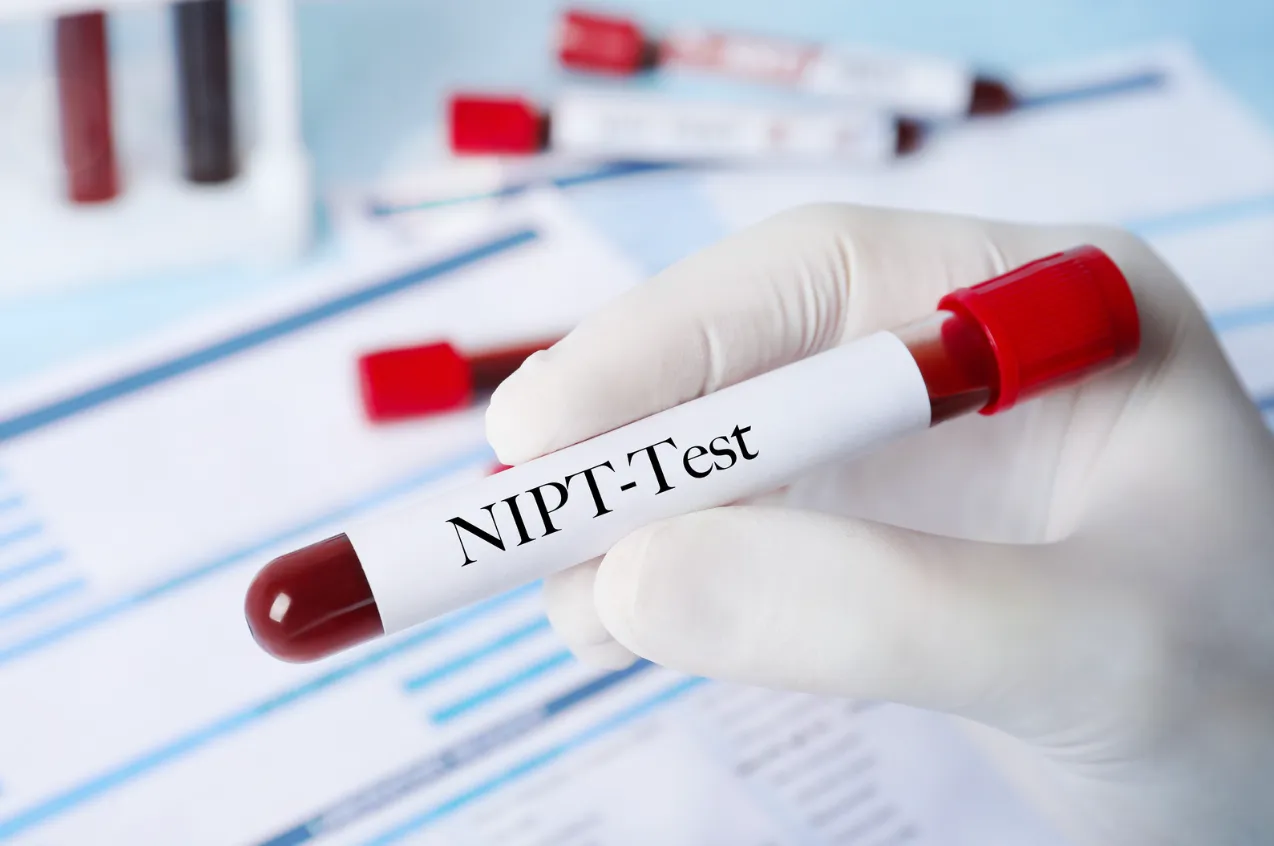
NIPT is a screening test that analyzes fragments of fetal-derived DNA contained in the mother's blood.
- What cffDNA is: These are small fragments of DNA released into the mother's bloodstream when placental cells naturally age and break down. They disappear naturally within a few hours after delivery.
- Timing of the test: From around week 10 of pregnancy onward, cffDNA comes to account for an average of 10-20% of all DNA in the mother's blood, making a stable test possible.
- Testing method: A blood sample is taken from week 10 of pregnancy onward, and cffDNA is analyzed using next-generation sequencing, a state-of-the-art technology.
- Conditions covered: The test checks for chromosomal abnormality risks such as Down syndrome (trisomy 21), Edwards syndrome (trisomy 18), and Patau syndrome (trisomy 13).
Differences from Amniocentesis and Chorionic Villus Sampling: Why NIPT Has No Complications
The decisive difference between NIPT and definitive diagnostic tests (amniocentesis and chorionic villus sampling) is "whether or not a needle is inserted directly into the uterus."
| Item | NIPT | Amniocentesis | Chorionic Villus Sampling |
|---|---|---|---|
| Testing method | Blood draw from the arm | Under ultrasound guidance, a needle is inserted through the abdomen into the uterus to collect about 20 mL of amniotic fluid | Placental tissue is collected via the abdomen or cervix |
| Timing of test | From week 10 of pregnancy onward | From week 15 of pregnancy onward | Around weeks 10-14 of pregnancy |
| Miscarriage risk | 0% (structurally nonexistent) | 0.1-0.3% | 0.1-0.3% |
Definitive diagnostic tests such as amniocentesis and chorionic villus sampling involve a procedure in which a needle is advanced directly into the uterus, so risks such as miscarriage, infection, amniotic fluid leakage, and bleeding exist. NIPT, on the other hand, involves only a blood draw, so the risk of complications from inserting a needle into the abdomen is structurally nonexistent.
Medical Evidence and Research Data Supporting the Safety of NIPT

The fact that NIPT is safe has been demonstrated by large-scale clinical studies conducted around the world.
- A large-scale study of 15,841 subjects: In a study published in 2015 in the medical journal "New England Journal of Medicine," among pregnant women at 35 institutions across six countries in Europe and the United States, not a single case of miscarriage, infection, or adverse event to the uterus was reported from NIPT, which is performed with a blood draw alone.
- A meta-analysis of 41 papers: A study that conducted a meta-analysis of 41 papers on NIPT also confirmed that there were no adverse events associated with NIPT for either mother or child.
Points to Note When Undergoing NIPT
NIPT is a safe test with absolutely no direct invasion of the uterus or fetus, but it is positioned as a "screening test." If the test result comes back high-risk (positive), a definitive diagnosis via amniocentesis or another confirmatory test is recommended to confirm the result.
/Find out your risk of Down syndrome or sex chromosome conditions during pregnancy\
 Apply / Purchase Kit
FAQ (Frequently Asked Questions)
Q. What is the probability of miscarriage from undergoing NIPT?
A. The probability of miscarriage caused by the NIPT procedure itself is 0%. Because it is performed with only a blood draw from the arm, there is no risk of miscarriage or infection from a needle being inserted into the abdomen.
Q. From what week of pregnancy can NIPT be performed?
A. The test can be performed from week 10 of pregnancy onward. Around week 10 of pregnancy, the fetal-derived DNA (cffDNA) needed for testing comes to make up an average of 10-20% of the DNA in the mother's blood, allowing for stable analysis.
Q. What should I do if my NIPT result comes back positive (high-risk)?
A. Since NIPT is a screening test, it is recommended that you undergo a definitive diagnostic test such as amniocentesis to confirm the result.
[References]
Lancet. 1997 AugUltrasound in Obstetrics & Gynecology. 2015 Jan
Ultrasound in Obstetrics & Gynecology. 2019 Oct
The New England Journal of Medicine. 2015 Apr
BMJ Open. 2016 Jan
Reassuring Support from seeDNA Genetic Medical Research Institute
seeDNA Genetic Medical Research Institute is a trusted and reliable specialist institution for DNA testing and genetic testing that has obtained the international quality standard ISO9001 and the Privacy Mark for privacy protection.
If you have concerns about disease risks for your unborn baby, biological relationships, or a partner's infidelity, our DNA testing specialists will support you so you can feel fully at ease, so please feel free to contact us.
[Free Consultation with Specialist Staff]

If you have any questions,
please feel free to contact our toll-free number.
/Open every day, including weekends\
Business hours: Monday-Sunday 9:00-18:00
(except holidays)
Author
M.D., Ph.D.
Tasuku Hiroshige
Ph.D. in Medicine; Board-Certified Specialist and Instructor of the Japanese Urological Association; Certified Physician of the Japanese Society of Medical Oncology; Specialist of the Japanese Society of Anti-Aging Medicine; Occupational Physician Certified by the Japan Medical Association; Certified Physician of the Japanese Society of Chemotherapy; Certified Physician of the Japanese Society for Sexually Transmitted Infections; Certificate of da Vinci system Training As a Console Surgeon, among others.
After graduating from Kagoshima University School of Medicine in 2010, he has built extensive clinical experience as a urologist. In addition to his clinical work, he is also actively engaged in academic activities such as presenting at conferences, writing papers, and securing research funding. He holds specialist qualifications across a wide range of fields, including urology, cancer treatment, anti-aging medicine, and infectious disease treatment. He draws on his extensive medical knowledge and skills to provide care tailored to each individual patient.