
Aging and Genetics | Expert Commentary
Individual Differences in Aging Speed
──The Relationship Between Biological Age and DNA
The speed of aging varies from person to person — even at the same chronological age, biological age can differ by up to 33 years. This difference is determined by two factors: lifestyle habits and genetics (DNA).
The Purpose and Overview of This Article
- Define the difference between chronological age and biological age
- Introduce three research studies demonstrating individual differences in aging speed
- Organize the roles of lifestyle and genetics in determining aging
- Explain the significance of knowing your own genetic tendencies
What is the difference between chronological age and biological age?
Chronological age advances uniformly for everyone, while biological age reflects the actual condition of the body. The two do not necessarily match, even in the same person.
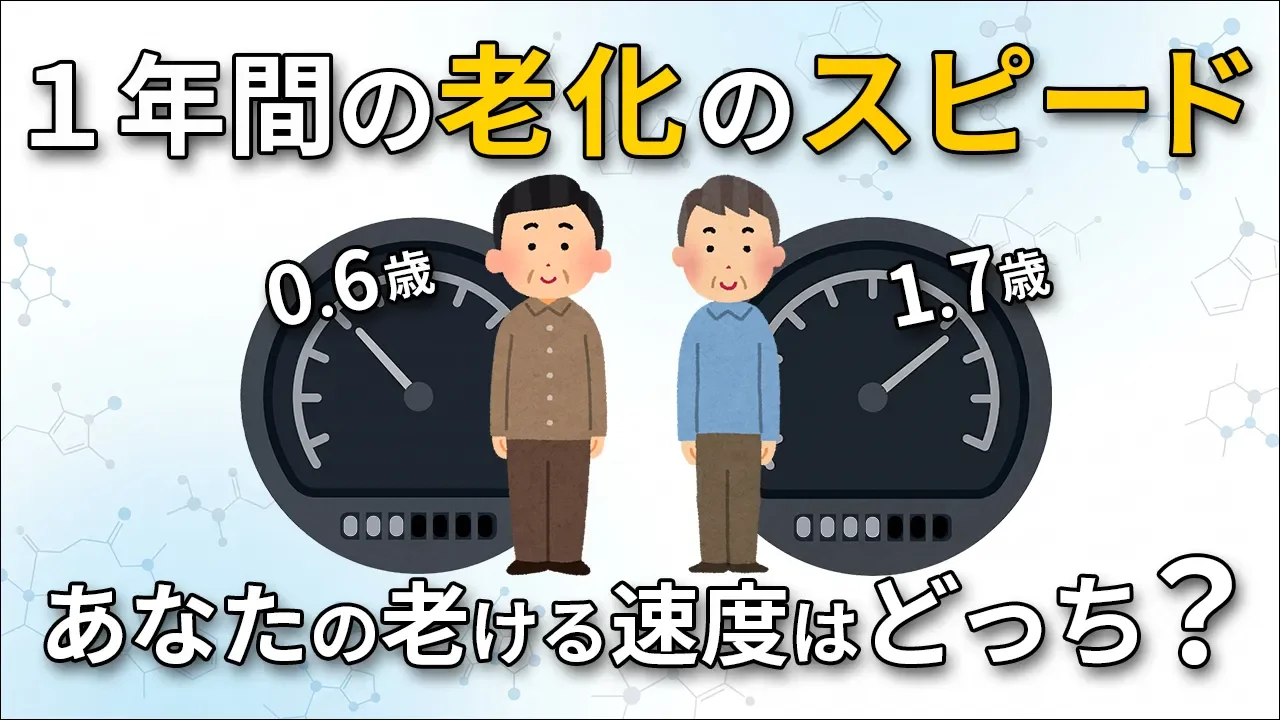
We each have "two ages." One is chronological age, which advances uniformly for everyone with each birthday. The pace at which the calendar moves forward is the same for everyone.
Some people at 40 by the calendar have bodies closer to their sixties, while others retain the vigor of someone in their twenties. It is the "speed of aging" that creates this difference.
| Item | Chronological Age | Biological Age |
|---|---|---|
| Definition | Years elapsed since birth | Age indicated by the condition of cells and organs |
| Rate of progression | Uniform for everyone (1 year per year) | Varies by individual |
| Measurement method | Calendar | Blood and physical function tests |
| Can it be changed? | Cannot be changed | Can change through lifestyle and countermeasures |
Why do individual differences in aging speed occur?
Large-scale studies show significant differences in biological age even among people of the same chronological age, and that the speed of aging also differs by organ.

The Dunedin Study: At the Same Age of 38, Biological Age Ranged from 28 to 61
In conclusion, individual differences in aging speed already exist from one's twenties. Dr. Moffitt's research team followed 954 young people at three time points — ages 26, 32, and 38 — measuring 18 items including blood, heart, lungs, kidneys, and liver (1).
There were also differences in the pace of aging. Some people aged the equivalent of 1 year per year, while others aged the equivalent of 3 years per year (1). Aging was already progressing from one's twenties, not just in old age.
Stanford Study: Aging Speed Differs by Organ
In 2023, the Wyss-Coray lab at Stanford University analyzed blood from 5,676 people and used machine learning to estimate the "age" of each of 11 organs (2).
| Metric | Result |
|---|---|
| Number of people analyzed | 5,676 people (ages 27–104) |
| Organs studied | 11 organs (brain, heart, liver, kidneys, lungs, etc.) |
| Accelerated aging in 1 organ | About 20% of people |
| Accelerated aging in multiple organs | 1.7% of people |
| Increased mortality risk with accelerated aging | 20–50% |
What became clear is that even within a single person's body, the speed of aging differs by organ (2). The whole body does not age uniformly.
"Physical strength is fine, but brain function declines quickly."
This unevenness can also be a warning sign of risk. It was reported that people with accelerated heart aging had about a 2.5-fold increase in heart failure risk, and that accelerated aging of the brain and blood vessels could predict the progression of Alzheimer's disease (2).
| Organ with accelerated aging | Associated risk |
|---|---|
| Heart | Approximately 2.5-fold increase in heart failure risk |
| Brain/blood vessels | Predicts progression of dementia (Alzheimer's disease) |
What are the two factors that determine aging speed?
The speed of aging is determined by two factors: lifestyle habits and genetics (DNA). Twin studies show that 20–30% of lifespan is explained by genetics.

Factor 1: Lifestyle Habits
The first factor is lifestyle. Diet, exercise, sleep, and stress directly affect the body's aging speed. These are elements you can improve yourself.
Factor 2: Genetics (DNA)
Individuality in "how one faces aging" — such as resistance to oxidative stress, cellular repair capacity, and susceptibility to inflammation — is encoded in DNA (3). The difference between "someone who stays healthy despite an unhealthy lifestyle" and "someone who tires easily" is also explained by a combination of genetic predisposition and environment.
However, genes are not destiny. By knowing your predispositions and choosing your lifestyle accordingly, you can change your future rate of aging.
| Factor | Specific examples | Can it be changed? |
|---|---|---|
| Lifestyle habits | Diet, exercise, sleep, stress | Can be improved |
| Genetics (DNA) | Oxidative stress resistance, repair capacity, inflammatory response | Predisposition is fixed / can be offset with countermeasures |
What are the benefits of knowing your own aging tendencies?
Knowing your genetic tendencies lets you choose the countermeasures you actually need. The benefit is avoiding anti-aging approaches based on passing trends.
In conclusion, the first thing to do is find out "where you are most prone to aging." The reason is that the priority of countermeasures differs from person to person.
For example, someone whose blood vessels age quickly and someone whose brain ages quickly need to focus on different lifestyle habits. By understanding your own weak points, you can concentrate your limited time and energy on the countermeasures you truly need.
One way to do this is through genetic testing. seeDNA's "DNA Score" analyzes numerous DNA regions related to disease risk and constitution, expressing your genetic tendencies as numerical values (4). A future of health and vitality begins with today's choices.
Summary
- Two ages: Chronological age advances uniformly for everyone, while biological age varies by individual.
- Evidence of individual differences: Among people who were all 38 chronologically, biological age ranged from 28 to 61 (PNAS, 2015).
- Differences by organ: About 20% of people show accelerated aging in one organ. Accelerated heart aging brings about a 2.5-fold increase in heart failure risk (Nature, 2023).
- Two factors: Aging speed is determined by lifestyle and genetics. The heritability of lifespan is 20–30% (Gerontology, 2022).
- A guide to action: The key is to know your genetic tendencies and choose the countermeasures you need.
Frequently Asked Questions (FAQ)
What is biological age?
What is the difference between chronological age and biological age?
Is the speed of aging determined by genetics?
Does the speed of aging differ by organ?
Is there a way to know my genetic tendencies regarding aging?
References
- (1) Belsky DW, et al. Quantification of biological aging in young adults. Proceedings of the National Academy of Sciences (pnas.org), July 2015
https://www.pnas.org/doi/10.1073/pnas.1506264112 - (2) Oh HSH, Rutledge J, Wyss-Coray T, et al. Organ aging signatures in the plasma proteome track health and disease. Nature (nature.com), December 2023
https://www.nature.com/articles/s41586-023-06802-1 - (3) Genetic determinants of aging and longevity. The Journals of Gerontology: Series A (academic.oup.com), 2022
https://academic.oup.com/biomedgerontology/article/78/2/333/6702661 - (4) DNA Score|seeDNA Genetic Testing and DNA Paternity Testing (seedna.org)
https://seedna.org/gene/score/
This article was created based on academic research and is intended for informational purposes only; it does not guarantee any specific effect or efficacy. For health-related decisions, please consult a physician or other specialist.
seeDNA Genetic Medical Research Institute's Peace-of-Mind Support
seeDNA Genetic Medical Research Institute is a trusted specialist institution for DNA testing and genetic testing, holding the international quality standard ISO9001 and the Privacy Mark for privacy protection.
If you have concerns about family or parent-child blood relationships, or a partner's infidelity, our DNA testing specialists are here to provide you with reassuring support, so please feel free to contact us.
【Free Consultation with Specialist Staff】

If you have any questions,
please feel free to contact our toll-free number.
/Open every day, including weekends/
Business hours: Monday–Sunday 9:00-18:00
(excluding holidays)
 Author
Kihan Tomikin, M.D., Ph.D.
Graduated from the master's and doctoral programs in Biosystem Studies/Molecular and Systems Medicine at the University of Tsukuba
In 2017, developed Japan's first prenatal DNA testing(Patent 7331325) using trace-DNA analysis technology(Patent 7121440)